
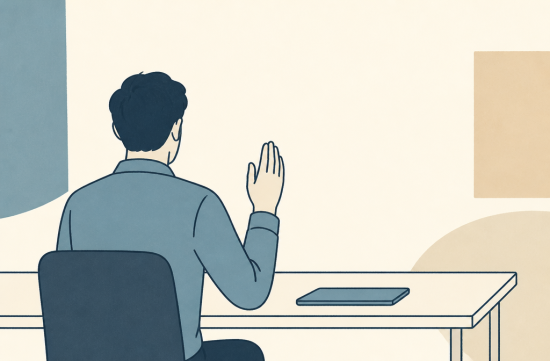
There was a time when I sat for thirty minutes just staring at the self-evaluation form at the end of the year.
The first sentence that came to mind was, "Thanks to my team, we completed it successfully." That feels just right based on what I learned in Korea.
However, if I write that here, it really reads as if the project ran smoothly solely because of the team. The manager takes my words at face value.
At first, the idea that humility is not a virtue sounded cynical, but as time went on, I realized it's not a moral issue but a translation issue.
This kind of scene repeats outside the office as well.
In school, the assignments children bring home are often about self-introduction and presentations. They are trained from a very young age to explain what they do well and why it matters.
Conversations with strangers usually start with what one does, and if you can't summarize your job in one sentence, the conversation just flows away.
The culture of talking about oneself in America runs deep. The term "self-made man," meaning someone who has risen by their own efforts, first appeared in a speech by Henry Clay in the Senate on February 2, 1832.
This means that the narrative of self-made success has been used as a language of praise for nearly 200 years. In such a place, deflecting credit to others is not seen as a virtue but simply as a lack of information.
What's even more interesting is that if you try to mimic this poorly, it can actually make things worse.
A research team from Harvard Business School, including Francesca Gino and Michael Norton, analyzed what they called "humble bragging" in nine studies.
The conclusion was simple. Complaining or boasting while pretending to be humble resulted in lower likability and competence ratings than outright bragging, and the reason was that it seemed insincere.
The interview experiment was quite painful. When asked about their biggest weakness, 77 percent of 122 college students chose a disguised boast instead of a real weakness, with 32.8 percent citing perfectionism.
I've also mentioned perfectionism in response to that question, but evaluators preferred candidates who answered honestly.
There's more direct evidence that humble self-descriptions actually reduce opportunities.
A study by Christine Exley and Judd Kessler published in the 2022 Quarterly Journal of Economics had participants rate their performance on a test from 0 to 100.
The average score for men was 61, while for women it was 45. In fact, women answered more questions correctly.
This gap remained not only when participants were told it would be shown to employers but also when there was no incentive at all. This indicates that it's not a matter of how well one sells themselves but rather that the metrics for self-assessment are different.
Data on culture points in a similar direction.
A study by Jackson Lu, Richard Nisbett, and Michael Morris published in PNAS in 2020 analyzed 10,030 people across nine studies.
East Asians were less likely to attain leadership positions in the U.S. compared to South Asians or whites, and the variable that consistently explained this gap was not bias or ambition but assertiveness in self-expression.
Interestingly, South Asian MBA students reported experiencing more discrimination, which made me pause.
This suggests that it's not a matter of ability or who dislikes us, but rather a mismatch with the local grammar of how leaders are expected to speak.
I hope there's no misunderstanding. This isn't to say that humility is a sign of low self-esteem.
According to the self-construal theory summarized by Markus and Kitayama in 1991, in cultures that define oneself in relation to others, humility is a rational norm for managing relationships. Speaking about oneself in a big way in America is also a norm of that society.
However, that doesn't mean American-style self-promotion is always right.
It's true that looking at resumes and LinkedIn feeds where exaggeration is the default can be exhausting, and it's common to see people who are better at talking than actually doing.
But simply refusing to play that game doesn't change the game itself. The only thing that changes is my evaluation score.
So what should I do? My conclusion is to change the wording, not my personality.
Instead of saying, "I did my best, but I'm lacking," I should write, "I handled this part and reduced the processing time by a few days." It's not boasting; it's just reporting the facts.
The key is to avoid going back to humble bragging. Strip away the embellishments and leave only the numbers and verbs.
I still find myself slow in front of self-evaluations. However, I've managed to get to the point where I can list what I've done without emotions.
This isn't about discarding virtues, but rather about bringing a translator when virtues don't translate in certain environments.




 lavender |
 logger |
 Conflite Teacher |
 Unknown Dog Walk blog |
 Khan Film Blog Production |
 Far East Movement |
 moo moo |


 Lol Life |
  Waiting for Godot |
  parlon |
  Say Yes in English |
  Sayonara H |
  rigid |
  Ohio Ohayoung Hello |
  U.S. Military Recruitment Information |
  You Turn Me On |
  DaeBak Electronics CNET |
  Anjollinya Blog |
  solid90 |
  elion |
  xylora |
  Study Abroad Life Know-How Tips |
  cheesepup |
  carpflow |
  mapsina |
  Softy |
  Mr. Largo |