

When you buy a house and live in the U.S., you can't help but think about schools every time you receive a property tax bill.
This is because even homes where children have already graduated or where there are no children still bear the burden of school-related taxes. In Salt Lake City, there was a significant decision regarding this issue in 2024.
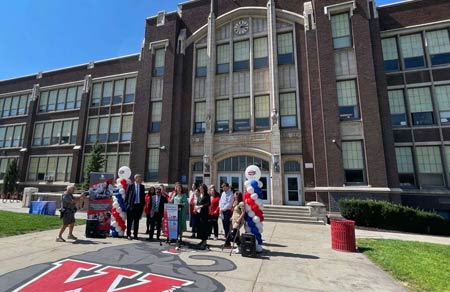
In the November 2024 election, the Salt Lake City School District's proposed $730 million school facilities bond was approved by voters.
When you think about $730 million, it's an enormous amount of money. You might wonder what on earth requires so much funding for schools, and upon looking into it, the biggest project is essentially rebuilding an old high school.
Notable examples include West High School and Highland High School. This isn't just about fixing a few classrooms and painting; it's a long-term project to extensively renovate outdated facilities and create schools that will be used for decades to come.
West High has a very long history. The school's roots go back to the 19th century, so issues regarding the modernization of buildings and facilities have been continuously raised. Highland High also opened in the 1950s, so it faces similar facility aging issues.
Additionally, there are plans to construct a new athletic field house at East High School. This project aims to improve sports facilities and student activity spaces. We shouldn't just think of it as building a gym like we do in Korea. In American high schools, sports like football, basketball, and swimming, along with various after-school activities, play a significant role in school life.
Moreover, although it may not be immediately visible, an important aspect is the improvement of sustainability across all schools in the district. This includes replacing old heating, cooling, and electrical systems and enhancing energy efficiency. While the initial construction costs may be high, the goal is to reduce electricity and gas usage and facility maintenance costs over the coming decades.
From the perspective of homeowners, the most pressing question is this.
"So how much more tax will I have to pay?"
The bond will be repaid over a long period through property taxes. According to the estimates presented by the district at the time, the additional property tax burden for the average homeowner was explained to be about $220 annually in the first year. Calculated monthly, that's about $18.
Some people might think, "If I have to pay an extra $18 a month to build new schools for the kids, that's reasonable." Conversely, retirees without children in school might express dissatisfaction, saying, "I don't even use the schools, so why should I keep paying more taxes?" Both perspectives are understandable.
Interestingly, school-related taxes haven't just gone up in one direction. In the general operating budget for the 2024-25 fiscal year, the district planned to lower the property tax rate compared to the previous year.
Therefore, we need to look at the additional burden from the bond separately from the adjustments in the general operating tax rate. Moreover, since home prices have fluctuated significantly in Utah, the actual increase or decrease in tax bills must also take into account changes in the assessed value of one's home. It's not guaranteed that "taxes will definitely go down because the tax rate has decreased," nor is it true that "all homes' taxes will rise significantly because the $730 million bond passed."
However, I believe that for those considering moving to Salt Lake City from other states, this project should be viewed a bit differently.
Investing such a large sum in school facilities indicates that the city is committed to maintaining educational infrastructure in the future. Even if I don't send my children to school, the quality and facilities of local schools ultimately affect the image of the neighborhood and property values.
Especially, instead of continuously repairing old schools, deciding to invest hundreds of millions of dollars to create facilities that will be used for decades is a significant decision for the city.
Of course, we need to keep an eye on whether the $730 million is used properly. Large public construction projects can face issues like rising construction costs or delays, and there's a possibility that costs could exceed initial estimates.
Still, for parents considering a move to Salt Lake City, one thing is clear. This city chose to ask residents for tax burdens rather than simply postponing the issue of aging schools and ultimately opted for a large-scale investment.
This is a major decision that will require repayment over 25 years. There are plenty of reasons to watch how the newly built West High and Highland High will provide educational environments for students and what changes this investment will bring to the residential environment in Salt Lake City.
 SmileTiger
 AZCowboy




 Round and Round Children's Song Kingdom |

 new sugar |

 Way to easy |

 Magic Cabbage School of Martial Arts |

 Vacation on Hawaii |

 Utah, the Most Livable State |

 Tan Sol |
 morvex37 |

 AliAluAlo Blog |
 loran |
 The Gelaton |
 Twist Kim |
 berlon93 |
 Physical Laws and Science |
 good thinking |
 Solo Yolo |
 Mr Oh |
 laro90 |
 San Diego TOP Idol |
 American Golf Course Travelogue |
 MEDBIO American Doctor Blog |
 Hot Seat Driver |
 bryvexi |
 koala organic farm |
 riverstone |
 My Antonio |
 California Information News |
 chilli chilli |
 Moon Su San |