

When discussing the history of beauty pageants in Korea, the 'Miss Korea Pageant' organized by the Korea Daily, which began in 1957, symbolizes authenticity. In contrast, the corporate-sponsored model selection contests that emerged in the 1970s were events that shook the popular culture of the time.
At the pinnacle of this was the 'Miss Lotte Pageant,' which kicked off in 1972, hosted by Lotte Confectionery (now Lotte Wellfood).
The finals, broadcast live nationwide through terrestrial networks like TBC, transcended mere corporate promotional events. Winning the contest was a fast track to being selected as a Lotte advertising model and guaranteed stardom, effectively becoming a key gateway for aspiring actresses, rivaling even Miss Korea.
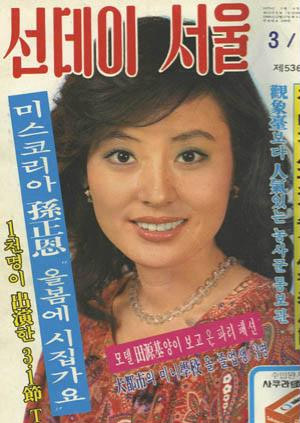
Seo Mi-kyung was the winner of the '1st Miss Lotte' contest that opened this glamorous festival.
She wore the crown at the inaugural event in 1972 and became a beloved high-teen star due to her stunning looks, solidifying her status as one of the top youth stars of the era, crossing over from screen to television.
The influence of Miss Lotte later produced stars like Won Mi-kyung and Lee Mi-sook, and many high-teen stars of the 1980s, such as Chae Shi-ra and Lee Mi-yeon, passed through this contest to become mainstream in the entertainment industry.
However, the Cinderella of the silver screen, who was the focus of public attention and envy, took a path that was entirely unexpected.
In 1981, at the height of her fame, she suddenly announced her retirement to study abroad and left for Japan, disappearing completely from the public eye. It was later revealed that her choice was to marry Shin Kyuk-ho, the chairman of the Lotte Group, who was 37 years her senior. Although it was a common-law marriage rather than a legal one, the union of the top star selected as the face of the company with its highest power figure sent shockwaves through both the business and entertainment worlds.
Their previously secret relationship became public when they welcomed their daughter, Shin Yu-mi (former advisor to Hotel Lotte), in 1983, and in 1988, after a DNA test, she was officially registered as the biological child of the honorary chairman, solidifying what had been an 'open secret' into an official fact.
Unimaginable Wealth
The moment when she and her daughter, Shin Yu-mi, who seemed to have been forgotten by the public, regained national attention was during the Lotte Group's management dispute and the ensuing prosecution investigation.
During this process, the hidden assets of the mother-daughter duo were revealed, and their total wealth is estimated to be between approximately 800 billion won and 1 trillion won. This is the result of irregular gifts and inheritances from the honorary chairman, combined with shares in subsidiaries and valuable real estate.
The most critical and impactful asset they hold is their stock holdings. When combined, the shares owned by her, her daughter Shin Yu-mi, and their personal company 'Gyeongyu Industrial' amount to a total of 6.8% of Lotte Holdings in Japan. Lotte Holdings is the apex of the governance structure that effectively controls the entire Lotte Group in Korea and Japan.
The value of this 6.8% stake is estimated to be at least 700 billion to 800 billion won when converted to cash. Remarkably, this stake is significantly higher than the personal direct and indirect stakes of Shin Dong-bin (1.4%) and Shin Dong-joo (1.6%), the chairman and former vice-chairman of the Lotte Group, respectively. This serves as evidence of how solidly the honorary chairman sought to establish a financial foundation for the two women in preparation for his passing.
Valuable Real Estate Assets Worth Billions
The real estate assets held by the mother and daughter in Korea are also worth billions based on publicly assessed values, and considering the actual market value and asset liquidity processes, their worth is beyond imagination.
Land in Sangdong-myeon, Gimhae-si, Gyeongsangnam-do: This land was directly gifted by the honorary chairman in 2007 and covers an area of approximately 730,000 square meters (about 220,000 pyeong). Based on public assessment, it is a massive asset worth nearly 180 billion won.
Yugi Tower in Samseong-dong, Gangnam-gu, and Uniplex in Dongsoong-dong: These include building assets such as Yugi Tower in Samseong-dong, which was owned in her name (later sold to the Korea Standards Association), and the large performance venue 'Uniplex' located in the cultural and artistic hub of Daehak-ro.
Other High-End Residential Real Estate: She has owned high-end properties worth hundreds of billions, such as Lotte Castle Belvedere in Banpo-dong, Seocho-gu, and a five-story villa in Bangbae-dong. Her daughter, Shin Yu-mi, is also reported to own personal real estate worth about 18 billion won separately.
Her family secured enormous cash mobilization power through past internal transactions and preferential treatment within the Lotte Group. The company 'Yuwon Industrial,' which they owned, monopolized the business rights for Lotte Cinema's nationwide concessions, while 'Yugi Development' monopolized the prime restaurant areas in major stores like Lotte Department Store's main branch.
The illicit gains from this process were estimated to be around 77 billion won during past investigations by the prosecution for breach of trust.
As social criticism of typical corporate self-dealing and legal risks grew, the Lotte Group eventually began to reclaim or reorganize the concession rights and restaurant operations.
Questions Left by the Shadows of the Era
The Miss Lotte Pageant, which had catapulted her into the limelight, faded into history around the late 1980s.
Beauty contests led by large corporations, like Miss Lotte and Miss DeBong, were naturally abolished due to rapid advancements in the entertainment agency system, the activation of street casting, and the establishment of public talent recruitment systems by broadcasting companies. The practical benefits of companies hosting large-scale contests to secure exclusive models had disappeared.
While the contest has become a relic of the times, the public's perception of her, the inaugural star of that stage, remains complex and cold to this day. The union that transcended a 37-year age gap and the resulting astronomical wealth have sparked sharp criticism and lonely reflections in online spaces.
"Ultimately, this is a case that shows money is supreme in a capitalist society," and "Having exchanged youthful beauty for immense wealth, she must have no material regrets for a lifetime," are common cynical sentiments.
However, on the other hand, there are also sympathetic views questioning, "What good is immense wealth and fame if one has to live in the shadows for decades, avoiding the media, within the thorough physiology of a chaebol family where the massive management rights are ultimately inherited by the eldest and second sons?"
Ultimately, her life and actions transcend mere entertainment scandals or gossip about chaebols. They serve as a mirror reflecting the overwhelming power and wealth enjoyed by large corporations during South Korea's rapid growth period, as well as the realities of irregular gifts made within legal boundaries.
The trajectory of her transformation from the spotlight of a glamorous beauty pageant to the most secretive axis of a massive conglomerate, and then to an astronomical asset holder, continuously poses heavy and bitter questions about the 'value of wealth' and 'individual happiness' in our society.
 DreamRoad








 Community Cross |
 Conflite Teacher |
 SEVEN SEVEN |
 Korean Mom |
 novapixel |
 Wiscon Shin Blog |
 Superman Cat Blog |
 middlekick |
 ollege Mom |
  Pronunciation Yo |
  nuvex11 |
  Living in Florida |
  axelon47 |
  lumbus |
  Texas Migration Story |
  Scade Studio |
  love ya |
  biscuit90 |
  chicpo |
  Helpful Life Stories |
  Kitchen Ideas |
  Diana Blues |
  Agenda Center |
  journey |
  heeve |
  leman |