
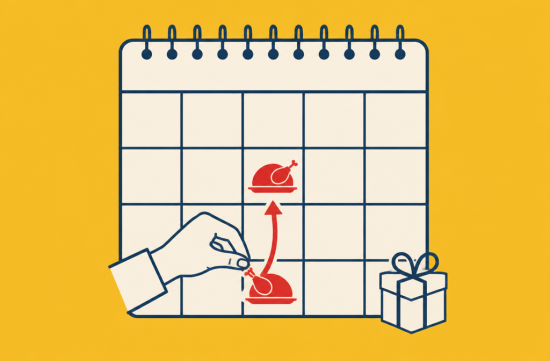
This year, Thanksgiving is on November 26. While looking at the calendar, I suddenly wondered, why is it on the 'fourth Thursday'?
I thought it was just a tradition from long ago, but upon researching, I found that there's quite a humorous yet sad story behind it. It's a tale that many Americans don't even know, called 'Franksgiving.'
It all started back in 1863. President Lincoln declared the last Thursday of November as Thanksgiving Day, and subsequent presidents followed this tradition every year.
The problem is that the last Thursday changes every year. In years when there are five Thursdays in November, Thanksgiving can be pushed back to the 30th.
1939 was one such year. November 30 was the last Thursday, which meant there would be significantly fewer shopping days until Christmas.
At that time, the shadow of the Great Depression still loomed large, and the economy had taken another downturn between 1937 and 1938. For retailers, losing a week of holiday shopping was a significant blow.
Ultimately, merchants requested the White House to move the date up. It was common knowledge that serious Christmas shopping began only after Thanksgiving.
President Franklin Roosevelt first hinted at this plan during a press conference on August 14, 1939. He declared that Thanksgiving that year would be on November 23, the Thursday before the last one.
Honestly, when I first heard this story, I thought it made sense. Given the tough economic times, the idea of trying to boost consumer spending was understandable.
However, the reaction was much more intense than expected. Changing a long-standing tradition for shopping stirred many people's emotions.
The White House was flooded with protest letters. Calendar companies complained that their already printed calendars would become useless, and organizations that had scheduled events around the original date were left in a bind.
Many families living far apart struggled to adjust their plans to gather together. The holiday ended up becoming a source of stress.
This led to the nickname 'Franksgiving.' It's a blend of Roosevelt's first name, Franklin, and Thanksgiving, reportedly coined by the mayor of Atlantic City, New Jersey, in a sarcastic manner.
Poll results were also harsh. According to the National Archives, a Gallup poll at the end of that year showed 62% opposed to the change, while only 38% supported it.
Interestingly, at that time, the authority to set the date for Thanksgiving actually rested with the governors, as it wasn't a legally established federal holiday.
This led to a split across states. Some states followed Roosevelt's date, while others stuck to the original date of the 30th.
Texas and Colorado even took both days off. Can you imagine having Thanksgiving twice in one country? It seems quite absurd in hindsight.
Roosevelt continued to move the date up in 1940 and 1941 in a similar manner. However, a critical issue emerged.
When they looked at the year-end sales from the past two years, it turned out that moving the date didn't have a significant impact. Just extending the shopping period didn't mean people spent more money.
Eventually, Congress intervened. The House initially passed a bill for the 'last Thursday,' but the Senate amended it to 'fourth Thursday' to account for years with five Thursdays.
Roosevelt signed this resolution on December 26, 1941, and starting in 1942, the fourth Thursday of November became the established federal holiday. That's the date we now celebrate.
In summary, the shift from the last Thursday to the fourth Thursday was a compromise. It allowed for some preservation of the shopping period in years with five Thursdays.
Reading this story made me think of today's Black Friday. Nowadays, as soon as Halloween is over, stores are already decorated for Christmas.
In 1939, the president tried to extend the shopping season by moving the date, but now retailers are pulling the season forward to October on their own. The methods have changed, but the concerns seem similar.
Personally, I don't want to view Roosevelt's intentions negatively. It was an attempt to do something for economic recovery, and when data showed it wasn't effective, he ultimately backed down.
However, this case also illustrates that when policies touch people's daily lives and traditions, sufficient explanation and consensus are necessary first. Good intentions can leave behind nicknames like 'Franksgiving' if pushed without persuasion.
This year, there are only four Thursdays in November, so the 26th is both the fourth and last Thursday. If Roosevelt were alive, it would have been a worry-free year.
This Thanksgiving, I plan to focus more on the table than on sale alerts. Bringing up this Franksgiving story in front of the turkey could make for some interesting conversation.
 blueseabuilder2023
 LikeGalaxy







 Art patch |

 Rice Shop Uncle BLOG |

 Noodle Noodle |

 Chino Min |

 Glow Yo |

 Purple Moons, |

 My Carmen |

 Korean Mom |

 strawberry |
 US Regional Information Local News |
 USA Business News |
 Blondee |
 E whisper |
 Potato House |
 freshmint |
 Ansaso |
 Golado |
 babybay |
 honeycom |
 French Macarons |
 Exploring American Life Information |
 Sunshine Blog |
 Community Cross |
 Sayonara H |
 What can make money? |
 Information Search LifeMAN |
 morvex37 |
 neontrail |