
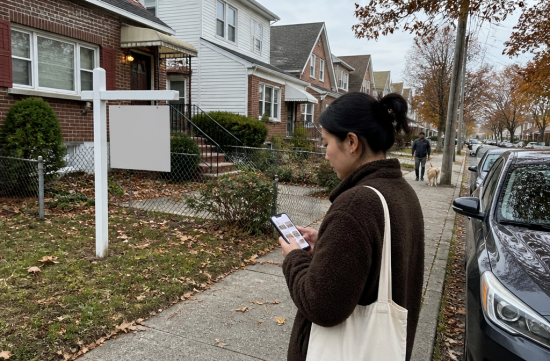
In October, the biggest change in Queens Village real estate wasn't the home prices. The renewal increase rate for rent-stabilized apartments was capped at 0%, and mortgage rates fluctuated around 7%.
There's still no evidence to suggest that home prices in the neighborhood have changed significantly in just one month. It takes time to compile October transactions, so this article will summarize the confirmed numbers as of the end of October.
First, regarding rent. The New York City Rent Guidelines Board (RGB) voted on June 25 to freeze rents by a 7 to 1 margin.
Both one-year and two-year leases will have a 0% increase, applicable to contracts starting between October 1, 2026, and September 30, 2027. The rent-stabilized apartments under the board's jurisdiction number nearly one million citywide.
So, October 1 was the actual change date. Contracts that began before September 30 will still follow last year's guidelines of 3% for one year and 4.5% for two years.
This is certainly good news for tenants. However, since Queens Village has a high proportion of 1-3 family homes, it's important to first check if your residence is subject to rent stabilization.
You can find out by requesting your apartment's rent history from the New York State Division of Housing and Community Renewal (HCR). If you're renting a basement or a unit on the second floor of a regular home, you likely won't be affected by this freeze.
Market rents vary significantly depending on the source. Apartments.com reported an average of $1,524 for one-bedroom apartments and $1,931 for two-bedrooms as of April, indicating a 2.5% decrease from a year ago.
In contrast, Zumper reported an average of $3,100 as of June, which is much higher. This discrepancy arises from whether the data includes only apartments or all rental homes, so please don't rely solely on one site's numbers for negotiations.
Now, let's look at sales. According to real estate data firm Resideline, there were 217 transactions recorded as of October 3.
During this period, the median sale price was $800,000, with half of the transactions falling between $600,000 and $890,000. The price range is narrower than expected.
The price per square foot moved from $490 in May and $485 in June to $538 in July, $553 in August, and $540 in September. It seems to have peaked in the summer and then slightly stabilized in September.
Only 18 transactions occurred in September, making it difficult to draw conclusions from just one month's data. With such a small sample size, a few high-priced sales can skew the average.
It took a median of 42 days for listings to go under contract, and 75 days from contract to closing. This means homes contracted in October will likely be recorded in numbers around the end of the year or January.
The overall atmosphere in Queens is also worth noting. According to a Brick Underground article citing Compass's third-quarter report, there were 4,446 transactions in Queens, a 1.2% increase from a year ago, and home closings rose by 8.7%.
The areas with the largest increases were northeastern Queens, including Bayside, Flushing, and Glen Oaks. Given the high demand from the Korean community, Queens Village is unlikely to be completely detached from this trend.
And then there's the interest rate. Throughout October, this was the variable that most significantly impacted buyers.
According to Freddie Mac's weekly survey, the 30-year fixed mortgage rate started at 7.28% on October 1, rising to 7.40% on the 8th and 15th. It then dropped to 7.32% on the 22nd and 7.24% on the 29th.
In the span of a month, this represents a decrease of 0.16 percentage points from the peak, but compared to the same time last year when it was 6.19%, it's still over 1 percentage point higher. Honestly, I was a bit surprised by this number.
If you buy an $800,000 home with a 20% down payment, the loan amount would be $640,000, and a 1 percentage point difference in interest rates would change the monthly principal and interest payment by about $400. This is before taxes and insurance.
So, October in Queens Village can be summarized like this: it was definitely a favorable month for rent-stabilized tenants, while buyers still faced significant interest rate burdens.
From a landlord's perspective, having the rent income from stabilized units fixed for a year can be a concern, as property taxes, insurance, and repair costs continue to rise.
On the other hand, landlords renting out regular homes are not subject to this freeze and can follow the market trends. Depending on the type of property you own, the experience can be completely different even within the same neighborhood.
If you're considering buying, now that rates have dropped for two consecutive weeks, it might not be a bad time to explore negotiation opportunities. However, it's advisable to avoid aggressively raising prices based on the assumption that rates will drop further.
I would compare rate lock conditions from two or three lenders and, considering that it takes about 75 days to close, I would set a generous lock period.
If you're a tenant, when you receive renewal paperwork, check if the contract start date is after October 1. If you are subject to stabilization but there's an increase, you can contact the HCR.
The actual numbers for October sales transactions will likely become clear around late November to December. When more data is available, I will summarize it again.
The figures in this article are based on Freddie Mac's weekly survey (up to the report released on October 29), RGB's decision report, Resideline's October 3 compilation, and Brick Underground's article from October 8.
 SuperBoss








 Choco Choco Star |

 gentle |
 neapolis |

 moo moo |

 ultron78 |
 skykong |

 New York Queens Native Blog |

 Chili Boy Club |

 Bushing Around Life |

 central |
 ssome |
 Shining Our Own World |
 gardener 007 |
 golfmaster |
 Nanana Nanana Nanana |
 Who's watching? |
 endone |
 RockStar |
 Casa Mia |
 You Only Live Once |
 Hardworking CPA |
 Joyce 77 |
 Runner Kim |
 My Town My Way Blog |
 My Miami Stories |
 Entip |
 Tony Park |
 Jean Claude Bundang Blog |