
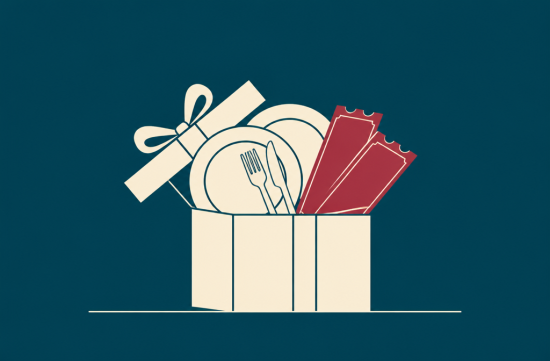
As the year-end approaches, the same dilemma begins. What should I buy this year? I wonder if the mug I gave last year is still being used.
However, looking around lately, the atmosphere seems to have changed. There are definitely more people giving restaurant gift cards, concert tickets, or a day trip together instead of gifts wrapped in boxes with ribbons.
I thought it might just be a feeling, so I looked for some numbers. To cut to the chase, it wasn't just a feeling.
According to the 2026 Holiday Retail Survey released by Deloitte in mid-October, 50% of respondents said they plan to buy experience gifts this year. This survey was conducted among 4,000 American consumers from late August to early September.
This percentage was 47% in the 2025 survey and 39% in 2024. That's an 11 percentage point increase in just two years, which is quite a steep trend.
Specifically, 37% of people are considering giving restaurant meals or restaurant gift cards, while 19% plan to give event tickets. Ultimately, the focus is on gifts that involve sharing a meal or going to see something together.
So why has this change occurred? I see three main reasons.
The first is that people already have too many things. In an era where you can get almost anything from Amazon with just one click and have it arrive the next day, the uniqueness of material gifts has diminished significantly.
From the recipient's perspective, receiving something that doesn't match their taste can be quite burdensome. Don't we all have items in our drawers that are awkward to use or throw away?
The second reason is that research findings are quite clear. A paper by Cindy Chan and Cassie Mogilner published in the Journal of Consumer Research in 2017 concluded that experience gifts strengthen the relationship between the giver and the recipient more than material gifts do.
The key is emotion. The stronger the emotional intensity felt at the moment of receiving the gift, the closer the relationship with the giver becomes.
I can relate to this from my own experience. I can barely remember where I put the watch I received a few years ago, but I still remember the taste of the hot dog from the basketball game ticket my friend gave me.
The third reason is generational change. The Deloitte survey found that for the first time this year, Gen Z and Millennials will account for half of total year-end spending, and this generation is much more accustomed to spending money on experiences rather than possessions.
From this perspective, it seems that experience gifts have solidified as a trend. However, it's also important to look at the opposing data for a fair assessment.
According to the same Deloitte survey, the average planned year-end spending per household this year is $1,654, which is a 4% increase from last year. However, the increase is primarily in retail products, while spending on travel or events is actually decreasing.
For reference, in the 2025 survey, the average spending was $1,595, which was a 10% decrease from the previous year. This suggests that when budgets tighten, people tend to cut back on expensive experiences like travel first.
In summary, while the number of people giving experience gifts has increased, the amount each person spends on experiences has not necessarily grown.
Therefore, I would like to call this the "Era of Small Experiences." This means that gifts like a dinner at a local favorite restaurant, two movie tickets, or a one-day cooking class are becoming the norm.
There is some logic to those who insist on material gifts. Experiences require coordinating dates, and if the deadline passes, they simply go to waste.
Many of us have probably had the experience of receiving a gift card that we ultimately couldn't use. If the recipient's schedule is tight, experience gifts can even become a burden.
The authors of the aforementioned paper also offered similar advice. They suggested that experience gifts should be given in a way that is not tied to specific dates and times to be most effective.
And not all experience gifts need to be expensive. Going hiking together and buying a cup of coffee can also be a great experience gift if it conveys sincerity to the recipient.
So how can we implement this in practice? Let me share a few methods I use.
First, choose places that the recipient frequents. While I understand the desire to introduce new places, in my experience, gift cards to familiar favorite spots tend to be used much more often.
If possible, add a "let's go together" to the gift. Setting the date together creates that emotional moment more effectively than just handing over tickets.
For parents' generation, mixing material gifts with experiences can also be a good approach. Including a small gift along with a meal invitation card allows for both the tangible and memorable aspects to be enjoyed.
For children, the excitement of unwrapping gifts is still important, so there's no need to focus solely on experiences. This is more about common sense than data.
Ultimately, what matters is not the format but tailoring it to the recipient. Just because the trend is experiences doesn't mean everyone needs to receive an experience gift.
However, if you ask for my choice, I would cast my vote for experiences this year. I've confirmed several times that while material gifts may be forgotten, the dinners shared together leave lasting memories.
 MomsFund







 Anjollinya Blog |

 Kitchen Ideas |

 Spaghetti Flying Religion |

 Giant Squid and Sweet Potato Soup |

 choi family |

 Nanana Nanana Nanana |


 United States National Administrative Organization Stories |


 cathywhite |

 ssome |
 skykong |
 Shining Our Own World |
 gardener 007 |
 golfmaster |
 Who's watching? |
 endone |
 RockStar |
 Casa Mia |
 You Only Live Once |
 Hardworking CPA |
 Joyce 77 |
 Runner Kim |
 My Town My Way Blog |
 My Miami Stories |
 Entip |
 Tony Park |
 Jean Claude Bundang Blog |
 DJ DC BLOG |