
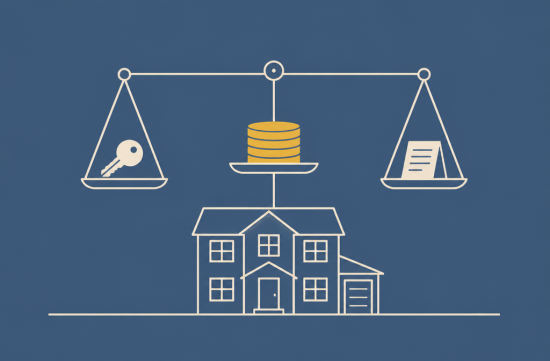
These days, the first question people looking to sell their homes ask is this: Do I, as the seller, have to pay the buyer's agent commission in addition to the listing agent's fee?
To put it simply, there is no legal requirement to pay it. However, not paying it doesn't always mean it's beneficial.
If we follow the situation of a seller looking to sell a single-family home in Ridgefield from the beginning, you'll understand why this is a gray area.
When this seller opens the listing agreement, one noticeable difference stands out. Next to the commission section, there is a statement indicating that the commission is not legally set and is entirely negotiable.
This is due to New Jersey state law. The Real Estate Consumer Protection Act will take effect on August 1, 2024, requiring that residential transaction brokerage agreements be in writing and that the method of calculating compensation and its negotiability be disclosed in the contract.
Around the same time, the National Association of Realtors (NAR) also changed its rules. Following a $418 million commission lawsuit settlement, starting August 17, 2024, it will be prohibited to post buyer agent commission offers in MLS listings.
Previously, MLS listings indicated what percentage the seller would offer to the buyer's agent. It was almost standard for sellers to pay both commissions at once.
Now, that number has been removed from the MLS. However, it is not prohibited for sellers to pay the buyer's commission. The structure allows for separate negotiations outside of the MLS.
The buyer side has also changed. Buyer agents must enter into a written agreement with the buyer before showing a home, and the commission amount or percentage must be clearly stated in that agreement.
Moreover, buyer agents cannot receive more than the amount specified in that contract, even if the seller offers more. Many people are surprisingly unaware of this.
Returning to our seller's story, buyers come in for the open house on the first weekend after the home is listed. Many of them have already signed agreements with their agents.
That agreement specifies the buyer agent's commission, and for the buyer, who will pay it is a very real concern. Many are already stretched thin trying to cover down payments and closing costs.
As a result, when offers come in, they sometimes include a condition asking the seller to cover the buyer agent's commission.
The seller has roughly three options here: to express willingness to pay the buyer's commission upfront during the listing phase, to negotiate after receiving an offer, or to outright refuse to pay.
What does reality look like? According to an analysis by Redfin released in early 2025, buyer agent commissions have not changed significantly even after the agreement took effect. In fact, they slightly increased for lower-priced homes and slightly decreased for higher-priced homes.
Redfin agents reported that most sellers are still paying the buyer's commission. However, as more sellers become aware that they can negotiate, there have been instances where some of that burden has shifted to the buyer.
The atmosphere in New Jersey is not much different. Industry insiders explain that it is still rare for buyers to pay directly because sellers do not propose anything.
However, even within Ridgefield, circumstances vary depending on the type of home. Condos or townhouses often attract younger first-time buyers who may have less cash on hand, and offers can vary based on this condition.
Conversely, single-family homes in desirable school districts or locations tend to fare better. If inventory is low, there are cases where sellers receive offers even if they refuse to pay the buyer's commission.
Ultimately, the key issue is not whether to pay the buyer's commission, but where that money will go. If the seller does not pay, the buyer is likely to try to negotiate a lower price or request credits.
In numerical terms, whether the seller pays the commission or reduces the price by that amount or handles it as a seller credit can result in similar net proceeds. The difference arises in the appraisal and buyer mortgage conditions.
For example, seller credits can vary based on the type of loan the buyer has. Therefore, it's essential to coordinate with the buyer's loan officer before drafting the contract.
If I were the seller, I wouldn't outright refuse to pay from the listing stage. Instead, I would choose to negotiate it along with the price during the offer stage.
Closing the door from the start could reduce the number of buyers coming to see the home, especially in price ranges where first-time buyers are prevalent.
When selecting a listing agent, be sure to ask this question: How will you negotiate if a request for buyer commission comes in, and how have recent transactions in this neighborhood been handled?
Also, make sure to read the commission section of the listing agreement thoroughly. Whether the listing commission and buyer commission are bundled together or separated can affect future negotiation possibilities.
This article is based on information as of early November 2026, and references New Jersey state laws related to the Real Estate Consumer Protection Act, NAR rules regarding the settlement, and commission flow as reported by Redfin. Regulations may change, so please verify the latest information just before signing a contract.
 LakeTalk







 Choco Choco Star |

 gentle |
 neapolis |

 moo moo |

 ultron78 |

 loveyom |
 gardener 007 |


 Delicious Food Finder |

 forevergee |
 central |
 ssome |
 skykong |
 Shining Our Own World |
 golfmaster |
 Nanana Nanana Nanana |
 Who's watching? |
 endone |
 RockStar |
 Casa Mia |
 You Only Live Once |
 Hardworking CPA |
 Joyce 77 |
 Runner Kim |
 My Town My Way Blog |
 My Miami Stories |
 Entip |
 Tony Park |