

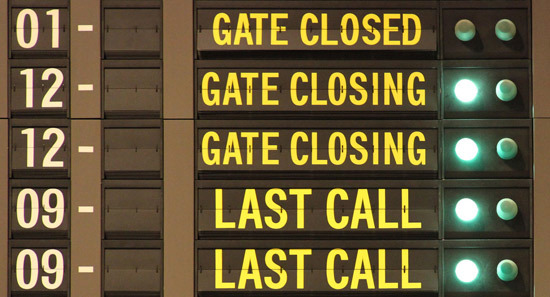
There is an announcement that you will hear so often at U.S. airports that it becomes ingrained in your ears. It is the last call for boarding.
While this phrase is occasionally heard at Korean airports, it is almost a daily occurrence in the U.S.
Honestly, I didn't understand this announcement every time I heard it for the first time. I wondered why they were pushing people so hard when there were still 20-30 minutes left until the scheduled departure time. However, after taking hundreds of flights due to frequent business trips in the U.S., I now understand why this announcement is necessary.
For domestic flights in the U.S., the last boarding time is strictly enforced. Boarding usually ends 15 minutes before departure, and at that time, the gate closes. If the ticket shows a departure time of 10:00, boarding is mostly finished by 9:45. If you miss this time, you cannot board even if the plane is still at the gate.
Another reason, which is quite simple when you think about it, is that U.S. airports do not have the luxury of waiting for latecomers. The airports themselves are large, and the number of passengers coming and going each day is beyond imagination. Major hub airports like New York JFK, Atlanta, Chicago O'Hare, and LA have dozens of flights coming and going from a single gate from early morning until midnight.
If just one flight is delayed, the impact can cause a domino effect, delaying the next flight and the one after that. Therefore, it is not feasible to wait for one last passenger when over 200 people have already boarded.
Additionally, the unique travel patterns in the U.S. play a role. Because the land is so vast, the ratio of connecting flights through cities to direct routes is much higher. Airports like Denver, Atlanta, Dallas, and Chicago are almost exclusively for connections. If one flight arrives even slightly late, there are often several passengers who miss their next connection.
From the airline's perspective, dozens of connecting passengers who need to catch the next flight are much more important than one late passenger. Therefore, the boarding deadline is very strict.
When a staff member stops someone who has run breathlessly to the gate after boarding has ended, and they can see the plane right in front of them, it may seem cold at first, but their explanation is always the same. They say, "We made the last call announcement, so we cannot wait any longer. It is against regulations to reopen a closed door on a plane," which I remember hearing as I passed by.
When the last call for boarding announcement appears in the news, I noticed that there were common reasons for the late arrivals.
First, there is confusion between the departure time and the boarding deadline. Many people think based on the departure time printed on their ticket. They assume it's fine since the plane hasn't taken off yet, only to find out at the gate that boarding has already ended. Many people are unaware that the doors close 15 minutes before departure at U.S. airports.
Second, there is overconfidence in mobile check-in. Some people mistakenly believe that since they checked in via computer or phone, it's okay to arrive a little late. Mobile check-in only secures a seat, not a guarantee of boarding. Many people lose their sense of time, thinking they have already checked in, even if they haven't arrived at the airport or are delayed at security.
Third, there is a failure to calculate the airport layout and distance. U.S. major airports are much larger than expected. Even at airports I was somewhat familiar with, I thought I could reach the gate in about 5 minutes, but it often takes over 15 minutes. If tram transfers, terminal changes, and gate changes overlap, it becomes difficult to arrive at the gate on time even after hearing the last call. This is why it is advised to arrive at the airport at least 1 hour before a domestic flight and to reconfirm gate information.
Moreover, the frequent last call for boarding announcements is also tied to unique security issues at U.S. airports. Occasionally, if a passenger checks in their luggage at the front but does not show up, that luggage must be taken off the plane. This process takes more time than expected. If the removal of one piece of luggage delays the entire flight, the consequences fall squarely on the airline and other passengers. I have heard in-flight announcements stating that the departure is delayed by 15 minutes because they have to remove luggage from a passenger who did not board.
Thus, the last call announcement is essentially not a friendly reminder but rather a final warning. It means if you don't come now, you will miss this flight. Interestingly, there are always people who stroll in leisurely with coffee in hand even after hearing this announcement. At such times, the announcement becomes more assertive, even calling out the names of the latecomers.
If they still don't arrive, that's it. U.S. airports prioritize the system for the public over the individual circumstances of each passenger, and boarding times are an absolute standard.
In the end, the last call announcement at U.S. airports is not a sign that airports have become less accommodating, but rather a signal that has become stricter as times have changed. When flying in the U.S., what matters more than whether you checked in is whether you are standing in front of the gate on time.
Airports are not places that wait for you; they are places that only take on-time passengers, and the last call announcement reminds us of this fact today as well.
I now enjoy listening to that last call announcement. It's quite amusing to hear the announcement struggle to pronounce difficult last names from India like Subramanian, Chandrasekhar, and Southeast Asian names like Nguyen or Phongsavanh.
 ThirstyJjang







 candytip |
 Gold Bar |
 Pirate Ship Popcorn Maker |
 Montgomery Mom |
 Anjollinya Blog |
 xylora |
 Gorama Round |
 wendra |
 ultron78 |
 There Are Such Things in the World |
  round1 |
  Way to easy |
  musicque |
  road98 |
  Churros Train Conductor |
  gleeful |
  Burbank Lee |
  Olivia's Blog |
  Bushing Around Life |
  Active |
  Cherokee Rose |
  Kor. Master |
  Holey Moley |
  Conflite Teacher |
  Hodong Prince Over Flex |
  Mist inn |
  citrus pop |
  Onion Ring |
  phoenixia |
  viewtop |