
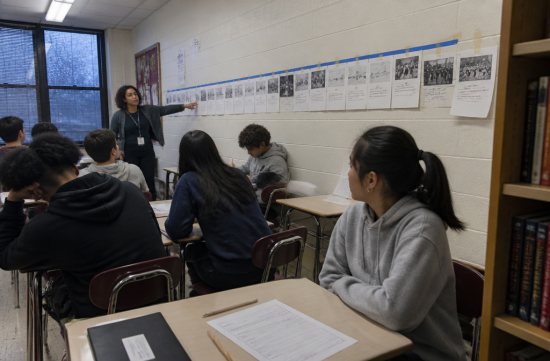
Recently, I visited a friend's house and casually asked their middle school child, "Have you learned about Asian American history in school?" The child thought for a moment and shrugged.
"Um, the poster we made in May? Other than that, I don't really know much." I was a bit surprised by that answer. Illinois has made this a legal requirement.
The law is called the TEAACH Act, which stands for Teaching Equitable Asian American Community History Act. Governor Pritzker signed it on July 9, 2021.
With this law, Illinois became the first state to mandate the teaching of Asian American history in public schools. The state senate passed it unanimously at 57 to 0, and the house passed it 108 to 10.
Implementation began in the 2022-2023 school year. All public elementary and high schools are required to include at least one unit on Asian American history in their curriculum.
So what exactly are they required to teach? The law's text indicates a surprisingly broad scope.
It includes the history of Asians in Illinois and the Midwest. Contributions of individuals in government, arts, humanities, and sciences are also included.
The role of the Asian community in the economic, cultural, social, and political development of the United States is addressed. Contributions to the civil rights movement since the 19th century are also specified.
At this point, it sounds quite solid. However, from my perspective as someone who has worked in IT for a long time, it seems like a document with specifications but lacking implementation details.
Each school board determines how many hours of instruction are required for a unit to be recognized. There is still no state-level standard curriculum.
The Illinois State Board of Education (ISBE) states that each school district will decide how to meet the requirements within their own curriculum. They have released a resource guide to assist in curriculum development.
Compliance checks will be conducted annually by the regional superintendent during compliance visits. Completing requirements through online programs or courses is also allowed.
Another point is that when the law was passed, no budget was allocated. It wasn't until 2025 that the state government allocated $2 million for inclusive K-12 history education, some of which went towards TEAACH.
So, what is the situation like now, five years later? According to a report from WBEZ this September, it's honestly a bit disappointing.
State Representative Jennifer Gong-Gershowitz, who introduced the bill, mentioned that about 25% of Illinois teachers and students have encountered related materials to some extent. The number coming from the bill's sponsor is one in four.
The HANA Center in Albany Park surveyed 113 students, teachers, and parents in the fall of 2023. 73% of student respondents reported that they received little to no education about the Asian community in the past school year.
Of course, a sample size of 113 is small. There is certainly a valid counterargument that you can't generalize for the entire state based on this.
Still, I believe the direction points to the same conclusion. The Cambodian Heritage Museum has reported instances where schools do not respond to their outreach, and they have been deprioritized due to lack of time or teachers.
What about Chicago Public Schools (CPS)? CPS stated that the Social Science Department curates instructional materials for K-12 teachers and provides content and teaching resources.
So, the materials exist. However, how much and when teachers actually use those materials can vary from school to school.
There are indeed schools that are doing well. CPS's Skinner North has integrated Asian history and culture into their lessons even before the law was enacted, and they were featured on ABC7.
Asian Americans Advancing Justice Chicago held 63 teacher training sessions related to TEAACH from July 2022 to June 2023. They have also made scope and sequence materials available for K-5 and 6-12.
At this point, it would be fair to mention the opposing viewpoint. From the school's perspective, there are already many mandatory education items, and it is understandable that they find it challenging to manage a mandate that comes without funding.
The principle of local control, which states that local education is determined by the community, cannot be ignored either. I don't necessarily think that a one-size-fits-all approach is the right answer.
However, if the law exists and a child is asking, "Was that the poster we made?" then something has been lost in translation. Ultimately, there are aspects that only parents can inquire about.
There's no need to overthink it. You can simply email the homeroom or social studies teacher to ask when and what content will be covered in this year's Asian American history unit.
If the answer is vague, you can also ask at the principal's or Local School Council meeting. A curious tone rather than an aggressive one is sufficient.
At home, it's also a good idea to review the ISBE resource guide or materials from Advancing Justice Chicago together. When children discuss what they learned at school during dinner, it tends to stick with them much longer.
If it were me, I would send an email to the teacher before this winter break. The law has already been established, so I think it's our responsibility to help bridge the gap to the classroom.
 WinterZone
 SunnyTrail79








 Augusta 90 |

 Pointy |

 rissa |

 Gomo Nim |

 lattepop |

 Illinois Mom |

 Epoca News |

 Electricity Field Certification Collector |

 Rice Shop Uncle BLOG |

 Hodong Prince Over Flex |
 Raymond K. |
 gravity |
 714 Success Era Real Estate |
 Investment Beginner Company Information Encyclopedia |
 musicque |
 The Gelaton |
 ovelion |
 Chicagonian |
 Freedom Yea |
 AZ Road Master |
 glenix39 |
 Something is popping in the situation |
 orvella |
 vella |
 comets |
 Banana |
 Yes Dorian |
 zentar |
 mykiwi blog |