

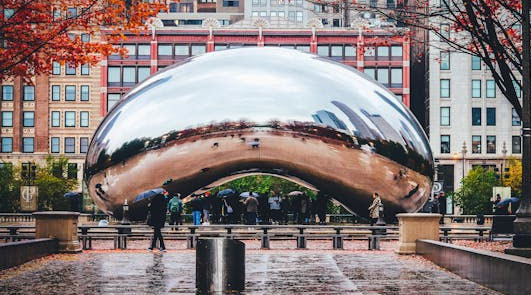
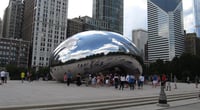
In Chicago, everyone must visit the shiny sculpture located in the middle of 'Millennium Park,' known as the 'Chicago Bean.' Its official name is 'Cloud Gate,' created by British sculptor Anish Kapoor. At first glance, it resembles a giant bean, which is why locals and travelers often refer to it as "The Bean."
What is the Chicago Bean (Cloud Gate)?
-
Reflective Effect
The biggest feature is its mirror-like surface that reflects the flowing clouds, surrounding skyscrapers, and even the people standing in front of it. It is made by joining a whopping 168 stainless steel plates. The surface is perfectly smooth, allowing for various reflections depending on the viewer's perspective. -
Scale and Location
Construction began in 2004 and was completed in 2006, measuring about 20 meters in length and approximately 10 meters in height, making it quite large. It is located in the heart of Millennium Park, a major tourist attraction in downtown Chicago, making it one of the must-visit spots for tourists. -
Artist and Artistic Intent
The artist Anish Kapoor wanted to create a piece that connects the sky and cityscape like a gateway, hence the name "Cloud Gate." His main intention is to unify the viewer and the urban landscape through the reflected images, providing a variety of visual experiences in the process.
Is it a copyright violation to take and share photos?
Given the fame of this artwork, many wonder, "Will there be copyright issues if I take photos and post them online?" Since copyright exists for the original creator or the artwork itself, it is generally good to understand the following points.
Personal Use and Non-commercial Use
For most travelers, posting photos on personal social media or blogs, like a 'Chicago travel diary,' is usually not a big issue. In the U.S. and many other countries, it is generally accepted practice to take and share photos with public art as a background for tourism purposes. However, just because it is 'allowed' does not mean the artist has completely waived their copyright, and it is mainly not a problem when shared at a personal, non-commercial level.
Commercial Use
Activities that generate profit using the artwork (e.g., selling photos as merchandise or using them in advertisements) may lead to copyright issues. Anish Kapoor is known to assert his copyright relatively strongly, so using it for commercial purposes could pose potential problems. For example, creating and selling merchandise (t-shirts, postcards, etc.) featuring the Chicago Bean image or using the artwork in promotional videos should be done with prior permission for safety.
The Concept of 'Freedom of Panorama' in the U.S.
Compared to Europe and other countries, the regulations for photographing public art in the U.S. are somewhat complex.
There is no clear, unified regulation across the U.S. stating that 'public art can be freely photographed and used.' There can be regional or case-by-case differences. However, it is generally similar that taking personal photos of public artworks for tourism purposes and posting them on social media is not a significant issue.
In conclusion, sharing personal photos of the Chicago Bean on a blog or social media is generally not viewed as a copyright violation. However, if you engage in profit-generating activities with those photos (merchandise production, advertising, sales, etc.) or use them in a way that could infringe on the artist's rights, copyright issues may arise, so caution is needed.





 Khan Film Blog Production |
 dermoon |
 hoosierdaddy |
 sun walker |
 Let's Be Like a Salt-like City Person |
 Illinois Mom |
 Rice Shop Uncle BLOG |
 Nanana Nanana Nanana |
 Enjoyable American Life Diary |
  US Embassy |
  NYC saladbar |
  Finding Superfoods |
  lightyear |
  song bang |
  vexomo |
  Indiana Jones |
  meloncat |
  novapixel |
  mortrix |
  Esther 1983 |
  fortbliss |
  Moscow Kim |
  My Two Way |
  toastyfox |
  FLORIDA Acus |
  tracker |
  TONTON COFFEE |
  sunrise |
  ultron78 |