

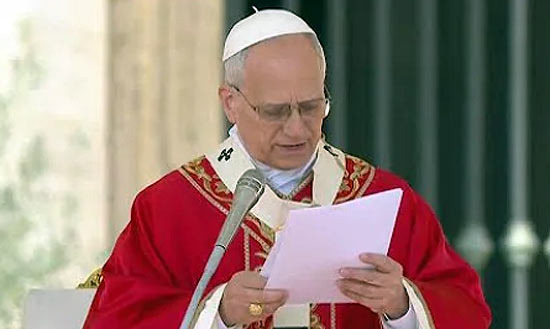
Pope Leo XIII delivered a strong message by openly criticizing war during the Palm Sunday Mass.
On the 29th (local time), at St. Peter's Square in Vatican City, the Pope stated, "The prayers of those who wage war will be rejected."
This statement clearly indicates that the act of waging war cannot be accepted even from a faith perspective, going beyond a simple appeal for peace.
The Pope emphasized, "Jesus rejected war, and no one can justify it."
This is interpreted as a clear stance against attempts to rationalize conflict or violence under the guise of religious justification.
In particular, the Pope quoted scripture to convey his message more clearly.
He highlighted that "Jesus was unarmed, did not defend himself, and did not wage any war," reaffirming that the essence of Christian faith lies in non-violence and peace.
This statement carries greater significance as it intersects with the ongoing international conflict situation, moving beyond a mere religious sermon.
The Pope has set a clear standard for all leaders who choose war and those who support such decisions.
Moreover, there are interpretations suggesting that the Pope's remarks go beyond mere principles and touch on specific political contexts.
In particular, the comments of U.S. Secretary of Defense Pete Hegseth have been mentioned.
He recently led a prayer meeting at the Pentagon, reportedly praying for "overwhelming violence against those who lack the value of mercy." This expression used religious language but was ultimately perceived as a message justifying military action.
In this context, the Pope's statement that "the prayers of those who wage war will be rejected" is interpreted as a direct rebuttal.
Additionally, on the 13th, the Pope indirectly criticized political leaders by asking, "Do Christians who bear significant responsibility in conflicts have the humility and courage to confess?"
Many individuals within the U.S. government openly identify as Christians.President Donald Trump has identified as a Presbyterian, and Vice President JD Vance and Secretary of State Marco Rubio are also known to be Catholics.
In this situation, the Pope's message is seen as a question that goes beyond a simple religious recommendation, challenging the relationship between faith, power, and war.
Ultimately, Pope Leo XIII's message can be summarized in one line.
Faith cannot be a tool to support war, and the moment one chooses violence, no prayer can gain legitimacy.
This message resonates even more strongly in the current unstable international situation.





 Encyclopedia of New York and Surrounding Areas |
 washington mom |
 California Dreamer |
 Sugar Cream Door Bulletproof Noodles |
 Investment Campus Home Ownership |
 Rice Shop Uncle BLOG |

 Illinois Mom |
 Electricity Field Certification Collector |
 Love Joy Blog |
  Let's Be Like a Salt-like City Person |
  Belgray Miscellany |
  sweetvan |
  Augusta Univ |
  Round and Round Children's Song Kingdom |
  butter 90 |
  Lando Mao |
  Washington Denzel DJ |
  LIZ Legal Information Blog |
  vegas mom |
  Sandiego Auntie |
  Premium Gas Camp |
  Things to know |
  TEXAS Fishing Boat |
  AUTO OK |
  aaoaa |
  Florida King |
  Study Abroad Life Know-How Tips |
  Conflite Teacher |