
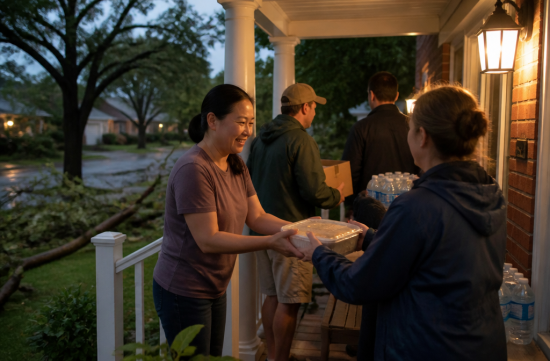
I still remember the scenes I saw on the news a few years ago when a major flood hit Texas. Neighbors with fishing boats loaded onto their trucks were pulling strangers out of the water and rescuing people trapped on rooftops.
Among those people, there were no firefighters or rescue workers. They were just ordinary neighbors with boats.
Interestingly, these scenes repeat every time a major disaster strikes in the U.S. Whether it's a hurricane, wildfire, or tornado, the news always features people selflessly offering their time and resources for strangers. The same happened a few years ago during a major wildfire in Los Angeles, where volunteers were frequently in the news for opening their homes to those who lost theirs and bringing blankets and food to shelters.
Why do we only see this kind of behavior in the face of disaster, even in neighborhoods where people usually don't know each other's names? Curious about this, I found that scholars have been studying the same question for a long time.
Sociologists refer to this as convergence behavior, which describes the phenomenon where people, resources, and help naturally converge to a disaster area. It's a social phenomenon commonly observed in almost all disasters.
American author Rebecca Solnit interestingly addressed this in her book. After examining various disasters from the 1906 San Francisco earthquake to 9/11 and Hurricane Katrina, she found that it is actually rare for people to panic and trample each other; instead, voluntary cooperation and altruism are much more common. This is quite different from the chaotic images we often see in disaster movies.
The reason ultimately boils down to one thing. People who usually have different political views, lifestyles, and frequent conflicts feel a shared experience of suffering and fear under the same disaster. In that moment, they sense that they are not so different from each other. Scholars call this a sense of shared fate.
I have felt something similar many times in my life. In the Midwest, tornado warnings are common in spring and fall, and neighbors who usually feel awkward around each other are the first to knock on doors to check if everyone is okay and if the kids are safe as soon as the sirens go off. Even those who would usually argue about politics set aside their differences in those moments.
The same goes for the Korean community. When a crisis occurs, messages checking in on each other flood group chats, someone brings over side dishes, and others gather necessary items to send. Even if people are usually distant, in those moments, they act like one big family. Mothers raising children also reach out to each other regardless of which school or neighborhood they belong to when something significant happens.
Ultimately, I think people are inherently born to help each other. It's just that in everyday life, they are busy, live differently, and are preoccupied with various concerns, so they temporarily set aside that instinct. It takes a special occasion like a disaster to bring that instinct back to the forefront.
Of course, after the disaster passes and time goes by, people return to their daily lives and individual thoughts. Rather than feeling sad about that, I think it's a natural occurrence. We can't live every day putting everything aside for others.
However, even after a disaster has passed and life returns to normal, I hope we can continue to hold onto at least a piece of that warm feeling we experienced. It doesn't have to take a major crisis for us to care for each other; if we can share that feeling little by little in our daily lives, our neighborhoods could become much more livable. It wouldn't hurt to knock on the door of the neighbor next door today.

 logger |
 Conflite Teacher |
 Unknown Dog Walk blog |
 Khan Film Blog Production |
 Yoyma |
 Iri Jori Missouri |

 tooto |
 Missouri Kings News Information |
 colo colo |
  U.S. Weather Bureau News |
  Dragon Lee |
  American Food Information & Calories |
  zephyrs |
  ness 6 |
  Montgomery Mom |
  SteelOrbit |
  Puddle Puddle |
  Arizona Cowboy |
  macaronpop |
  marydock |
  peachpanda |
  U.S. College Admission Information |
  Fruitop |
  Exploring American Life Information |
  sing sing |
  ORAVEZIN Oppa |
  Lego My Ego |