
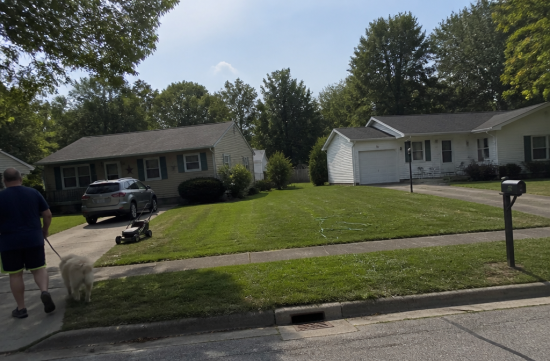
One of the things that surprised me when I first lived in an American neighborhood was the lack of fences in the front yard. The grass of the neighboring house just flowed into our yard without any boundary, making it hard to visually distinguish where my property ended.
On the first day I mowed the lawn, I didn't know where to stop, so I pushed a little further into the neighbor's yard, but the neighbor just smiled and thanked me. In that moment, I realized that the real rule in this neighborhood is not to draw lines but to look out for each other.
In Korea, whether in an apartment or a detached house, it was natural to have a gate or fence clearly separating the inside from the outside, so at first, this openness felt strange and a bit unsettling.
Initially, I thought it was just a characteristic of the neighborhood, but as time went on, I learned that it was not a coincidence but rather a long-standing custom.
Up until the mid-19th century, it was common for American homes to have fences in their front yards. However, by the 1870s, the atmosphere completely changed.
At that time, landscaping books spread the idea that living openly with neighbors was more sophisticated and considerate, and by the 1890s, fence-less front yards became a common sight.
After World War II, the explosive growth of suburban housing developments solidified this trend. The yard became less of a private property and more of a shared landscape for the entire neighborhood.
So, the absence of a fence is not just a natural occurrence; it was once a signal that a house fit well within the neighborhood.
This trend has not completely disappeared. According to neighborhood management regulations, while back yard fences are usually allowed up to about 6 feet, front yard fences are often limited to 3 to 4 feet.
The reasoning behind this is quite logical. Keeping front yard fences low allows vehicles and pedestrians at intersections to see each other well, and having an unobstructed view of the neighborhood helps spot any suspicious activity.
From a scientific perspective, a fence-less yard resembles two gas masses meeting without a wall. As long as there is no pressure difference, they naturally mix together; similarly, two different homes can coexist without erecting walls as long as they follow certain rules.
Moreover, building and maintaining a fence costs money, so not having one can actually be more beneficial for household finances.
Of course, the back yard is a different story. Most neighborhoods do not prevent high fences in back yards since they are spaces that require privacy.
Ultimately, the American fence culture is based on the principle of keeping the front open and the back closed. The front yard serves as a shared face of the neighborhood, while the back yard is distinctly a family space.
To live with open yards among neighbors, there must be a minimum level of trust between each other. It's fascinating to see how even the timing of mowing the lawn or the range of children playing is subtly coordinated.
When children kick a ball into the neighbor's yard, no one gets upset, thanks to this open structure. The blurred boundaries of the yard create a natural atmosphere where such small intrusions are easily accepted.
What I've felt living in this neighborhood is that the absence of a fence does not mean there is no privacy. Even without visible boundaries, everyone implicitly respects the lines of their own yard.
A cherry may look simply round and plain on the outside, but it is filled with firm seeds inside. A fence-less yard is just like that; it may appear wide open, but it has its own set of rules that keep it solid.
Living in a place where everyone maintains their own space without drawing a line has surprisingly grown on me. If it were up to me, I would rather spend the money for a fence on maintaining the yard instead.


 Lol Life |
 lavender |
 logger |
 Conflite Teacher |
 Unknown Dog Walk blog |
 Living in New Jersey blog |

 gentle |

 mygoddess blog |
  Yavrix 92 |
  cherry cherry |
  moonlight |
  Coastal city |
  There Are Such Things in the World |
  Mazinger Z Rocket Punch |
  celtics |
  shinee cho |
  Kondae Garusong Blog |
  quiet river |
  alamo |
  Waiting for Godot |
  parlon |
  Say Yes in English |
  Sayonara H |
  rigid |
  Ohio Ohayoung Hello |
  U.S. Military Recruitment Information |
  You Turn Me On |