

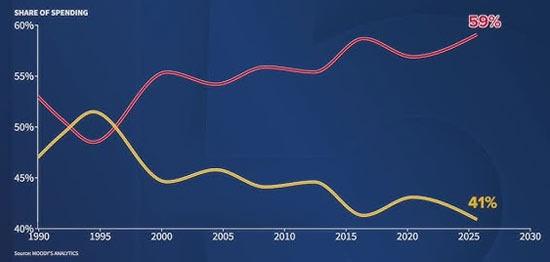
Last week, Treasury Secretary Yellen appeared on CNBC and made a comment.
She said she was tired of hearing about the K-shaped economy. She believes the K-shape is over and that wages for low-income workers have risen significantly, indicating that the U.S. economy is moving towards a C-shape.
After reading the article, the first thought that came to my mind was this.
"So how has my life improved?"
These days, I haven't even picked up a few items at the market, and my total at the checkout exceeds $100.
In this situation, telling someone, "Your wages are increasing" honestly doesn't resonate.
According to the Atlanta Fed's wage growth tracker, based on a 12-month moving average, the wage growth rate for the bottom 25% of workers was 3.6% in June, while the top 25% was 3.9%.
The bottom is not surpassing the top; it is still behind. And since 2026, the bottom has never once exceeded the top.
On the consumer side, according to Mark Zandi, households earning over $200,000 a year increased their spending by nearly 4%, while the bottom 80% spent the same as last year after adjusting for inflation.
Additionally, RSM's Joe Brusuelas pointed out that of every dollar made from the stock rally, 75 cents flows to the top 20% of households.
This means that as stock prices rise due to the AI boom, the gap is not closing but widening.
So, it is true that the bottom has risen a bit. But is that enough to declare that the K-shape has turned into a C-shape?
The data still says no. This is more of a talking point ahead of the elections.
In any case, statistics are statistics, and the real issue is where that 3.6% is disappearing to here in California.
This area is unlivable without a car. Car payment $500, insurance $200, gas $150. That's already $850.
Just to operate one car costs this much. California has the highest gas prices in the nation, and every time I renew my insurance, I receive a letter saying, "Your rates have been adjusted."
I have never seen the word adjustment used to mean a decrease.
In addition, a one-bedroom in Koreatown is in the $2,000 range. Some places charge extra for garage parking.
When you add in various utilities, electricity, internet, cell phone, and food costs, your paycheck disappears in just a few days.
Let's say the hourly wage increased by $1. If you work 40 hours a week, that's about $170 more a month.
But if insurance goes up by $40, rent increases by $100, and groceries rise by $30?
Statistically, wages have gone up, but my wallet remains the same. This is the situation most working-class Americans are facing right now.
The real danger is not inflation but lifestyle inflation.
This is where I want to make my point.
If you're short, you swipe your card. At first, it's $300. The next month it becomes $500, and at some point, the balance reaches $5,000.
Credit card interest rates in the U.S. are frightening. The moment you start making only the minimum payment, you're not using the money you earned to buy food; instead, you're paying bank interest.
So, during times like these, the most important thing to be cautious about is raising your standard of living just because your salary has increased.
Just because your pay has gone up doesn't mean you should immediately sign a contract for a $60,000 brand-new SUV.
If you get a bonus, you should think twice before completely redecorating your home or booking a trip.
It's easy to increase a $300 car payment to $700 with just one piece of paper, but reducing it back to $300 requires selling the car, which usually means taking a loss.
Once your standard of living has risen, it never comes down on its own. It always comes down forcibly, along with a layoff notice.
Right now, it feels more comfortable to go in the opposite direction.
If the car is still running fine, I'll keep driving it for a few more years. Continuing to drive a car that has finished its payments is essentially a $500 raise every month.
If you have credit card debt, pay that off first. Paying off a 20% interest debt is like earning a tax-free 20% return. There's no guaranteed ROI like that in the market.
Keep at least three months' worth of living expenses in your checking account. You should be able to handle a broken refrigerator or four new tires without pulling out your card.
In LA, it's not uncommon to have a fender bender in the same month.
In the U.S., the gap is widened not by wages but by assets. Those who own homes see their property values rise, and those with stocks see their stock prices increase, while those with nothing are just waiting for the next paycheck.The fact that 75 cents of every dollar earned from stock profits goes to the top 20% is exactly that. The K-shaped divide is not determined by salary but by the presence or absence of assets.
So, putting at least one foot in the asset column is more significant in the long run than negotiating hourly wages.
Whether the economy is K-shaped or C-shaped, on the 1st of next month, the mortgage and rent will undoubtedly be due.
Ultimately, what working-class Americans can rely on is not the alphabet drawn by economists but the numbers left in their bank accounts.
 Jellybean
 JakyungSis
 MohicanIndian







 coloradoman |
 pintos |
 mapsina |
 Mr. Largo |
 Victory 1988 |
 There Are Such Things in the World |
 Anjollinya Blog |
 novapixel |
 Sunny's Travel in America |
  Let's Be Like a Salt-like City Person |
  Belgray Miscellany |
  sweetvan |
  Augusta Univ |
  Round and Round Children's Song Kingdom |
  butter 90 |
  Lando Mao |
  Washington Denzel DJ |
  LIZ Legal Information Blog |
  vegas mom |
  Sandiego Auntie |
  Premium Gas Camp |
  Things to know |
  TEXAS Fishing Boat |
  AUTO OK |
  aaoaa |
  Florida King |
  Encyclopedia of New York and Surrounding Areas |
  Study Abroad Life Know-How Tips |
  Conflite Teacher |