
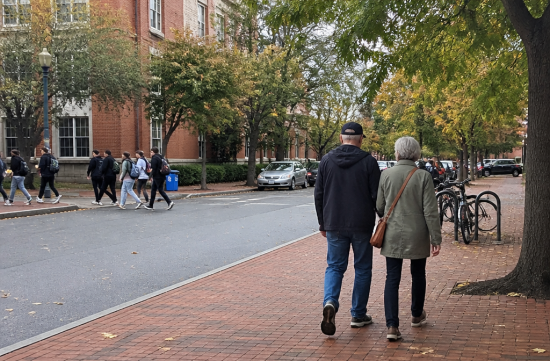
These days, I notice an interesting pattern whenever I hear about friends' parents retiring.
Everyone thought they would move to the countryside, but it turns out that many are heading to small towns with universities.
When people think of retirement, they often picture a quiet life in a rural village, tending to a garden. However, the actual trend among American retirees is quite different.
In fact, there have been numerous articles reporting that more retirees are choosing college towns as their new homes. Forbes even included many college towns in its list of the best places to retire this year.
Specifically, names like Athens, Georgia; Lawrence, Kansas; and Lexington, Kentucky frequently appear on these lists.
Interestingly, Iowa City, where I live, also made the list. It felt personal to me.
But why college towns? If we break down the reasons, they make a lot of sense.
The first reason is healthcare access. College towns often have large university hospitals.
There are small towns with surprisingly high-quality healthcare systems despite their low populations. Considering that proximity to hospitals becomes increasingly important as we age, this is a logical choice.
The second reason is lifelong learning. An organization called the Osher Foundation supports lifelong learning programs at college campuses, with a total of 125 programs available.
It's said that there is at least one in every state and Washington, D.C. With over 160,000 registered members, the scale is quite significant.
I was a bit surprised by this number. It indicates that these are not just casual hobby classes.
Not only at the main campus but also through satellite campuses and partner institutions, classes are offered in 276 cities and towns across the country. This means you can benefit even if you're not near a university.
The lifelong learning program at the University of Michigan in Ann Arbor reportedly has a course list that exceeds 100 pages. From nuclear physics to modern European history, the curriculum for retirees is quite impressive.
It's not just about attending lectures. Many people report gaining energy from interacting with younger students on campus.
The Oak Hammock retirement community in Gainesville, Florida, is located right next to the University of Florida on a 136-acre site.
Residents here can audit classes for free, allowing them to be lifelong students without worrying about tuition.
In Newton, Massachusetts, the Lasell Village takes it a step further. Each resident is required to participate in 450 hours of learning or exercise programs each year.
This is intended to encourage continuous learning and activity rather than just relaxing after retirement, and it's impressive that there's still a steady demand for residency under such conditions.
The third reason is mobility convenience. College towns are often designed for students who walk rather than drive.
This means that even as one ages and stops driving, they can still manage their daily life. This is a condition that is hard to expect in rural areas.
The fourth reason is the cultural and dining infrastructure. The key is that you can enjoy big-city-level performances, exhibitions, and restaurants at small-town prices.
In contrast, in rural areas, even getting to a hospital can require a long drive. This isolation can be a significant issue.
As this trend has taken hold, retirement communities specifically partnered with universities have emerged. The industry refers to these as university-based retirement communities.
There are reportedly over 85 such university-linked retirement communities across the country. However, only about four are officially recognized, and this concept itself is a term that was created in 2004.
This model has been refined for over 20 years. It's not just a trend that happened by chance.
Given the data-driven nature of these decisions, seeing these numbers gives me confidence. College towns generally have an open atmosphere and a mix of generations living together.
For retirees who prefer connection over isolation, this environment is a good fit. Additionally, most have decent access to airports or large cities.
This means it's much easier for children or grandchildren to visit compared to rural areas.
Of course, there are downsides. In popular college towns, housing prices have risen significantly, and traffic can be congested during home game weekends.
There are reasons for the rising housing prices. The stable employment base provided by the university supports the local economy, so even when the economy fluctuates, demand tends to remain strong.
Recently, there have been reports that even young people working from home are flocking to college towns, making competition for housing even fiercer. It seems retirees and remote workers are vying for the same neighborhoods.
Being in the automotive industry, I particularly notice these aspects. The demand for parking during home game seasons and the usual weekday traffic flow are completely different in these towns, as the data shows.
So, if you're preparing for retirement, I would recommend visiting during a home game weekend and a regular weekday to see the difference in atmosphere. The contrast is more significant than you might think.
Overall, the answer seems clear. If it were me, I would choose a college town where there are people, hospitals are nearby, and I can attend lectures over a quiet rural area.
 RapidValley98







 Florida King |
 AH LALA |
 Victory 1988 |
 Panorama Kstar |
 Giant Squid and Sweet Potato Soup |
 ORAVEZIN Oppa |

 berrypup |

 Sandiego Auntie |
  Premium Gas Camp |
  Things to know |
  TEXAS Fishing Boat |
  AUTO OK |
  aaoaa |
  Encyclopedia of New York and Surrounding Areas |
  Study Abroad Life Know-How Tips |
  Conflite Teacher |
  Silent Sea |
  Montgomery Mom |
  Franco Family |
  coloradoman |
  lumora |
  Valley Bang |
  pravix22 |
  Cohesive Kong |
  werehere |
  CA Real Estate |