
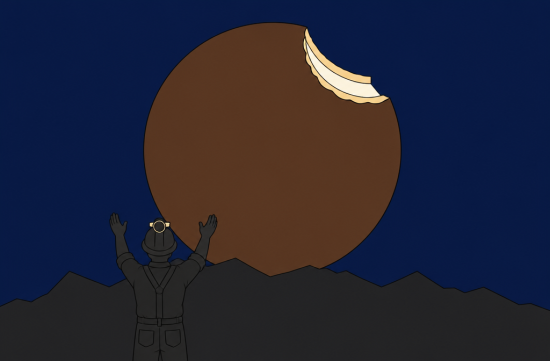
The first Korean person to pick up a MoonPie at the grocery store checkout usually says, "Isn't this just a Choco Pie?" I can't mock anyone for that, as I said the same thing.
However, in terms of age, MoonPie is quite a bit older. The Korean Choco Pie came out in the 1970s, while the MoonPie company claims its origins date back to 1917.
With a difference of over half a century, it's not just an older sibling but almost a father figure. So, I decided to dig into how this round snack came to be, and the more I explored, the more interesting and somewhat mysterious it became.
From the start, it was far from romantic. The Chattanooga Bakery was established to deal with surplus flour from the Mountain City Flour Mill.
The founding year is listed as 1903 in the Tennessee Encyclopedia and 1902 in Encyclopedia.com. Initially, they baked various items like cookies, crackers, and fig bars.
Here's where a famous scene unfolds. A company salesman, Earl Mitchell, stopped by a Kentucky coal mine and asked the miners what snack they wanted.
The miners' response was graham crackers and marshmallows, and they wanted it as big as the moon. In some versions, the miner is said to have gestured the size by cradling the rising moon with both hands.
What came out of that was a snack made of two 4-inch graham cookies with marshmallow in between, coated in chocolate. It was priced at 5 cents.
A 4-inch cookie is just about 10 centimeters. Given the request for something as big as the moon, this was a bit of a delivery dispute. Still, it fit nicely in a lunchbox and filled the miners up, so they seemed satisfied.
Now, we need to hit the brakes for a moment. This story has surprisingly scant evidence.
The company reportedly did not keep records of how this snack was invented. The claim that Earl Mitchell created it comes from testimony given later by his son, Earl Mitchell Jr., to a researcher.
The dates also don't align perfectly. The company claims 1917, but the Tennessee Encyclopedia notes that the salesman returned with the request around 1919.
So, while the title mentions 1917, it would be more accurate to say, "the company claims 1917." However, there is consensus that it originated from that bakery in Chattanooga. The main storyline can be trusted.
What's truly fascinating comes next. During the Great Depression, a MoonPie for 5 cents and an RC Cola for another 5 cents made for a 10-cent meal. People referred to this as a working man's lunch.
Why RC Cola, you ask? According to a 2017 NPR report, no one knows for sure. It seems to be a Southern conclusion that as long as it was cheap and plentiful, it didn't matter what it was.
In the 1950s, a country song even came out asking for RC Cola and MoonPie. The artist's name varies by source, but once a snack's name is in the title of a song, the game is pretty much over.
According to the company, during World War II, MoonPies were sent overseas as care packages for soldiers. There are also stories of Southern workers taking them along when they moved to Northern steel mills and auto factories in Chicago and Detroit.
By the mid-1950s, the company dropped all other products and focused solely on MoonPie. A company that started to get rid of excess flour ended up surviving on just one snack, which shows how unpredictable life and business can be.
In the 1960s, the Double Decker was introduced. It featured three cookies with two layers of marshmallow, designed for vending machines, and was priced at 10 cents. By my standards, that was the pinnacle of technological innovation for that era.
We can't skip over the Southern festival stories. In Mobile, Alabama, during Mardi Gras, MoonPies are thrown from parade floats. Instead of beads, snacks are flying through the air, with the starting point varying between 1956, the late 1960s, and 1974 according to different sources.
This snack's history is always a bit hazy. However, it is clear that since New Year's Eve 2008, a giant MoonPie is lowered from a building in Mobile to ring in the new year. If New York has its ball drop, Mobile has its pie drop.
The scale is even more amusing when you look at the numbers. The company timeline states that in 1929, employees packed hundreds of them into boxes each day.
After moving to a larger factory by the Tennessee River in 1983, they produced 300,000 a day by the early 1990s. According to a 2017 NPR report, they now produce over a million a day.
Yet, they have not been acquired by a large corporation. As of 2017, it remains a family-owned business held by the Campbell family for five generations. They hardly advertise, so I have to give them credit for their guts.
I can't skip the taste discussion. For those accustomed to Choco Pies, the cookies may feel drier and the marshmallows chewier. They are also unapologetically sweet. Eating one alone with coffee might lead to surrender halfway through.
So, if it were me, I would enjoy one after a long walk along the Tennessee River, paired with a cold RC Cola. After sweating a bit, I would understand why this was considered a working man's lunch.
If you ask me whether all the moon-related stories are true, I would say I don't know. Perhaps they are just a beautifully polished tale over time.
Still, I like this story. A company that started with leftover flour, a miner asking for something as big as the moon, and a 5-cent meal. The records may be blurry, but it's quite clear who this snack has filled.
 OceanPeak79


 Chino Min |

 Glow Yo |

 Michigan Enthusiast |
 xylora |

 Tan Zoo |

 silverfox |

 quietwave |

 ttano |


 U.S. Weather Bureau News |

 Elastico |
 peltra |
 banleaf |
 humpday sonata |
 silver |
 Queens Blues |
 Christopher |
 timemachine |
 frostpup |
 Non-Stop Squat Team |
 laughing |
 sweetvan |
 lattepop |
 Augusta Univ |
 Well Done Sir |
 nrixa |
 vrixen73 |
 A landlocked state |
 rockets |
 Smile Face |