
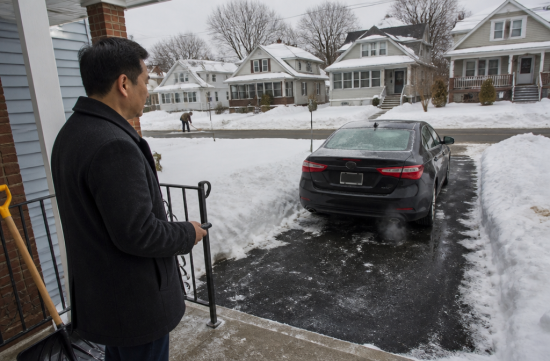
On a frosty morning, the satisfaction of pressing the key fob button from inside the house is something every winter car owner can relate to. But this year, I suddenly wondered: is it really legal for a car to run by itself when no one is inside?
Taking this opportunity, I looked up the legal texts for each state as of early November. To confess right away, the regulations vary significantly from state to state, and New York's rules are quite ambiguous.
First, let's look at the idling time limits. New York State's environmental regulation 6 NYCRR 217-3 prohibits idling for more than 5 minutes while stationary.
However, this applies only to large vehicles. It targets buses and trucks with a gross vehicle weight rating (GVWR) exceeding 8,500 pounds, while regular sedans or standard-sized SUVs do not fall under this category.
So, the statement "It's illegal to leave your engine running for more than 5 minutes in New York" is only half true. If you own a large pickup or van, it would be wise to check your vehicle's GVWR on the door label.
New York City has different rules. According to the city's Department of Environmental Protection, idling for more than 3 minutes is illegal, and for commercial trucks near schools or parks, a 1-minute limit applies.
This means that even within the same state, the standards change when crossing city boundaries. If you park your car in Manhattan and leave it running out of habit, you could find yourself in trouble.
The real issue isn't the idling time but the unattended vehicle clause. New York State Vehicle and Traffic Law Section 1210 states that when leaving a vehicle unattended, the engine must be turned off, the ignition locked, the keys removed, and the brakes set.
The text I read does not mention any exceptions for remote starting. The only exception pertains to keys that are hidden out of sight.
So, if you remote start your car in front of your house, is that an immediate violation? Here, we need to consider the scope of application.
Section 1100 of the same law indicates that these regulations apply to public roads, private roads open to general vehicles, and parking lots. The definition of a parking lot refers to private property for customers of stores or businesses.
Based solely on the text, my home driveway is not explicitly mentioned. In contrast, a supermarket parking lot or the street in front of my house seems to be a different story.
I'm not a lawyer, so I won't make definitive interpretations. If you park in ambiguous places like an apartment complex parking lot, I recommend checking with the management office or local ordinances.
Looking at neighboring states, the differences become clearer. Michigan's MCL 257.676 explicitly states that the unattended vehicle clause does not apply to vehicles with remote start functionality.
Ohio's Section 4511.661 takes a different approach. While it doesn't mention remote starting, it exempts vehicles parked on residential property and locked vehicles.
Michigan focuses on the functionality, while Ohio considers the location and locking status. The same winter, the same button, yet the legal reasoning varies across state lines.
If you've moved or are on a long business trip to another state, you should look up that state's regulations separately. I haven't checked beyond these three states, so don't assume others are the same.
However, before worrying about the law, prioritize safety. The CDC advises against running a car in a garage, even if the door is open.
If you have a detached garage, they recommend opening the door before starting the engine. This is where the trap of remote starting lies. With just one button press, it's easy to forget that the car is inside the garage.
According to CDC statistics, non-fire-related carbon monoxide poisoning results in over 400 deaths and more than 100,000 emergency room visits in the U.S. each year. Seeing these numbers, I changed my habit of pressing the start button on the app.
Be cautious even the day after a heavy snowfall. The National Weather Service advises clearing snow from the exhaust pipe of a car trapped in snow to prevent gas poisoning.
This is especially true when someone is inside the car. If it's a morning with lake-effect snow, it's best to step outside and check the tailpipe before pressing the button.
So, is warming up your car necessary these days? According to fueleconomy.gov, most manufacturers recommend starting smoothly after 30 seconds.
The engine warms up faster when driving than when idling, and the heater kicks in just as quickly. In fact, from a mechanical standpoint, gently driving is the best way to warm up the vehicle.
I also calculated the fuel costs. Idling consumes about 0.25 to 0.5 gallons per hour, so if you idle for 10 minutes a day for 20 days in a month, that's 0.83 to 1.67 gallons.
That's not a staggering amount for your wallet. However, at 20 degrees Fahrenheit, the city fuel economy for a regular gasoline vehicle is 15% lower than at 77 degrees, and for short trips of 3 to 4 miles, it can drop by up to 24%, so it adds up on short commutes.
My standard is this: on days when I need to defrost the windshield, I remote start my car for no more than 5 minutes in front of my house, locking the doors before pressing the button.
I do not use it in supermarket parking lots or on the street. I never press it inside the garage.
Sitting in a warm seat and starting off is a luxury I, as a Mercedes owner, cannot give up. However, I believe that owning a nice car also includes knowing when to let go of that luxury.
 SbuxFake




 DO Main TODAY |

 Caribbean |

 tredolo |

 Anjollinya Blog |

 Kitchen Ideas |

 The Day the Sun Rises |

 tough guy |
 Elastico |

 Belgray Miscellany |

 flexible |
 peltra |
 banleaf |
 humpday sonata |
 silver |
 Queens Blues |
 Christopher |
 timemachine |
 frostpup |
 Non-Stop Squat Team |
 laughing |
 sweetvan |
 lattepop |
 Augusta Univ |
 Well Done Sir |
 nrixa |
 vrixen73 |
 A landlocked state |
 rockets |
 Smile Face |