

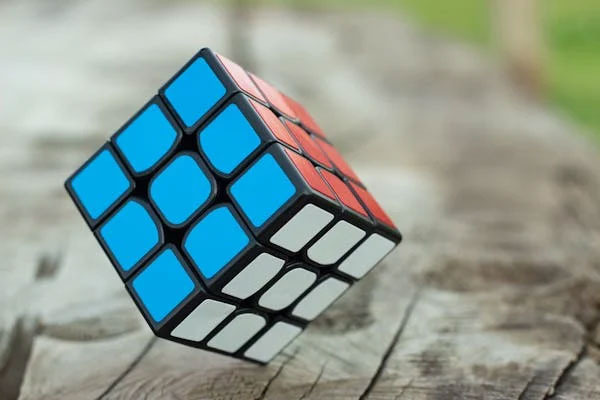
Rubik's Cube! This is a really fun puzzle. In fact, when you first see this cube, you might think, "How do I solve this?" But once you understand it, there are quite simple principles to solve it. So, shall we learn more about the Rubik's Cube?
The Rubik's Cube is a three-dimensional puzzle invented in 1974 by Ernő Rubik, a professor of architecture from Hungary. Originally sold under the name "Magic Cube," it gained immense popularity worldwide after changing its name to the current "Rubik's Cube."
The basic structure of the cube is 3x3x3, meaning it has 6 faces with 9 small squares on each face. Each face consists of red, blue, green, yellow, white, and orange colors, and when you twist the cube, the colors get mixed up.
In fact, the charm of the Rubik's Cube lies in its complexity. At first, when the cube is scrambled, it seems easy to rearrange it back to its original colors, but when you actually try to solve it, you might wonder, "What should I do?" But don't worry! There are certain rules to solving the cube. In particular, there are sequences called 'algorithms,' and by repeating them, you can eventually solve the cube.
There are various methods to solve the Rubik's Cube, but the most basic and widely known method is Layer by Layer (LBL).
Step 1: Aligning the White Face (White Cross)
- Goal: Complete the white face while positioning the white edges to match the adjacent sides.
- Method:
- Find the 4 white edge pieces based on the white center and place them in the correct positions.
- Each white edge piece must also match the color of the adjacent side. For example, the white-blue piece must align with the center of the blue face.
Step 2: Aligning the White Corners (White Corners)
- Goal: Complete the white face and ensure the white corners are placed correctly.
- Method:
- Correctly position the white corner pieces on the three corners of the white face.
- Twist each corner piece so that the white side is facing up.
Step 3: Aligning the Middle Layer (Middle Layer)
- Goal: This step involves aligning the edge pieces of the middle layer (second layer).
- Method:
- Once the white face is complete, you need to align the edge pieces of the middle layer.
- You will need to use several algorithms to position each colored piece correctly. (Two basic algorithms:
- Clockwise: U R U' R' U' F' U F
- Counterclockwise: U' L' U L U F U' F')
Step 4: Aligning the Yellow Face (Yellow Cross)
- Goal: This step involves aligning the yellow face. Since the white face is already solved, now we create a cross on the yellow face.
- Method:
- There may be no yellow at all (dot) or only some yellow present.
- Use algorithms to place the yellow edge pieces in the correct positions.
- Example algorithm: F R U R' U' F'
Step 5: Aligning the Yellow Corners (Yellow Corners)
- Goal: Ensure the yellow corners are positioned correctly.
- Method:
- If the yellow corners are not in the right place, use the following algorithm to position them correctly.
- Algorithm: U R U' L' U R' U' L
- If the yellow corners are not in the right place, use the following algorithm to position them correctly.
Step 6: Correctly Orienting the Yellow Corners (Orientation of Yellow Corners)
- Goal: Rotate the yellow corners so that the yellow face is facing up.
- Method:
- After rotating the yellow corners to the correct positions, use the appropriate algorithm to align each corner.
- Algorithm: R' D' R D (repeat this process for each corner)
- After rotating the yellow corners to the correct positions, use the appropriate algorithm to align each corner.
Step 7: Aligning the Final Layer (Final Layer Edges)
- Goal: Completely align the edge pieces of the final layer to finish the cube.
- Method:
- Finally, twist the remaining parts of the cube to match the colors.
- Algorithm: F2 U L R' F2 R L' U F2
- Finally, twist the remaining parts of the cube to match the colors.
These are the basic steps to solve the Rubik's Cube! At first, it may seem a bit complicated and confusing, but with practice and repetition of the algorithms, you'll be able to solve it naturally.
The process of solving this cube actually has a somewhat mathematical feel to it. Depending on how you proceed through each step, there are different ways to solve it, so there's also the fun of finding your own strategy. You can start with beginner algorithms and gradually progress to more advanced levels.
The Rubik's Cube is known to be a great tool for stimulating the brain and enhancing concentration, going beyond just a simple game. Moreover, the sense of achievement when the cube, which seemed incredibly complex before solving, is perfectly aligned is indescribably satisfying.
And the charm of the cube is that over time, you can solve it faster and faster. Eventually, you'll be able to solve it in a really short time, and that speed becomes an element of challenge. Many people find joy in reducing their solving time with the Rubik's Cube.
If you delve a little deeper into the cube, you'll find various variations. For example, there are versions with more faces like the 4x4x4 or 5x5x5 cubes, the pyramid-shaped "Pyraminx Cube," and the "Skewb" that creates more complex shapes when twisted. However, the basic 3x3x3 cube is the most popular and the version that most people challenge themselves with.
In conclusion, the Rubik's Cube is not just about solving a puzzle; it is an enjoyable activity that stimulates the mind and encourages a spirit of challenge. Give it a try yourself.






 Magic Cabbage School of Martial Arts |
 Vacation on Hawaii |
 morvex37 |
 Ari Songhan American Immigration Life |
 Bearded Strawberry Smoothie |
 Reggae Party |
 Story Bank |
 California Kangaroo |
 Shining Our Own World |
 manchester |
  constant |
  Leapfrog Move |
  vibranto |
  Tora Tora |
  yellowbutter |
  Dolly |
  US Embassy |
  NYC saladbar |
  Finding Superfoods |
  lightyear |
  song bang |
  vexomo |
  Indiana Jones |
  meloncat |
  novapixel |
  mortrix |
  Esther 1983 |
  fortbliss |
  Moscow Kim |