

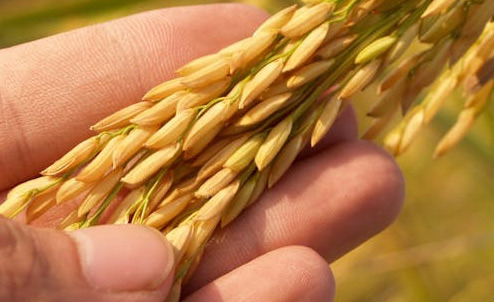
Many people are surprisingly unaware that rice is also cultivated in the United States.
At first, I thought, "Can rice farming really happen in the U.S.?" But it turns out that the scale of rice production in the U.S. is quite large, and the quality is good.
The main regions where rice is produced in the U.S. can be broadly divided into two areas. One is the southern region, including Arkansas, Louisiana, Mississippi, Missouri, and Texas, and the other is California in the west.
First, looking at the southern region, Arkansas is undoubtedly the largest rice-producing state in the U.S.
It accounts for more than 40% of the total production, which is quite impressive.
Louisiana, Mississippi, Missouri, and Texas also cultivate rice in similar environments along the Mississippi River basin. In this region, most of the rice grown is long-grain variety, which is commonly used for pilaf or fried rice rather than plain rice.
California is the second-largest rice-producing state in the U.S. Interestingly, it cultivates completely different varieties compared to the south. In California, medium-grain and short-grain rice, which is the type we are familiar with as Japanese rice, is primarily produced. This type of rice has a sticky texture, making it suitable for sushi, kimbap, and Korean meals.
California rice is mainly grown in the Sacramento Valley region. The Sacramento River flows through it, making it easy to irrigate the fields, and the soil is fertile. Additionally, the cool nighttime temperatures create ideal conditions for growing medium-grain rice. The most famous variety from this region is 'Calrose.' It is well-known as sushi rice, and its chewy yet firm texture is favored not only in Japan but also in Korea and Southeast Asian markets. If you've seen rice labeled 'Calrose' at an Asian market, that's the one.
Interestingly, there is also a significant domestic consumption of rice in the U.S. In the past, rice was only used in Asian cuisine, but now it is widely utilized in Mexican, Indian, and Hawaiian fusion dishes. Moreover, due to the large number of Asian immigrants, there is a steady demand for rice for home cooking. Therefore, U.S.-grown rice is consistently growing in both the local market and overseas exports.
Another reason for the development of California's rice industry is research. Universities like UC Davis have been conducting agricultural research consistently. They are developing new varieties and researching efficient cultivation methods that use less water. Especially since California is prone to drought, water-saving farming methods are crucial for survival. In fact, there was a time several years ago when rice production decreased due to drought, but improvements in irrigation systems and optimization of varieties have helped stabilize production again.
Even now, California accounts for 15-20% of the U.S. rice production and is rated among the highest in quality. If you see the name 'Calrose' at the store, consider buying it to try cooking rice. It may be slightly less sticky than Korean rice, but it has a soft and mild flavor that pairs well with Korean dishes like kimchi or bulgogi.
Ultimately, the rice industry in the U.S. is not just about "there is rice in America"; it is a distinct industry with clear characteristics in different regions. The south focuses on traditional long-grain, while California specializes in Asian-style medium-grain. This way, it satisfies the tastes of different cultural spheres simultaneously. Perhaps that's why U.S. rice has become an undeniable presence in the global market.







 Khan Film Blog Production |
 dermoon |
 hoosierdaddy |
 sun walker |
 Let's Be Like a Salt-like City Person |
 healthy |
 Moo Tang Clan |
 Static |
 Belgray Miscellany |
 newyorker 101 |
  US Embassy |
  Korean Mom |
  My NYC |
  moo moo |
  Mr Oh |
  forevergee |
  festival |
  manchester |
  constant |
  Leapfrog Move |
  vibranto |
  Tora Tora |
  yellowbutter |
  Dolly |
  NYC saladbar |
  Finding Superfoods |
  lightyear |
  song bang |
  vexomo |
  Indiana Jones |