
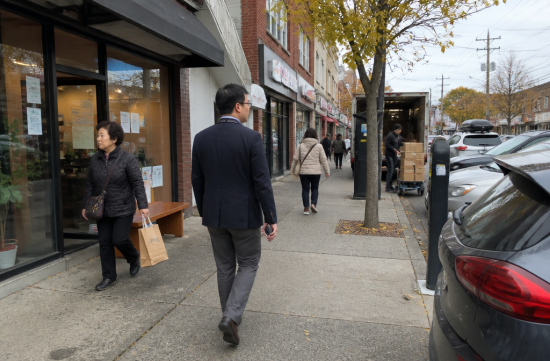
Walking along Broad Avenue during lunchtime, I sometimes find myself confused about whether I'm in New Jersey or a suburb of Seoul. That's because there are so many signs for blood sausage soup restaurants, bakeries, tutoring centers, and real estate offices all in one block.
I had closed my stock app after seeing nothing but red lights all morning and was on my way to grab a bowl of soup. Suddenly, I became curious. How did this small town become the place in the U.S. with the highest percentage of Koreans?
So this time, I decided to look for numbers. Knowing something intuitively is different from confirming it with records.
Palisades Park is a borough created in March 1899 by an act of the New Jersey legislature that took part of Ridgefield Township. It covers an area of 1.28 square miles, which you can walk around in half a day.
According to the 2010 census, the population was 19,622, and of those, 51.5%, or 10,115 people, identified as Korean. This made it number one in both Korean percentage and density among all municipalities in the U.S.
Ten years earlier, in 2000, the percentage of Koreans was 36.38%. In just ten years, it had surpassed one-third to over half.
If my bank account had risen like that over ten years, I would probably be at a golf course instead of at work. Unfortunately, the only thing that has risen is the Korean population in the neighborhood.
In the 2020 census, the total population was 20,292. At that time, the non-Hispanic Asian population alone accounted for 58.64%, or 11,900 people.
However, the 2020 figure includes all Asians, so it differs from the number specifically for Koreans. Still, you can tell just by walking around that most of the Asian population in this neighborhood is Korean.
The beginning was in the 1990s. Records show that Korean immigrants steadily began purchasing commercial buildings along Broad Avenue.
By 2000, there were already about 120 Korean-owned businesses in the borough. Reports later indicated that 95% of the businesses along a one-mile stretch of Broad Avenue were operated by Koreans.
Why here, of all places? Official records don't provide a clear answer, but looking at a map gives some clues.
Just past Fort Lee is the George Washington Bridge, and across the bridge is Manhattan. For those wanting to work or do business in New York while paying a bit less for housing, this location must have been quite rare.
In the 2000s, highly educated Korean professionals began moving to Bergen County. My guess is that as Koreans spread to surrounding neighborhoods, Palisades Park solidified its role as a gathering place for shopping and dining.
As people gathered, stores opened, and as stores opened, more people came. In stock terms, it's like compound interest working perfectly. My portfolio, unfortunately, is experiencing that interest in the opposite direction.
As the numbers grew, politics changed as well. Christopher Chung entered the city council in January 2014 after being appointed to fill a vacancy.
He won the Democratic primary for mayor in 2018 against incumbent James Rotundo by just eight votes after a recount. He was sworn in as Palisades Park's first Korean mayor in 2019.
Right after that election, the incumbent mayor's family posted claims of illegal voting by Koreans, which sparked controversy, and the mayor issued an apology. The city council also released a statement condemning racism.
In the 2022 primary, two Korean candidates faced off, with Councilman Paul Kim winning 616 votes to 451. Mayor Kim has been in office since January 2023.
Hearing about that eight-vote margin reminds me of those who don't vote. Missing out on that one vote is far more regrettable than hitting the buy button a moment too late on a stock that peaks.
This neighborhood also holds symbolic places in Korean history. In October 2010, a monument honoring the victims of the Japanese military's comfort women was erected in front of the public library.
It is known as the first monument in the U.S. to honor comfort women. In May 2012, a Japanese delegation requested its removal, but the borough authorities did not comply.
Some voices worried that it might escalate into a diplomatic issue. Still, it's clear that a small stone tablet in front of the library quietly tells the story of where the people of this neighborhood came from.
Of course, not everything is positive. Parking is still a battle, and on weekend evenings, Broad Avenue is half cars and half people.
I often hear that being able to spend a day without speaking a word of English is both an advantage and a disadvantage. It's also not entirely true that the distance between the original residents and the newcomers has completely disappeared.
Still, I believe this neighborhood has received quite a good report card. In just over 30 years, it has developed commercial areas, elected a mayor, and recorded its history.
When stocks rise, only numbers remain, but when a neighborhood thrives, people remain. Like the faces of the soup restaurant owner, the children in front of the tutoring center, and the monument in front of the library.
I don't expect much from the afternoon market either. However, if I stop by the bakery on Broad Avenue on my way home and pick up a red bean bun, I think I can quietly overlook today's losses.
 Stop206
 PineNoodle


 Tan Zoo |

 hot chocolate |
 Chichiki Chicago Train |
 Noodle Noodle |
 Twist Kim |

 postcard |

 Margarine Daebimama |
 mygoddess blog |
 eatontown blog |

 Once in a Lifetime |
 ssome |
 skykong |
 Shining Our Own World |
 gardener 007 |
 golfmaster |
 Nanana Nanana Nanana |
 Who's watching? |
 endone |
 RockStar |
 Casa Mia |
 You Only Live Once |
 Hardworking CPA |
 Joyce 77 |
 Runner Kim |
 My Town My Way Blog |
 My Miami Stories |
 Entip |
 Tony Park |
 Jean Claude Bundang Blog |
 DJ DC BLOG |