
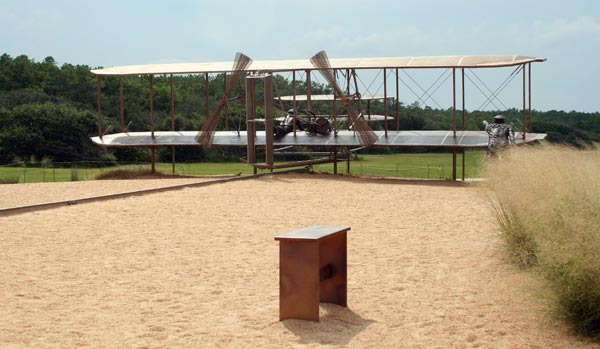
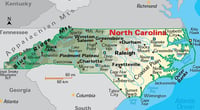
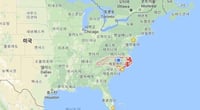
As you head east in North Carolina, you will come across the small town of Kitty Hawk, facing the Atlantic Ocean.
Although the name is a bit unusual, it looks like an ordinary beach town, but it holds a very special significance in history.
This is the place where the Wright brothers first flew in the sky. Now, the 'Wright Brothers National Memorial' stands here, making this quiet seaside town a pilgrimage site for aviation enthusiasts worldwide.
In the winter of 1903, Orville and Wilbur Wright, bicycle mechanics from Ohio, visited this place. They had long dreamed that "humans could fly like birds" and came here to make that dream a reality.
Among the many candidates for the first flight location in the United States, why was it specifically Kitty Hawk?
The reason was simple. The winds were strong, the land was vast, and there weren't many people around. Moreover, the surrounding sand dunes made crashes less dangerous.
The two brothers succeeded in the first powered flight of humanity on December 17, 1903, after hundreds of attempts on the sand dunes of Kill Devil Hills. The flight lasted only 12 seconds and covered a distance of just 37 meters, but at that moment, humanity became a being with the sky.
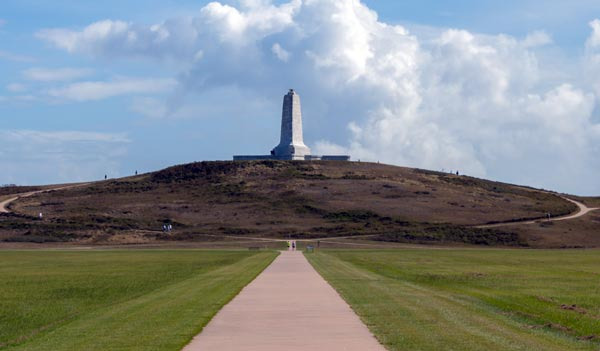
The current Wright Brothers National Memorial was built at that historic site. The memorial is divided into two parts.
One is a museum that showcases the brothers' experimental process, and the other is a massive monument built on the hill. The exhibition hall features a life-sized replica of the Wright Flyer, along with original blueprints, experimental records, and the brothers' old tools.
You can even see the devices used to measure the wind and the photography equipment. Once you enter the exhibition hall, you can truly feel how persistent the human desire to fly was.
As you climb the hill, you will see a large gray monument. Built in 1932, this tower is made of marble, and at the top, the words 'Faith, Courage, and Ingenuity' are inscribed. From a distance, it looks like wings cutting through the wind. Looking out to the sea from the hill, the exact direction the brothers flew that day is marked.
On the ground, stones are lined up indicating the distances and locations of the first, second, third, and fourth flights, allowing visitors to walk the distances and experience the records of that day.
You might feel that 37 meters is shorter than expected, but considering that it was the longest leap of human civilization, it is truly awe-inspiring.
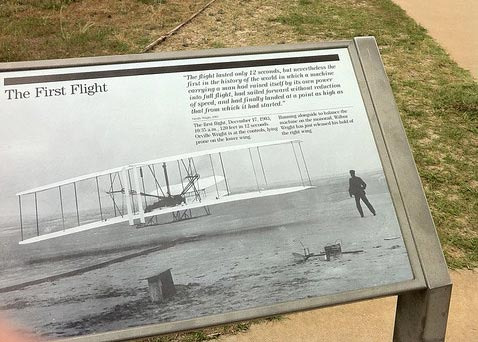
This place has almost no commercial facilities around, only endless winds, skies, and sand dunes remain.
Perhaps because of this, most visitors walk around quietly, lowering their voices as if they are taking a peaceful stroll.
Some people sit on the grass with notebooks, while others explain to their children, "This is where humans first took flight." Seeing such scenes makes you realize how symbolic this space is.
Every year on December 17, a commemorative event called 'First Flight Day' is held.
On this day, airline officials, Air Force pilots, and aviation enthusiasts from around the world gather to honor the Wright brothers.
The U.S. Air Force performs a flyover with helicopters, and students hold paper airplane flying competitions.






 NC Dreamer |
 Balan |
 Audio Mania World |

 secure |
  Tonky |
  viroma |
  cookie |
  Live and that's it |
  Alright Twain |
  eatontown blog |
  HAWAII Korean Church News |
  Amore |
  linex |
  Balancework |
  laro90 |
  MEDBIO American Doctor Blog |
  SWAT TEAM BLK |
  DREAM BIG |
  frostbite |
  330 Forever My Love |
  El Dorado |
  dralix58 |
  Gorama Round |
  Skydiving |