
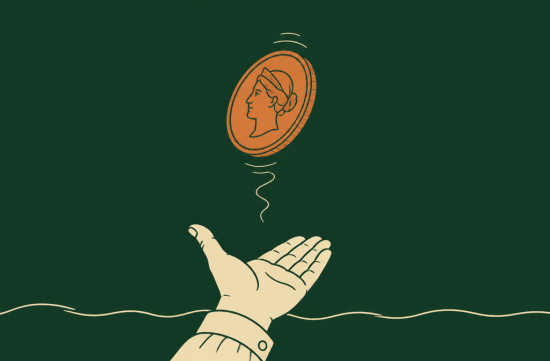
Whenever I have guests visiting Oregon, I always ask them if they know that the name of this city was decided by a single coin toss.
Most of them laugh. But this is not a joke; it's a real story documented in history. This city was almost named Boston instead of Portland.
Let's turn back the clock to the early 1840s. The area now known as downtown by the river was simply called The Clearing, literally a clearing in the woods.
It was a place where people would stop briefly while traveling between Oregon City and Fort Vancouver. It was essentially a nameless piece of land.
In 1843, two people took an interest in this clearing. William Overton, known as a broke drifter, and a lawyer from Boston named Asa Lovejoy.
The story goes that Overton didn't have the 25-cent land application fee, so he transferred half of the claim to Lovejoy. The two of them filed a claim for 640 acres with the provisional government at the time.
To think that a mere 25 cents led to the transfer of half the city was a bit disheartening when I first heard it. However, historians say this part of the story is almost legendary, so take it with a grain of salt.
Overton didn't hold on for long. After experiencing a flood in the Willamette River in 1844, he sold his share to a merchant from Maine, Francis Pettygrove, for goods worth $50.
Thus, the landowners became Lovejoy from Boston and Pettygrove from Portland, Maine. The problem started here.
Both wanted to name the new town after their hometowns. One wanted Boston, the other Portland. Neither was willing to back down.
So in 1845, they decided to settle the matter by tossing a coin. Best two out of three.
If Lovejoy won, it would be Boston; if Pettygrove won, it would be Portland. As we all know, Pettygrove won two out of three.
Since Pettygrove was from Portland, Maine, he essentially transplanted his hometown name to the West. That's why today we have both East Portland and West Portland in the U.S.
The location is known as Oregon City. Many historians believe the toss took place at the home of Francis Pettygrove, a Hudson's Bay Company trader.
However, there are no definitive records from that time, so some say it was at another judge's house. I find this ambiguity adds a human touch to the story.
The coin still exists today. It's a one-cent copper coin minted in 1835, and people refer to it as the Portland Penny.
The details of how the coin has been preserved vary across sources. What's certain is that it is currently displayed at the Oregon Historical Society Museum in downtown South Park Blocks.
The town named Portland grew rapidly afterward and officially became a city in 1851, just six years after the coin toss.
Every time I hear this story, I think about how random names can be. If the coin had landed the other way, we might have been explaining the difference between East Boston and West Boston.
But to be honest, the part of this story that sticks with me the most is Overton being pushed out because he didn't have 25 cents.
History remembers the names of the winners. While there are streets named Lovejoy, Pettygrove, and Overton in the Northwest, the story of Overton and the original Native inhabitants of the riverbank has been largely forgotten.
I find that a bit uncomfortable. It's fine to enjoy the coin toss story, but I wish we could also remember that the land was not empty from the start.
Now, let's get practical. If you want to see this coin for yourself, you should start at the Oregon Historical Society Museum.
The museum is right across from the Portland Art Museum, making it easy to visit both in one day. Since hours and admission fees can change, be sure to check their website before you go.
If you have more time, I recommend driving down to Oregon City. The Amattinger House has been restored and reopened as a museum.
It's also interesting to note that the house was moved from its original location. Just imagining the two men tossing a coin in the living room is worth the trip.
If you're going with kids, give them a coin to toss before you leave and have a best two out of three to decide lunch. That way, the history lesson will stick with them much longer.
If it were me, I'd plan to visit the downtown museum in the morning and then head to Oregon City in the afternoon. It's like taking a tour of a city that started with a single coin.
The next time someone asks why Portland is called Portland, you can confidently tell them it's thanks to a lucky person from Maine, and there was also someone who didn't have 25 cents.
 CloudLink



 Twist Kim |

 U.S. Weather Bureau News |

 Community Cross |

 Conflite Teacher |

 SEVEN SEVEN |

 Sunset Oregon |

 nuttypup |

 Time Management Enthusiast |

 Oregon Our Neighborhood Story |
 copanda |
 frostpup |
 chocopup |
 Angeles Choi |
 My Heart Popper |
 comova |
 vintago |
 Sky Way |
 Top Beaches |
 folyfoly |
 ground |
 averagestudent |
 hot chocolate |
 SODA MAKER |
 james kim |
 All About Cars |
 lomira98 |
 calmbridge |
 oneonly |
 Brighto |
 racuse |