
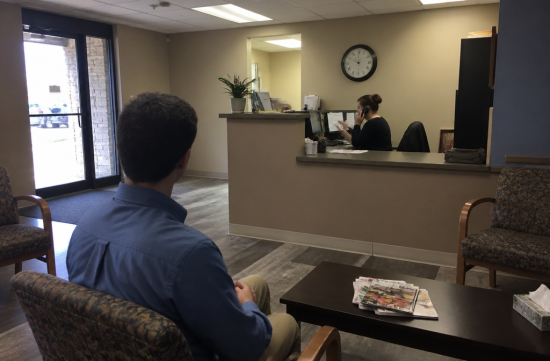
What if scores are already being given in the lobby before you even open the interview room door?
We often hear stories of candidates who sit in the waiting area, staring at their phones or gruffly greeting the front desk staff, only to smoothly answer questions in front of the interviewers. But if the hiring manager of that company checks in with the front desk staff first after the interview, the story changes.
This practice has long been referred to as the "waiter rule" in the U.S. hiring industry.
In 2006, USA Today reporter Del Jones interviewed several CEOs, and many shared similar insights. They said that how a person treats restaurant staff reveals their true character more accurately than how they treat their superiors.
Everyone shows politeness in front of their bosses, but their attitude can easily crumble in front of someone they perceive as unhelpful.
Ron Shaich, the former CEO of Panera Bread, reportedly took candidates to lunch and later asked his assistant how the candidate treated him.
When this principle enters the office, it becomes known as the "receptionist rule." Some candidates may be exceedingly polite in front of interviewers but fail to make eye contact with the lobby desk staff.
How early they arrive, their expressions while waiting, and whether they greet the staff first are often communicated directly to the hiring team.
Some companies even create simple checklists for front desk staff, placing those notes on the hiring manager's desk after the interview.
This might feel somewhat unfair since it's not explicitly listed as an evaluation criterion. Still, I believe it serves as a useful tool.
While everyone tries to present their best selves under the pressure of an interview, their usual habits tend to show in the more relaxed atmosphere of the lobby or hallway.
In fact, a survey published by Harvard Business Review in 2024 found that 63 percent of hiring managers identified a candidate's dishonesty as the biggest red flag.
In the same survey, 77 percent of executives said they were likely to exclude a candidate from consideration if they checked their phone during the interview.
Ultimately, what companies are looking at is not how many answers you get right, but your basic attitude toward people.
Understanding this trend means that your interview preparation should change a bit. In addition to choosing a suit and memorizing answers to expected questions, you need to practice showing the same courtesy to everyone you meet from the moment you enter the building until you leave.
Whether it's the parking attendant or an employee you encounter in the elevator, no one can guarantee where that moment's attitude will lead.
Even while organizing documents in the waiting area, a simple smile when making eye contact can have a surprisingly significant impact.
This isn't just applicable to interviews with corporate executives. In local hospitals or small offices, the front desk staff often interacts with patients and visitors the longest, so directors or managers frequently consider their opinions.
On the flip side, there are concerns that this practice could unfairly disadvantage certain candidates. Someone who is particularly nervous in front of strangers or who is not feeling well that day might be misjudged based on a brief moment in the lobby.
Therefore, more cautious companies often state that they use impressions from the front desk staff as just one piece of information and do not base their decisions solely on that.
If it were me, I would choose to put my phone away in my bag on interview day and make eye contact and greet everyone I meet. After all, I've learned that the person I need to impress that day isn't just the interviewer.

 mapsina |
 Mr. Largo |
 Victory 1988 |
 Infinite Style |
 novapixel |
 mintlogic |

 U.S. Weather Bureau News |


 Entip |
  Yavrix 92 |
  cherry cherry |
  moonlight |
  Coastal city |
  There Are Such Things in the World |
  Mazinger Z Rocket Punch |
  celtics |
  shinee cho |
  Kondae Garusong Blog |
  quiet river |
  alamo |
  Lol Life |
  Waiting for Godot |
  parlon |
  Say Yes in English |
  Sayonara H |
  rigid |
  Ohio Ohayoung Hello |
  U.S. Military Recruitment Information |