
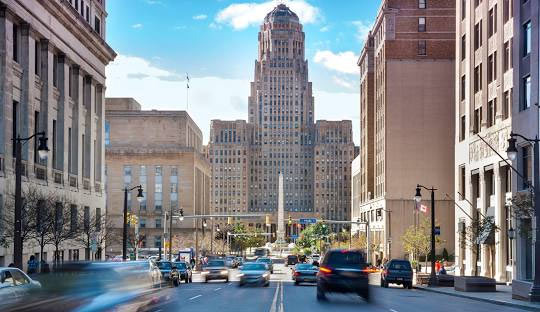
Buffalo, New York is a city located in the northern United States and is the second largest city in New York State. This city has played a significant role, especially as an industrial center during the Industrial Revolution. Here is some key information about Buffalo:
History
Buffalo began to develop significantly in the early 18th century when Europeans arrived. In the early 1800s, the construction of the Erie Canal connecting New York State and Ohio established it as a hub for transportation and logistics. This canal promoted Buffalo's commercial development, and the city's population grew rapidly. By the early 1900s, with the flourishing steel and machinery industries, Buffalo earned the reputation of being the 'Industrial Capital of the Midwest.'
However, since the mid-20th century, like other industrial regions in the United States, it has faced economic difficulties due to the decline of manufacturing. In recent years, efforts for economic recovery have continued with urban redevelopment and the introduction of new industries.
Population
Buffalo has a population of about 260,000, making it the second largest city in New York State after New York City. Traditionally, it is a city where various races and cultures mix, particularly with a significant immigrant population. The residential areas in this city range from middle-class to upper-class, and recently, there has been a trend of young professionals and college graduates flocking to the city for redevelopment.
Average Income
The average household income in Buffalo is about $50,000, which is slightly lower than the national average. However, there is a significant income gap within the city, with some areas recording quite high incomes. Additionally, due to its geographical proximity to New York City, Buffalo has a vibrant tourism industry, educational institutions, and healthcare facilities, contributing to steady economic growth.
Climate
Buffalo has a temperate climate and is known for its heavy snowfall in winter. Particularly, combined with winds from Lake Ontario, it experiences a snowfall phenomenon known as 'Lake Effect Snow,' often resulting in significant snowstorms during winter. Summers are mild, with average temperatures around 70-80°F (21-27°C), making it quite pleasant. Spring and fall can have mild temperatures and unpredictable weather, allowing residents to enjoy different charms in each season.
Unique Places in Buffalo
Niagara Falls: Located about 30 minutes by car from Buffalo, Niagara Falls is a world-famous natural attraction that draws millions of tourists each year.
Buffalo Zoo: Buffalo is home to one of the oldest zoos in the United States, which plays an important role in education and conservation.
Albright-Knox Art Gallery: This gallery, which houses both modern and classical art, is considered a cultural center of Buffalo.
Canalside: This area located in downtown Buffalo has been redeveloped in recent years and has become a popular destination with various facilities such as restaurants, cafes, and parks.
Buffalo has historically been an important industrial city and has gained new vitality in recent years through redevelopment. Thanks to its residents with diverse cultural backgrounds and beautiful nature and attractions, Buffalo can be said to have a different charm compared to other major cities. The city's growth potential is high, and more opportunities are expected to unfold in the future.








 Darnignac |
 Delicious Food Finder |


 Tennis City |
  Bushing Around Life |
  Active |
  Cherokee Rose |
  Kor. Master |
  Holey Moley |
  Conflite Teacher |
  Hodong Prince Over Flex |
  Mist inn |
  citrus pop |
  Onion Ring |
  phoenixia |
  viewtop |
  loverun |
  Kim Do Sun |
  SEVEN SEVEN |
  yentra |
  Make My Day |
  Victory 1988 |
  Tonky |
  viroma |