
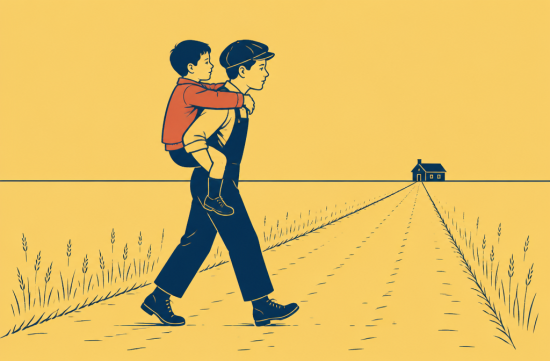
Have you heard the phrase "He ain't heavy, he's my brother"? Many might know it as a song title, but I was quite surprised to learn that this phrase is connected to a town in Nebraska.
The town is called Boys Town. It's located west of Omaha, and it all started with a priest who borrowed $90.
On December 12, 1917, Father Edward Flanagan, who was originally from Ireland, borrowed $90 from a man named Henry Monsky. With that money, he rented an old boarding house near 25th and Dodge streets in downtown Omaha.
The sign read Father Flanagan's Home for Boys, and it is said that there were five boys there at the beginning. Nowadays, even startups probably have more capital than that.
Flanagan was originally a priest who helped homeless men. He came to realize that many of the roots of homelessness often lie in childhood experiences.
His idea was to reach out to children before they became adults. This is what we now call upstream intervention. I became a fan of this approach right away.
At that time, it was common sense to send troubled boys to reform schools. Flanagan believed that this method was too punitive and stated that there are no bad boys.
He pointed to bad environments, poor training, and negative role models as the real issues. He meant that before blaming the child, we should consider the circumstances in which they grew up.
As the number of children grew, the house quickly became overcrowded. They moved out of the city to an empty building in South Omaha, and in 1921, they relocated again to Overlook Farm, which is ten miles west of Omaha.
This is where it gets really interesting. Instead of expanding an orphanage, they created a town run by the children themselves.
Schools and residences were established, and a self-governing body was formed where the children elected their own representatives. In 1926, the children voted to change the name of the farm to Boys Town.
Flanagan didn't like the name, but he accepted the outcome. By granting them the right to vote, he demonstrated that adults must also accept the results.
In 1936, it officially became a village in Nebraska. It became a real town with an elected government and its own post office.
The part that excites me the most is the issue of race. From the beginning, Boys Town accepted children regardless of race or religion.
During a time when segregation and discrimination were the norm, they welcomed Black and Jewish children, and reports from the United States Conference of Catholic Bishops indicate that they faced threats from the KKK. Children of different religions were allowed to pray according to their own traditions.
Records from Boys Town also mention an incident where, when Black students were barred from participating in a football game in Miami, Flanagan decided that they would not send athletic teams or school groups south of the Mason-Dixon line.
During World War II, they opposed the internment of Japanese Americans and provided housing for nearly 200 Japanese Americans at Boys Town. As someone of Asian descent living in America, I find this part particularly significant.
In 1938, MGM filmed the movie Boys Town on location. Spencer Tracy played Flanagan, and Mickey Rooney played one of the boys, with Tracy winning the Academy Award for Best Actor for this role.
Tracy's Oscar trophy was later donated to Boys Town and is said to be on display in the Hall of History.
The phrase I mentioned at the beginning originates from a photograph taken in 1921. A boy named Reuben Granger is seen carrying another boy named Howard Loomis, and this image later became the symbol of Two Brothers, establishing itself as a logo in 1943 along with the phrase.
There is also a connection to Korea. In 1947, Flanagan visited Japan and Korea at the invitation of MacArthur to advise on child welfare, and Boys Town records mention Seoul, Kaesong, and Busan.
The following year, he traveled to Austria and Germany, and on May 15, 1948, he passed away from a heart attack in Berlin. He remained active until the end.
Of course, the history is not without its criticisms. In 1972, a small newspaper in Omaha, the Omaha Sun, uncovered that Boys Town had amassed a large fund while continuing to solicit donations, leading to a Pulitzer Prize for the report the following year.
The owner of that newspaper was Warren Buffett. As a result of this incident, the person in charge at the time resigned. This event highlighted the need for oversight, especially for organizations that do good work.
Starting in 1974, they eliminated large dormitories and transitioned to a smaller Family Home model, closing the last dormitory at the end of 1975.
In 1979, they began accepting girls. The first five graduated in 1983, and in 1991, the first female mayor was elected. While the name remains the same, the organization has continually evolved.
On March 23 of this year, Pope Leo XIII recognized Flanagan's heroic virtues, advancing the process of canonization.
According to a statement from a Boys Town representative published in an EWTN article this year, there are currently 300 children living together, with nine locations. It is said that the program reaches 2 million children and families each year.
I find it disappointing that this story remains just a tale of the past. Today, foster care and juvenile justice often become budget battles. If it were up to me, I would advocate for increased public investment in these areas.
It might also be good to start looking for local foster care volunteer opportunities or mentoring programs. An initiative that began with $90 has lasted over a century, so there's no reason we can't do the same.
 Bright5








 Rice Shop Uncle BLOG |

 Noodle Noodle |

 Chino Min |

 Glow Yo |

 Michigan Enthusiast |

 NE Hodori Preik |

 Eagle in America for Five Years |

 selvon |

 Nebraska Center Director TOP |

 Amber H |
 The Good Life |
 garlic bread |
 Western US Medical Student Association |
 American Food Information & Calories |
 Big North |
 babybay |
 Ford Kim |
 honda civic |
 whimsical |
 nova nova |
 figtop |
 Yahoo LALA |
 Korea News Economic News |
 calvor |
 timistic |
 Lee Sang Don |
 victoria jung |
 The Long Shot |
 Univ Student |