
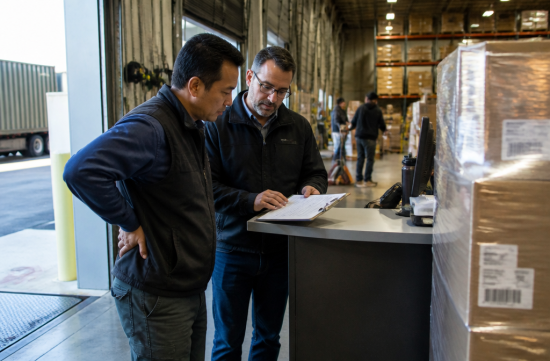
As November approaches, the atmosphere in warehouses and delivery sites changes. Boxes pile up, overtime notices are posted, and everyone tends to speak less.
Then, the moment you lift a heavy box, your back gives a jolt. Most people think, just get through today, tomorrow will be fine.
I would have been someone who would just stick on a pain patch and move on. However, after reading through California's workers' compensation regulations, I realized that that one day of silence can be the biggest loss.
First, it's important to note that there is no legal deadline of 72 hours. However, crucial procedures are clustered within a few days, so how you spend this time can make a difference.
Why am I bringing this up now? According to the Bureau of Labor Statistics (BLS), the injury and illness rate in transportation and warehousing for 2024 is 4.4 cases per 100 full-time workers.
I couldn't find the official percentage of injuries that occur at year-end. Still, I believe there are enough reasons to be cautious during this busy and urgent time.
In the first few hours, if it's an emergency, treatment comes first. The Division of Workers' Compensation (DWC) advises that in emergencies, you should go directly to the ER.
At this time, make sure to tell the medical staff that you were injured while working. Leaving out the phrase "work-related" can lead to complications later on.
Next, you need to inform your supervisor. The DWC advises that you should report it immediately, no matter how minor it seems.
If the company does not learn about the injury within 30 days, you may lose your right to benefits. Don't take the 30 days lightly. As time passes, it becomes harder to prove where the injury occurred.
I wouldn't just stop at verbal communication. I would write down the date, time, location, and the names of any colleagues who were nearby on my phone, and I would also send a text to my supervisor. While it's not legally required, it serves as a solid record later on.
Within a day, you should look for the DWC-1 claim form. The company must provide this document within one working day after learning about the injury, either in person or by mail.
If they don't provide it, don't wait. You can download it directly from the DWC website or call the information line at 1-800-736-7401 for assistance.
Fill out only the employee section, sign it, keep a copy, and return it to the company right away. If you send it by mail, it's best to use certified mail that provides delivery confirmation.
The DWC warns that failing to return this document can jeopardize your right to benefits. It's easy to mistakenly think that just verbally informing the company is enough.
Once the paperwork is submitted, treatment will begin. The company must approve treatment within one working day of receiving the form.
Until the claim is approved or denied, you can receive treatment at the company's expense, up to $10,000. This means there's no reason to delay going to the hospital.
You may have limited options when choosing a doctor. If the company uses a designated medical network (MPN), your first appointment must be with a doctor within that network, but you can switch to another doctor from the list afterward.
If you want to see your primary care physician, you need to designate them in writing before the injury occurs. There are conditions attached. If you're reading this and are still healthy, ask your HR department this week.
Now, let's talk about money. If a doctor says you can't perform your regular duties for more than three days or if you were hospitalized overnight, and the company does not provide you with another job at the same pay, you may be eligible for temporary disability (TD) benefits.
The amount is typically two-thirds of your pre-tax wages. For injuries occurring in 2026, the maximum weekly amount is $1,764.11, and the minimum is $264.61.
This money is not subject to income tax. If seasonal jobs or overtime are mixed in, the calculations can get complicated, so if the amount you receive seems off, it's appropriate to ask for a breakdown.
The first payment is generally due within 14 days after the company learns about the injury and the doctor's opinion, and thereafter, payments are made every two weeks. If the insurance company is investigating, it may be delayed, and in that case, you should send a letter explaining the reason for the delay.
The decision can take up to 90 days. If they do not deny it within that time, it is presumed to be compensable. If you find yourself in a bind with no money in between, you might consider applying for state disability insurance (SDI).
One thing to clarify is that serious incidents like hospitalization, amputations, or fatalities must be reported to Cal/OSHA by the company within 8 hours. This is the company's obligation, and you need to manage your claim separately.
Many people worry that reporting will lead to termination. Labor Code 132a makes it illegal to punish or fire someone for filing or intending to file a claim.
The same goes for quota pressures. AB 701 prevents large warehouses from disciplining employees for not meeting quotas due to restroom use or safety compliance. This applies to businesses with 100 or more employees at one location or 1,000 or more statewide.
If you don't know where the company's insurance is, you can find it at caworkcompcoverage.com. If you are not covered or if your coverage has expired, you should contact the Division of Labor Standards Enforcement (DLSE).
In summary, the steps are straightforward: get treatment, report it that day, document everything, submit the forms, and keep copies.
I understand that discussing your back issues in the busy end-of-year environment can feel awkward. However, my belief is clear: the real trouble comes from hiding an injury rather than speaking up and risking further harm.
 GottaRunHani







 Bald Eagle Brothers |

 sunny side |

 kodak |

 Valley Hong |

 Casa Mia |

 productionblog |
 Valley Bang |

 fernando park |

 U.S. Military Recruitment Information |

 Western US Medical Student Association |
 American Food Information & Calories |
 Big North |
 babybay |
 Ford Kim |
 honda civic |
 whimsical |
 nova nova |
 figtop |
 Yahoo LALA |
 Korea News Economic News |
 calvor |
 timistic |
 Lee Sang Don |
 victoria jung |
 The Long Shot |
 Univ Student |
 Tora Tora |
 pandaworld |