
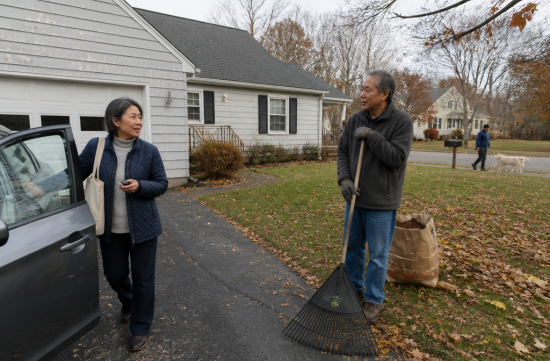
At ten in the morning, just as I'm trying to enjoy a cup of coffee, I hear, "What are we having for lunch?" It hasn't been long since I finished the breakfast dishes.
When retired housewives gather, the first topic that comes up is this: after spending a lifetime seeing each other only in the evenings, having someone around the house all day leads to more clashes, not because of dislike, but simply due to constant proximity.
The term "삼식" (samsik), which jokingly refers to a husband who eats three meals at home, sticks with me even after living in America for a long time. It means a husband who has all three meals at home. I find this term amusing yet somewhat unsettling.
However, it's not true that all couples' relationships deteriorate after retirement. In fact, the numbers suggest the opposite.
According to a study by Age Wave and Merrill Lynch featured in Kiplinger, 48% of respondents reported that their marriage improved after retirement. Only 11% said they argued more.
What caught my attention even more was another statistic. Two out of three retirees with a spouse or partner reported that they had never discussed or agreed on how to spend their leisure time together.
I believe this is the crux of the issue. Even after living together for decades, they have never decided how to share their 24 hours in a day.
A study from Cornell University echoes this sentiment. Published in the 2001 issue of Social Psychology Quarterly, it surveyed 534 married men and women aged 50 to 74 in northern New York State.
Recently retired individuals reported more conflicts than those who were either still working or had been retired for over two years. Couples who had both settled into retirement reported the highest satisfaction and the least conflict.
Phyllis Moen, a professor involved in the study, explains that the transition into retirement is the most challenging phase for a marriage. While this is based on older data from a specific region and cannot be generalized, it offers some comfort to those currently struggling.
Particularly, it was noted that when the husband retires but the wife continues to work, marital satisfaction tends to drop significantly. I nodded in agreement upon reading this.
Wait! There's no need to be alarmed by the rising number of gray divorces. According to a report citing research from Bowling Green State University, the divorce rate for those aged 65 and older has tripled since 1990, from 1.8 per 1,000 to 5.5.
Data from the same university indicates that nearly 10% of divorces in the U.S. involve individuals aged 65 and older. However, the researchers attribute this trend to factors such as the high divorce risk among remarried couples, women's economic independence, and increased life expectancy. So, don't misunderstand that being together all day leads to divorce.
Therefore, I recommend establishing household rules rather than making grand resolutions. Here are five rules to consider.
First, mornings are for individual activities. This method, mentioned in the Kiplinger article, involves each person taking care of their errands and exercise in the morning and returning home at a set time, just like when they were working.
Even when at home, getting up in the morning, washing up, changing clothes, and putting on lipstick serves the same purpose. It may seem trivial, but it creates a routine similar to going to work.
Second, lunch is handled separately. Having breakfast and dinner together is sufficient. Let each other know what's in the fridge, and it's up to each person to find their own meal.
Third, household chores should be divided rather than just assisted with. According to the 2013 time use survey by the U.S. Bureau of Labor Statistics, men aged 65 to 74 spent an average of 2 hours on household activities, which is different from younger men who spent less than 2 hours. I interpret this to mean that men will pitch in when they have the time.
However, once a task is assigned, interference is off-limits. Whether it's yard work, trash, or grocery shopping, the rule is to keep quiet even if the assigned task isn't done to your liking. This is the hardest rule to follow.
Fourth, set aside one day a week for individual outings. If you're in Connecticut, check out the West Hartford Senior Center. Residents aged 55 and older can become members for free, while others pay $40 a year.
As a member, you can access both Elmwood and Bishops Corner, which are open from 9 AM to 4:30 PM on weekdays. They offer art, exercise, and lecture programs, making it perfect for couples to choose different classes. Be sure to check the schedule on the city's website before signing up, as it changes.
Fifth, hold a 20-minute meeting once a week. Discuss the week's schedule, medical appointments, and any financial matters. Complaints should be limited to just one per meeting.
If you're feeling overwhelmed at the start, try the method mentioned in the Kiplinger article. Each partner writes down their ordinary day after retirement separately and then reads each other's notes. You'll be surprised at how differently you each envision your day, including what time you wake up and what you do with whom.
It's not that longer separate times are better. The same article notes that while separate trips are fine, being apart for too long can strain the relationship. It's good to take an evening walk together once in a while.
Issues like financial matters, retirement timing, and long-standing conflicts may not be resolved by rules alone. Since every household is different, it's advisable to consult a financial expert or couples counselor.
Our generation, raised in Korea, learned that couples should stay together to maintain a good relationship. However, after coming to America, I found that it's not unusual for each person to meet friends and pursue individual hobbies. I believe that the American approach is better after retirement.
I think a happy couple is not one that spends all day together, but one that has things to talk about when they meet again in the evening. Why not bring up one lunch rule tonight?
 FunElkNight







 American Politician Community |

 memorabilia |

 orvian89 |

 looksee 78 |

 vivavida |

 DJ DC BLOG |

 Buckwheat Muktudari Notebook |

 U.S. Weather Bureau News |

 Jin Soo V |

 New Song Sang |
 Ford Kim |
 honda civic |
 whimsical |
 nova nova |
 figtop |
 Yahoo LALA |
 Korea News Economic News |
 calvor |
 timistic |
 Lee Sang Don |
 victoria jung |
 The Long Shot |
 Univ Student |
 Bald Eagle Brothers |
 Tora Tora |
 pandaworld |
 lumix88 |
 choi family |
 Lansinger |
 Giant Squid and Sweet Potato Soup |