
One of the most confusing aspects for newcomers to Philadelphia is its administrative structure. While most U.S. cities operate with separate "City" and "County" governments, Philadelphia is a bit different.
Philadelphia is both a city and a county at the same time. In other words, the boundaries of the City of Philadelphia and Philadelphia County are exactly the same. This form is referred to as a 'Consolidated City-County' in the U.S., and Philadelphia is the only example of this in Pennsylvania.
This structure was established with the implementation of the 'Act of Consolidation' in 1854. At that time, several small municipalities and townships were merged to create what is now Philadelphia.
As a result, there is no separate county government in Philadelphia. Generally, in other areas, city halls and county courthouses operate separately, but in Philadelphia, the city government handles all county functions as well.
For example, county functions such as election management, court operations, district attorney's office, and sheriff's office are all managed by the Philadelphia city government. While this simplifies administrative procedures, it also means that the city government has a significantly larger role to play.
In contrast, surrounding areas have a different structure. Montgomery County, Delaware County, Bucks County, and Chester County each have independent county governments, with several Boroughs and Townships operating within them. Therefore, Philadelphia's administrative structure is quite unique compared to nearby cities.
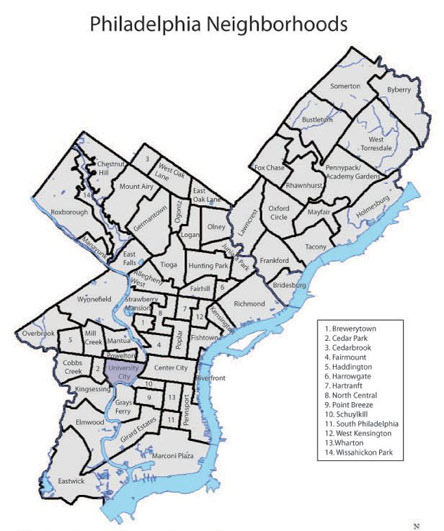
The area of Philadelphia is approximately 142 square miles (about 368 km²). The city is broadly divided into 10 planning districts. Notable ones include Center City, North Philadelphia, South Philadelphia, West Philadelphia, and Northeast Philadelphia.
However, residents tend to use neighborhood names more than the planning district names. There are over 100 well-known neighborhoods, such as Old City, Fishtown, University City, Chinatown, and Rittenhouse Square.
The electoral districts are also unique. Philadelphia is divided into 66 Wards, each of which is further subdivided into multiple Divisions. The city council consists of 7 district council members and 10 at-large members.
Politically, it is one of the strongholds of the Democratic Party in the U.S. The city is known for consistently high vote percentages for Democratic candidates in presidential and gubernatorial elections.
With a population of about 1.5 million, it is the fifth or sixth largest city in the U.S. It is also a representative multicultural city where various races, including White, Black, Hispanic, and Asian, live together. The Asian population, including Koreans, has been steadily increasing, especially in the Philadelphia metropolitan area, where many Koreans reside.
Living in Philadelphia, you will often find yourself using the city hall website. Most administrative tasks, such as applying for permits, paying taxes, reporting trash collection issues, accessing 311 services, and registering for elections, can be conveniently handled online.
If you are moving to Philadelphia for the first time, just remember this one fact: "In Philadelphia, the city hall also serves as the county government." Unlike other cities, the administrative offices are integrated into one, so most public services can be resolved through the Philadelphia city government.
 SilverTrail87
 blueforest1974







 Helpful Life Stories |
 prixon74 |
 Balancework |
 Make My Day |
 viroma |
 sparkling |

 Northeastern |
  Pennsylvania Information News |
 Nationally Certified Lightning Charcoal Review |
 DelphiaMo |
  Texas Migration Story |
  Scade Studio |
  love ya |
  biscuit90 |
  chicpo |
  Kitchen Ideas |
  Diana Blues |
  Agenda Center |
  Community Cross |
  journey |
  heeve |
  leman |
  corner kick |
  treasure |
  strawberry |
  Augusta Univ |
  B.I.G. Victor |
  Victory 1988 |