


It seems my American friend developed some misconceptions about Korea after watching the Netflix show on true education.
"Why aren't those young thugs being arrested?" "Where did the school police go?" "Why can't the teacher control a single student?"
The last question was the most striking. "So, is it legal for that special forces guy to hit kids?"
We laughed it off, saying it was all fictional, but it left a bitter aftertaste.
What we see as refreshing scenes in webtoons or Netflix dramas appear to Americans as a state of anarchy.
The most troubling aspect is the juvenile delinquent law. Those under 14 cannot be criminally prosecuted. Discussions to lower the age have been ongoing for years, but nothing has changed.In the U.S., even if laws vary by state, serious crimes can lead to minors being tried as adults.
Regardless of right or wrong, the scene where the perpetrator laughs and says, "I'm a juvenile delinquent, you know?" is seen by foreigners not as a loophole in the system, but as a failure of the national security system.
It's even harder to explain the situation with teachers. After the 2023 Seo Yi Elementary incident, a law to protect teachers was passed, but before that, teachers faced the risk of being reported for child abuse if they tried to intervene with students.It's not an exaggeration to say that the teachers in webtoons are just watching the situation unfold.
As the story progresses, the scale of the issue expands. Behind the bullies are organizations, and it involves illegal filming and prostitution. This paints a picture of school violence not as childish fights, but as the lower end of a criminal industry.
However, if someone unfamiliar with Korea takes this as a documentary, they might think, "Korean high schools are gang initiation camps." That's what a colleague of mine actually asked.
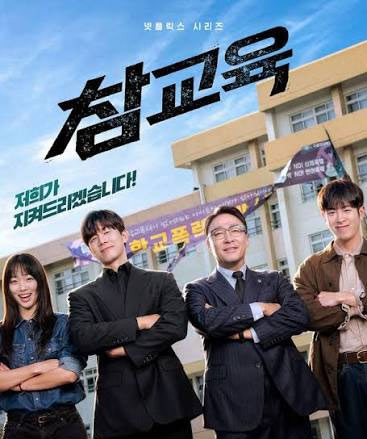
This is the real issue. In this work, the ones solving the problems are not the police, the courts, or the schools.
It's the martial arts skills and overwhelming force of a dispatched special forces member.
Vigilante groups exist in the U.S. too. Batman, The Punisher. The difference is in the name. We call it 'true education.' Not violence, but education. This indicates a significant loss of faith in the system.
That doesn't mean Korea is a disaster. The numbers tell a different story. The murder rate per capita is several times higher in the U.S. than in Korea, and gun incidents are incomparable. In Korea, it's safe for a woman to go to a convenience store alone at midnight. Here, it's not possible.I acknowledge the counterarguments. The evidence that harsh punishment for juvenile offenders reduces recidivism is weaker than one might think.
I don't believe in the infallibility of strict punishment. There's merit to the argument that lowering the age for juvenile offenders will only be a symbolic gesture.
The work itself doesn't hide the fact that it's a fantasy. Who would view a scene where a female detective throws a man twice her size as a documentary?
The problem lies in the setting. Even if the action is exaggerated, the juvenile delinquent and the powerless teacher are real. And the painful truth is that this belief is largely correct.
I support a small government. However, if there's one area the government must never withdraw from, it's public safety and law enforcement.When that minimum standard is shaken, people turn to a special forces veteran instead of the state.
The appeal of 'true education' is not just because the work is well-crafted. It's also because reality is that frustrating.
What we should be ashamed of in front of foreigners is not this webtoon, but the side that makes this webtoon feel refreshing.
 AnglerTales
 VelvetForest93
 GreatTown







 There Are Such Things in the World |
 Seattle - Emerald City |
 Next Year, Let's Become Rich |
 Strawberry Candy Smoothie |
 Happy Together 213 |
 Investment Campus Home Ownership |

 Sunny's Travel in America |
 California Dreamer |
  Conflite Teacher |
  summita |
  Ari Songhan American Immigration Life |
  marketbox |
  yentra |
  Iowa Egen Aunt |
  donut33 |
  gravity |
  American Golf Course Travelogue |
  Agenda Center |
  digital |
  timemachine |
  Starry Eyes |
  Desert King |
  Texas Real Estate Blog |
  U.S. Retirement Pension Information |
  Texas Migration Story |