
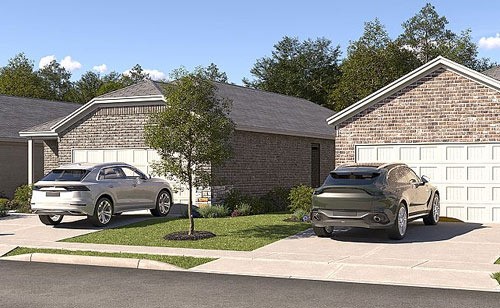
A person who has managed several rental properties in other states shared their investment experiences in San Antonio and said this.
"Isn't buying a house in Texas and renting it out the same thing?"
In a broad sense, that's correct.
You buy a house, get tenants, and collect rent.
However, when you actually get into the details, the rules of the game can change quite a bit when the state changes.
There are cases where you bring over the methods you used in another state and later have to recalculate.
First, let's look at the current rental market in San Antonio.
According to RentCafe's 2026 report, the average rent is about $1,264, which is a 2.65% decrease from a year ago.
A one-bedroom apartment is about $1,087, and a two-bedroom is around $1,384.
There's something important to note here.
You shouldn't calculate thinking that rents will keep rising when you buy a house.
For example, if you buy a house that currently rents for $1,400 and think, "Next year it will be $1,500, and in a few years it will be $1,700," you could start off with incorrect numbers.
During times like now, when rents are decreasing, it's more comfortable to calculate based on the current rent you can receive.
You also need to understand the characteristics of Texas.
If you've rented in places like California, you might think about rent control, but Texas does not allow typical local government rent control.
This means that in San Antonio, there isn't a structure that says, "This year, rents can't increase by more than a certain percentage."
However, that doesn't mean landlords can do whatever they want.
Lease agreements must be honored, and Texas rental laws regarding security deposits, repair obligations, and eviction procedures must be followed.
You also need to pay attention to property taxes.
Texas has no state income tax, which is appealing to newcomers.
"Taxes are much cheaper than in California."
But once you buy a house, you might be surprised by the property taxes.
The average effective property tax rate in Texas is in the mid to high 1% range, and in San Antonio, taxes can increase due to the combination of county, city, and school district taxes.
Moreover, investment properties do not qualify for the Homestead Exemption that applies to your primary residence.
So, you need to calculate property taxes generously for rental properties.
Loans are also different from those for primary residences.
When it comes to investment properties, banks tend to be a bit stricter.
They often require a down payment of 15-25%, and to get good terms, you need to have good credit.
Interest rates are generally higher for investment properties than for primary residences.
Expected rent is not fully recognized as income.
In loan assessments, it's common to use about 75% of the recognized rent.
So, you can't assume, "I'll receive $2,000 in rent, so that will all count as my income."
After buying a house, expenses keep coming in.
If you hire a management company, they often take about 8-12% of the rent.
Air conditioning can break down. The roof may need repairs. When tenants move out, you'll need to repaint.
Especially in the summer in San Antonio, if the air conditioning breaks down, it's not a matter of the landlord saying, "I'll fix it next month."
So, I believe you shouldn't just look at how much rent is coming in.
For example, even if a $250,000 house generates $1,500 in rent, you need to deduct property taxes, insurance, management fees, repair costs, and vacancies.
The remaining net operating income divided by the house price gives you the Cap Rate.
This number looks much more realistic when compared to properties in other cities.
San Antonio definitely has its advantages.
There are significant military facilities and a healthcare industry. It's not a city where rental demand relies solely on one specific company.
In areas with good school districts, you can expect demand from families. However, you should be cautious about buying a house based solely on one school.
It's advisable to verify school district boundaries and assigned schools using the actual address.
And if you plan to sell your investment property later and switch to another property, it's worth knowing about the 1031 Exchange.
If you meet the conditions properly, you can defer taxes on capital gains and move on to the next investment property.
Ultimately, if you ask whether San Antonio is an easy city to invest in, I think this way.
Just because home prices are cheaper than in LA doesn't mean investing is easy.
You need to look at how much rent is, deduct property taxes, insurance, management fees, repair costs, and finally calculate the mortgage.
And don't assume that just because you've invested in other states, Texas will be the same.
Houses may look similar, but when the state changes, taxes, rental laws, and loan calculations all differ.
 mintcoastbuilder1963
 SmileKing








 |
| 
 Premium Gas Camp |
 CA Real Estate |
 cheesepup |
 breezem |
 TEXAS Fishing Boat |
 Helpful Life Stories |
 solvix18 |

 Texas Migration Story |
  honeypot |
  summer |
  adventure77 |
  flexible |
  Shintongbangtong Shin Naerin James Park |
  truepixel |
  Kathy's Blog |
  Hae Naem |
  quatspace |
  Marisol |
  Glassroom |
  Granola |
  joyfull yang |
  Olivia's Blog |
  Living in America and Writing Essays |
  Piano Teacher Blog |
  bearcup |
  explorer |
  dictionary |
  Mr Bull Jung |