
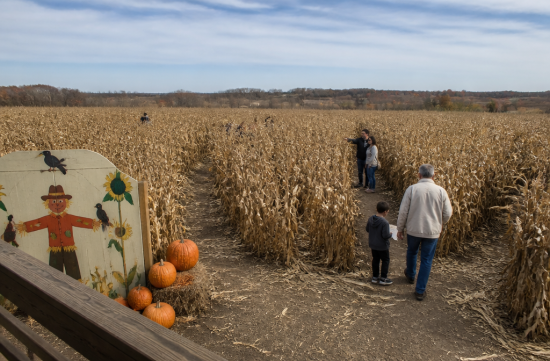
It seemed quite strange to me at first that getting lost in a cornfield in the fall became a paid activity.
These days, every weekend, signs for corn mazes pop up at the entrances of local farms. Next to piles of pumpkins, hay wagons are parked, and children dash into the yellow corn stalks, holding a map.
Watching that scene, I suddenly wondered when this became the face of autumn in America.
I had vaguely thought it was a rural tradition passed down since the pioneer days. But upon researching, I found out that it was not at all the case.
The corn maze we know first appeared in 1993. It's a much younger tradition than I expected.
The person who started it was not a farmer but someone from the show business. It was a director named Don Frantz, who was involved in planning stages for Broadway and Super Bowl halftime shows.
It is said that he got the idea while flying in an airplane and looking down at the endless cornfields. He must have thought about how it would be to carve a picture into that vast field.
He teamed up with a maze designer from England, Adrian Fisher. England has a long history of hedge mazes in its royal gardens, so he found the perfect partner. The idea of moving from stone and wood mazes to one made of a crop that grows for just one season was quite bold.
The two chose a field of just over 3 acres at a university in Pennsylvania. It was named The Amazing Maize Maze.
From above, the entire field was said to resemble a giant dinosaur. Its nickname was Cornelius the Cobasaurus, a pun that incorporates the word "cob," which refers to the corn ear.
The first maze did not rely on the sophisticated equipment we have today. They divided the area into a grid and manually pulled corn stalks to create paths, which must have been quite a laborious task. Just thinking about the people who walked the rows with a blueprint under the summer sun makes me bow my head in respect.
This living puzzle made it into the Guinness World Records and became a nationwide sensation. Attention from all over the United States turned to a rural cornfield. No one could have predicted that a field that would be cut down after one season would become such a big topic of conversation.
The person who spread the spark across the entire field was someone else. It was Brett Herbst, who lived in Utah.
After hearing about the Pennsylvania news, he rented land in 1996 to create his own maze. According to company records, 18,000 people visited in just three weeks.
This success led to the creation of the maze design company The MAiZE. It has now become the largest consulting company in the industry, supplying designs to farms across the United States and Canada every year.
Here's where I had an epiphany. The corn maze is not just a romantic idea; it is a survival strategy for farmers.
Farmers cannot set the price of grain. Even in a good harvest, if prices drop, there's nothing left in their hands.
However, if they create paths in the same field and charge an entrance fee, the story changes. They are not just selling corn; they are selling an experience of a fall day.
Americans call this agritourism. Pumpkin picking, hayrides, and apple cider donuts all come together as a package. When the maze attracts customers, the rest of the offerings open up their wallets.
This reminds me of my childhood fields. I recall running around between the rice bundles in the harvested fields playing hide and seek.
Back then, there was no entrance fee. The fields were simply ours, and when the sun set, the sound of my mother calling was our guide.
America has designed, named, and commercialized that simple play. At first, I thought it was a bit harsh, but upon reflection, I changed my mind.
If this is a method that farmers have found to protect their land, it deserves applause. I believe it is a much healthier solution than relying solely on government subsidies.
And after a generation, this new activity has donned the clothes of tradition. Children born in 1993 are now taking their own kids into the maze. This has happened in just over thirty years.
Isn't that what tradition is all about? Someone starts something, and if people return to it year after year, it becomes a tradition.
I plan to visit a nearby farm maze this fall. Getting lost in a place designed for getting lost is a luxury worth experiencing at my age.
If anyone is planning to go, I recommend checking the operating status and hours in advance. Each farm may have different circumstances each year, and some may close. It's better to enter while it's still light outside, as it's easy to lose your sense of direction when it gets dark.
If you pause for a moment in the middle of the maze, you will hear the sound of the wind blowing through the corn stalks. That sound must have been the same in 1993 and in the fields of my hometown.
 NightWriter


 Anova US Beauty Information |
 anchor |
 Korea Tiger News |
 Alpha and Omega World |
 Florida King |
 Park M.Y. |
 H Leader |
 Macon Boy |


 Going Once |
  honeypot |
  summer |
  adventure77 |
  flexible |
  Shintongbangtong Shin Naerin James Park |
  truepixel |
  Kathy's Blog |
  Hae Naem |
  quatspace |
  Marisol |
  Glassroom |
  Granola |
  joyfull yang |
  Olivia's Blog |
  Living in America and Writing Essays |
  Piano Teacher Blog |
  bearcup |
  explorer |
  dictionary |
  Mr Bull Jung |