
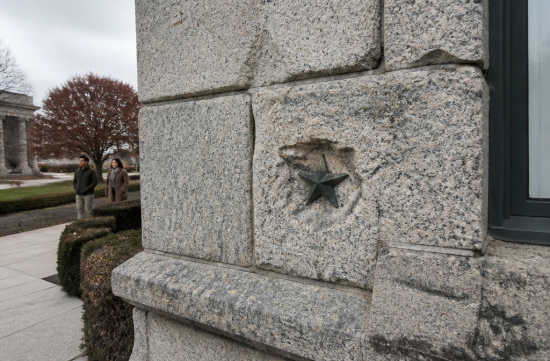
As you walk along the west wall of the statehouse, a small bronze star embedded in the gray granite catches your eye. Honestly, when I first saw it, I thought it was just an architectural decoration and passed by.
It turns out it wasn't just decoration; it was a coordinate. Each star marks the exact point where Union artillery struck the wall in February 1865.
To get straight to the point, there are six stars, and they were added by the state legislature in 1929, 64 years after the bombardment, not at the time of the attack.
This time gap is the crux of this article. The decision to mark the scars with stars and when that decision was made is a significant data point in itself. What to remember is always chosen by later generations.
Let's set the background. The current statehouse began construction in 1851, and its exterior was completed in 1907.
Some sources cite the start year as 1855 because the initial designer was dismissed due to construction issues, leading to significant portions being torn down and rebuilt.
So, the building in the winter of 1865 was not a finished product. It was essentially an incomplete construction site, lacking the dome we recognize today and primarily consisting of walls.
In February of that year, Union forces led by Sherman approached the capital. The artillery positioned itself on a hill across the Congaree River and fired at this building.
The purpose is clearly stated on the site's sign. It was calibration fire to establish the range to the city, with the statehouse serving as the reference point.
From an IT perspective, it's a kind of calibration. Having a large, prominent structure to use as a reference for distance is a natural choice.
The date of the bombardment varies slightly among sources. Historical markers and local historical societies state it was on February 16, while some educational materials list it as the 17th.
While it's only a one-day difference, it's best not to overlook such small discrepancies. Understanding that different sources have different standards helps reduce misunderstandings.
What's interesting comes next. On the night of February 17, a major fire swept through the city, destroying the old statehouse.
In contrast, the new statehouse, still under construction, survived with minimal damage. It was hit by shells but escaped the fire.
Now, let's analyze. Why were the stars added in 1929?
According to records, that year the state legislature also installed two brass plaques alongside the bronze stars on the statehouse, detailing the damage caused by the Union bombardment.
However, those plaques did not last long. They were removed in 1936 due to concerns about theft, and the following year, the text was engraved directly into the granite.
There's also a record that one star was replaced in 1938. Since then, there have been two major renovations, but the stars remain in place.
Specifically, this resembles a data preservation policy. Instead of overwriting damaged records, they marked the location and attached metadata.
However, that metadata carries a perspective. In my interpretation, marking this in the 1920s in the South goes beyond mere record-keeping; it emphasizes the narrative of having been struck by Union forces.
The statue of George Washington in front of the statehouse serves as a good comparison. The bottom of his cane is broken, and the adjacent plaque states that it was shattered by Union soldiers throwing bricks during the occupation.
The state government records also note that $40 was spent on the plaque. The method of leaving the scars intact while adding explanations is consistently applied to both the building and the statue. It's natural to view this as a record created by the same era and sentiment.
However, the student guide page from the legislature explains that the cane broke during the process of moving the statue. Even within the same state government, the stories diverge.
I found this point the most intriguing. The coexistence of two versions of the same event illustrates the nature of records. The six stars are a physically verifiable record, while the statue's plaque may contain mixed interpretations.
Therefore, I believe it's appropriate to view this building through layered perspectives. The event of 1865, the marking in 1929, and the way we interpret it today are each different layers.
In summary, the shell impacts are facts, while the timing and wording of the stars reflect the emotions of that era.
If we read them separately without mixing the two, this building becomes quite an honest record. By not erasing the scars, it leaves room for verification.
If you plan to visit, I recommend taking your time to walk around the west and southwest walls. Count how many stars you see and read the inscriptions in the granite; it feels quite different than just viewing the informational signs.
Personally, I believe marking is better than erasing. However, I think that to truly remember, we must also consider who placed the markers, when, and why.
 MySassyGirl


 moodansa 77 |

 Conflite Teacher |

 US Snowboard Information Exchange |

 There Are Such Things in the World |

 San Diego TOP Idol |

 See South Carolina |


 urbanmint |



 Yo Lock Me Up |
 Joyce 77 |
 ANSLO NEWS |
 maplebyte |
 Shining Our Own World |
 Raymond K. |
 gravity |
 714 Success Era Real Estate |
 Investment Beginner Company Information Encyclopedia |
 musicque |
 The Gelaton |
 ovelion |
 Chicagonian |
 Freedom Yea |
 AZ Road Master |
 glenix39 |
 Something is popping in the situation |
 orvella |
 vella |
 comets |