
A resident of Roland Heights received a rent increase notice and asked if the numbers are correct and if they can contest it. To summarize, the first thing to check is not the amount but rather "what regulations apply to my unit."
Roland Heights is not an independent city. It is an unincorporated area directly governed by LA County.
Therefore, the rent regulations of the City of LA do not apply; instead, the County's Rent Stabilization and Tenant Protection Ordinance, abbreviated as RSTPO, is in effect. The standards differ from neighboring cities like Diamond Bar and Walnut. If your address is in Roland Heights, the first step is to refer to the county regulations.
According to a notice from the County's Department of Consumer and Business Affairs (DCBA), the annual increase cap for general units from July 1, 2026, to June 30, 2027, is 1.919%.
The cap for the previous period was around 1.93%. Despite the rising cost of living, the cap itself has decreased slightly.
The formula is as follows: it uses 60% of the change in the Consumer Price Index for the 12 months up to September of the previous year, with a cap set at 3%.
There are two exceptions. Qualified small landlords can add 1 percentage point, allowing for an increase up to 2.919%.
Properties classified as luxury units can add 2 percentage points, allowing for an increase up to 3.919%. However, both must disclose this fact in the notice, and small landlords must submit their certification to the county annually.
So, does the 1.919% apply to all apartments? Not necessarily. This is where many people get confused.
The "fully covered units" that receive this cap must meet three conditions: they must be located in an unincorporated area of the county, the building must have two or more rental units, and the initial occupancy approval must be before February 1, 1995.
This means that apartments built after 1995 are outside this cap. Single-family homes and condos are generally excluded as well.
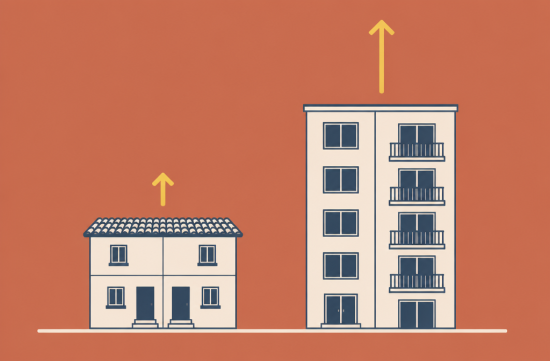
When comparing two homes side by side, it becomes clear. A duplex built in the 1980s is subject to the 1.919% cap.
In contrast, a newly constructed complex built in the 2000s must consider whether the state law AB 1482 applies instead of the county cap.
According to DCBA guidance, starting August 1, 2026, the AB 1482 cap for the LA metro area will be 8.7%. This is the basic 5% plus an inflation adjustment of 3.7%.
Even in the same neighborhood and with the same square footage, the age of the building can result in caps of 1.919% versus 8.7%. This difference is significant.
AB 1482 does not apply to every home. Buildings less than 15 years old or certain individually owned single-family homes may be exempt, so each condition needs to be checked individually. This information is well organized on the state Attorney General's office guidance page.
Checking is not difficult. You can view the unit registration status by address on the county rent registry.
The age of the building can be roughly estimated by looking at the year it was built on the county assessor's website. However, this may not match the exact occupancy approval date, so use it as a reference only.
If in doubt, contacting the DCBA Rent Stabilization Program directly is the quickest way to get answers. Bringing a copy of the notice will make the consultation much easier.
You should also consider the frequency of increases. Fully covered units can only increase once every 12 months.
For example, if the rent is $2,000 per month, the amount that can be increased based on the 1.919% cap is $38.38. If the notice states $50, it would be reasonable to ask for justification.
Also, check for any pass-through of registration fees. Fully covered units can pass on a maximum of 50% of the annual registration fee to tenants, divided over 12 months, but late fees for unregistered units cannot be passed on.
From the landlord's perspective, the calculation is reversed. If they notify an increase exceeding 1.919%, they risk violating the ordinance, and tenants can contest this with the county.
To use the small landlord add-on, the certification submission and notice wording must come first. Writing 2.919% without documentation can lead to disputes.
From an investment perspective, this difference is reflected in property values. Multifamily buildings built before 1995 have limited rental income growth, so it's essential to calculate the current rent versus market price before purchasing.
Newly constructed complexes, on the other hand, have more flexibility to adjust rents according to market rates. While the yield may be better, they require more attention to tenant turnover and vacancy management.
For tenants, the stability of older buildings is an advantage. Predictable monthly rent is particularly beneficial for families planning to stay for several years due to school districts.
The conditions and exceptions of the ordinance are quite complex, and circumstances can vary by individual contract. If a significant amount is at stake, consulting with the county or a lawyer specializing in tenant or landlord issues is advisable.
If I were in your position, I would check three things as soon as I received the notice: when the building was constructed, whether it is registered, and whether the increase rate exceeds 1.919%.
Before getting upset over a single number, first confirm where your unit falls within these categories. That will be the starting point for the conversation.
 mintrivertraveler1965
 PizzaDrone




 Something is popping in the situation |
 lumix88 |

 quiet river |

 Doori Ark |

 My Town My Way Blog |

 Community Cross |
 People Moon |

 Finding Superfoods |

 Shining Our Own World |
 Raymond K. |
 gravity |
 714 Success Era Real Estate |
 Investment Beginner Company Information Encyclopedia |
 musicque |
 The Gelaton |
 ovelion |
 Chicagonian |
 Freedom Yea |
 AZ Road Master |
 glenix39 |
 orvella |
 vella |
 comets |
 Banana |
 Yes Dorian |
 Minnesota Sonata N |
 zentar |