
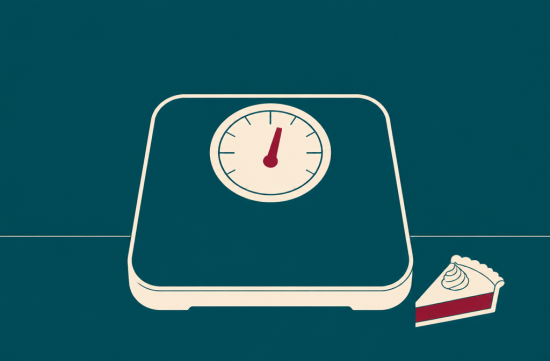
Every year around the second week of January, conversations like this come up: "I think I gained 5 pounds over the holidays." And the person saying this is usually holding a container of leftover cookies.
I'm no exception. Starting with Thanksgiving turkey, moving on to Christmas ribs, and then New Year's rice cake soup, my pants buttons quietly protest.
But I was curious. Is it really that easy to gain weight, and why does that weight not budge even when spring arrives? So this time, instead of just guessing, I looked for some data.
The most cited study is one published in the 2000 New England Journal of Medicine. Researchers from the National Institutes of Health (NIH) consistently measured the weight of 195 adults around the holidays.
To cut to the chase, the results are a bit disappointing. The average weight gain between Thanksgiving and New Year's Day was about 0.8 pounds. Less than 10% of participants gained more than 5 pounds.
Interestingly, participants overestimated their weight gain by more than 3 pounds. The "5 pounds" we feel we gain is largely a matter of perception.
Feeling relieved so far? But the real issue comes next.
The researchers called back 165 participants the following September and found that the weight gained over the holidays had not budged at all. On average, everyone was 1.4 pounds heavier than a year prior.
Dr. Yanovski, who led the study, concluded simply that weight gained during the winter holidays does not come off during the rest of the year. If this continues to accumulate year after year, it leads to middle-aged belly fat.
One pound may not seem like much, but over ten years, the math changes. It's frustrating that while savings don't accumulate, this weight does.
A similar study was briefly published in the same journal in 2016. Analyzing records from smart scales used by people in the U.S., Germany, and Japan, it found that Americans' weight increased by an average of about 0.4% around Christmas.
This study noted that about half of the weight gained during the holidays came off quickly, but the other half lingered until after summer. However, one of the co-authors later became embroiled in controversy over research misconduct, so take this with a grain of salt.
So what about the half that comes off quickly? The general explanation is that it's mostly water rather than actual fat.
When you eat a lot of carbohydrates, like rice cakes, japchae, and pies, your body stores the excess as glycogen, which pulls in water. If salty foods are involved, your body swells even more.
So there's no need to be too shocked by the number on the scale the morning after a party. If you eat normally for a few days, that part will take care of itself.
The problem lies with the remaining half. The NIH study identified two factors that influenced weight gain: activity level and hunger.
People who moved more or felt less hungry hardly gained weight, and some even lost weight. Conversely, those who moved less and felt hungry more often gained the most.
Additionally, those who were already overweight were more likely to gain more than 5 pounds. This means that the holiday season is particularly risky for those already concerned about belly fat.
Ultimately, the reason why that one pound doesn't come off isn't some mysterious metabolic curse. It's because the habits that changed during the holidays persist into January.
With the cold weather, walks decrease, leftover snacks pile up at home, and once increased meal portions are hard to reduce. Our bodies are honest; they only give back what we put in.
According to CDC data, people who lose weight slowly at a rate of 1 to 2 pounds per week are more likely to maintain that weight loss. Therefore, trying to starve yourself in January to lose weight quickly isn't a great strategy.
The same CDC data suggests that to lose about 1 pound a week, you should eat about 500 calories less or burn an additional 500 calories each day.
So, the 0.8 pounds gained over the holidays is actually a number that can be resolved in just a few days. There's no need to panic; it's just a number that shouldn't be postponed.
My strategy is this: enjoy the parties but keep one meal light the next day. I send leftover desserts home with guests.
The recommended amount of exercise for adults is about 150 minutes of moderate-intensity activity per week. My goal is to keep walking for 30 minutes after dinner, even in the cold, until January.
And I plan to keep the scale out even during the holidays. Not seeing the numbers may feel comforting, but the bill that comes in March is scarier.
No one can lose the weight for me, and the government isn't going to give me a belly fat subsidy. Ultimately, it's up to me to take care of my body.
However, if you have a chronic illness or are taking medication, or if you notice sudden significant weight changes, please consult a doctor or pharmacist instead of making judgments on your own.
This year, I've set just one goal: not to carry around the 0.8 pounds gained over the holidays until next September. Would you like to join me?
 Focus 1






 zestorbit |

 hihihi |

 fruitflash |

 Anjollinya Blog |

 United States Army |

 ZELLE when sending money |

 skykong |

 Village Man |

 Bushing Around Life |

 Frosty hill |
 San Diego TOP Idol |
 kerkee |
 HAWAII Korean Church News |
 stalion |
 Dala Dala |
 Noodle Noodle |
 Encyclopedia of New York and Surrounding Areas |
 bluebird |
 New York New York NYC |
 Finding Superfoods |
 Dr. Kelso |
 Valley Hong |
 Georgia Springcamp |
 myheart |
 Missouri Kings News Information |
 Going Once |
 monica hong |
 Tainami American Travel Story |
 tarve7 |
 Something is popping in the situation |