

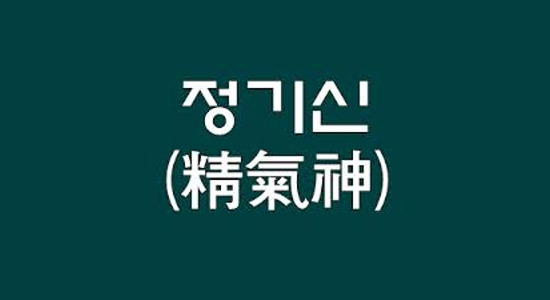
Having lived in the United States for over 30 years and now being over 60, I find myself reflecting on words I learned in my youth in Korea that I rarely thought about when I was younger.
One of those words is Jeonggisin. Jeonggisin is written in Hanja as 正氣神.
正 means correct or upright, implying a sense of balance and integrity, 氣 refers to the energy that moves a person's body and mind, representing vitality and life force. 神 refers to the spirit, indicating thoughts, judgments, and the state of the mind.
When these three characters are combined, it means the correct energy and clear spirit. Ancients believed that for a person to live healthily and rightly, both the body's energy and the mind's spirit must be aligned.
To be honest, who uses this word in everyday life? In the U.S., it is even less likely to be heard, and even the younger generation in Korea may not fully understand its meaning.
However, as I age and have lived as an immigrant for a long time, this term resonates with me in a peculiar way. Breaking down Jeonggisin into its Hanja components, it refers to uprightness, energy, and spirit, ultimately questioning whether a person's center is standing correctly.
When I was younger, I could endure with physical strength, push through with my temperament, and work all night while pretending to be fine the next day.
But now that I am 60, that is no longer possible. My body sends signals first, and my mind quickly becomes unsettled.
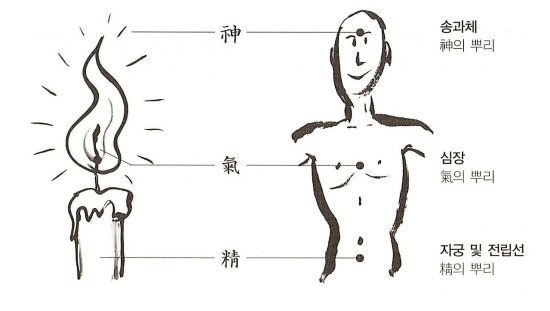
At times like this, I begin to understand why the ancients did not separate the body and mind.
When the body collapses, thoughts become scattered, and when thoughts waver, judgments go awry. When judgments go awry, I find myself reacting angrily to a careless comment or feeling upset over an email. I have been increasingly aware that this is the state of Jeonggisin being disrupted.
American society is fast-paced, values efficiency, and does not readily accommodate age. There is hardly any consideration just because one is a 60-year-old man. As a result, if one cannot maintain their own pace, it is easy to be swept away.
In the past, it was said that when a country was in turmoil, Jeonggisin was in ruins, and seeing the current state of America makes me ponder such thoughts alone. Just turning on the news reveals only sensational stories, and social media constantly stirs everyone's emotions.
In such times, I truly feel the need to stay mentally alert.
What people today refer to as meditation, routines, and self-management is ultimately just a rebranded form of managing Jeonggisin. Getting proper sleep, avoiding overeating, reducing alcohol, walking daily, and taking a moment to pause when emotions rise are all habits that establish Jeonggisin.
It is not some profound philosophy, nor does it come from reading another book. It is simply the strength to be less shaken in turbulent situations, the ability to filter responses instead of reacting immediately to others, and that is Jeonggisin.
As I age, I realize that what is important in life is not to have more, but to be less shaken.
Ultimately, I believe Jeonggisin is not a grand old saying but rather a central aspect of life that one comes to understand after experiencing several ups and downs as an immigrant.




 Khan Film Blog Production |
 dermoon |
 hoosierdaddy |
 sun walker |
 Let's Be Like a Salt-like City Person |
 Tomato Health Club blog |

 Open Flex Mind |
 Bushing Around Life |
 Finding Superfoods |
  lightyear |
  song bang |
  vexomo |
  Indiana Jones |
  meloncat |
  novapixel |
  mortrix |
  Esther 1983 |
  fortbliss |
  Moscow Kim |
  My Two Way |
  toastyfox |
  FLORIDA Acus |
  tracker |
  TONTON COFFEE |
  sunrise |
  ultron78 |
  uplifted |
  Folding Instructions |