
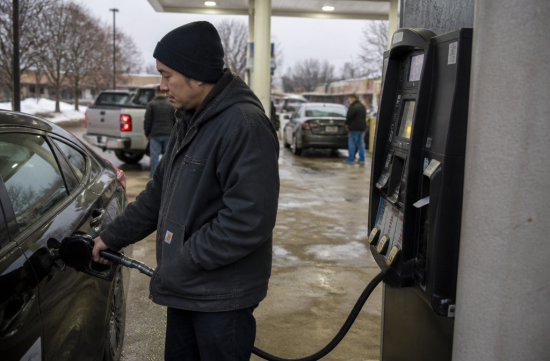
This week, I noticed the gas station sign on my way home, and the number started with a 3. Just at the end of September, it was close to $5, so I thought I must have misread it.
I did some calculations. While prices have dropped significantly, they haven't returned to last year's levels.
According to AAA Michigan, as of November 16, the average price for regular gas is $3.81 per gallon. That's down 36 cents from a week ago and 77 cents from a month ago.
However, compared to the same time last year, it's still 79 cents more expensive. The average in Metro Detroit is also $3.81, which is 76 cents higher than last year.
The phrase "up $1.74 in a year" is misleading; that figure refers to the peak last fall when prices were over $1 higher.
At the end of September, the state average was $4.93, marking the highest point of the year, which was $1.75 higher than last year. At that time, filling a 15-gallon tank cost $74.
At the end of October, prices were still at $4.83, with Metro Detroit being the most expensive area at $4.89. Since November, prices have been dropping by over 30 cents each week.
Currently, filling a tank costs about $57. AAA explains that this is about $6 more than the peak price last August.
Reasons for the drop include the switch to winter gasoline, decreased driving demand due to cold weather, falling crude oil prices, and increased inventory. There are also analyses suggesting that tensions in Iran could cause prices to rise again.
Diesel prices still have a long way to go. At $6.25 per gallon, it's a stark contrast to last year's price of $3.94, which truck drivers are likely feeling significantly.
We also need to discuss taxes. Starting January 1 of this year, Michigan eliminated the 6% sales tax on gasoline and increased the fuel tax from 31 cents to 51 cents per gallon (indexed to inflation).
For reference, Michigan's all-time high was $5.22 in June 2022. While this fall's peak didn't reach that level, it was quite close.
The sales tax fluctuates with gas prices, but the fixed fuel tax does not. Therefore, when gas prices are low, you end up paying a bit more than before, and when prices are high, you pay less.
So, how can you save? The first step is comparing gas stations. Even on the same day, prices can vary significantly by location.
This week, AAA data shows that Saginaw has the cheapest price at $3.66, while Ann Arbor is the most expensive at $3.94, a difference of 28 cents per gallon.
The same goes for local neighborhoods. There was a time when a gas station near I-75 in Detroit charged $6.09 per gallon, which made the news.
I check two or three gas stations along my commute using apps like GasBuddy. Going out of my way can actually cost me more.
The second tip is using grocery points. Kroger Rewards gives you a 10-cent discount per gallon for every 100 points earned, up to a maximum of $1 off per gallon.
Many people waste points they earn while shopping. Since they have an expiration date, it's a good idea to check the app periodically.
If you have a Costco or Sam's Club membership, consider including their gas stations in your comparisons. On busy days, I sometimes skip them due to long lines.
Some gas stations charge different prices for credit card and cash payments. Just checking the price board at the pump again and choosing your payment method can save you a few cents.
The third tip is about driving habits. The Department of Energy's fuel economy site (fueleconomy.gov) states that aggressive driving, such as rapid acceleration and hard braking, can reduce highway fuel economy by 15-30% and city fuel economy by 10-40%.
Speed also plays a significant role. Once you exceed 50 mph, every 5 mph increase can cost you an additional 28 cents per gallon.
Idling can surprisingly waste fuel too. It consumes about a quarter to half a gallon per hour, so it's worth reducing the habit of warming up your car for too long on winter mornings.
Also, consider cleaning out your trunk. Reducing weight by 100 pounds can improve fuel economy by about 1%.
Roof boxes have an even greater impact. At speeds of 65-75 mph, they can reduce fuel economy by 10-25%, so it's better to remove them when not in use.
Tire pressure also drops in colder weather. Checking it while refueling can help maintain fuel efficiency and ensure safety.
Honestly, each of these tips might save just a few cents. However, when you fill up every week, combining several of them can lead to savings of several dozen dollars a month.
If I were you, I would fill up frequently while prices are low, keeping the tank half full, and when I hear prices are going back up, I would fill it completely before that happens.
Even with prices dropping over a dollar from the peak, it has provided some relief. Still, it's true that prices are higher than last year, so I plan to keep saving wherever I can and endure this winter quietly.
 GeumjaHome




 West Kong |

 havero70 |

 Grow Your Gut Bacteria Well |

 choi family |
 content |

 honeycom |

 bayaa |

 juniper |


 San Diego TOP Idol |
 kerkee |
 HAWAII Korean Church News |
 stalion |
 Dala Dala |
 Noodle Noodle |
 Encyclopedia of New York and Surrounding Areas |
 bluebird |
 New York New York NYC |
 Finding Superfoods |
 Dr. Kelso |
 Valley Hong |
 Georgia Springcamp |
 myheart |
 Missouri Kings News Information |
 Going Once |
 monica hong |
 Tainami American Travel Story |
 tarve7 |
 Something is popping in the situation |