
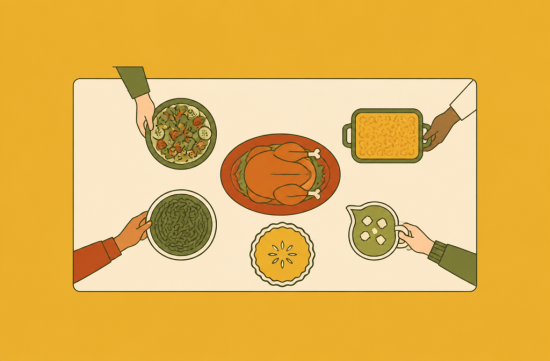
Last year, I hosted my first Friendsgiving, and we ended up with three trays of mac and cheese for nearly ten people. It was funny, but there wasn't a single light dish like salad.
While potlucks seem convenient since everyone brings a dish, if no one coordinates, this is what happens. People tend to gravitate towards dishes they are confident in or ones that are easy to buy at the store.
This year, I really planned it out properly. I thought it would be helpful for first-time hosts, so I organized my thoughts.
By the way, the term Friendsgiving was officially added to the Merriam-Webster dictionary in 2020. The first recorded use was in 2007.
Surprisingly, it has a short history, right? It refers to the culture of friends gathering together for a meal when family is far away or when people can't go home for the holidays. I think it's a particularly relatable term for immigrants like us.
The first principle is that the host should take care of the main dish. Whether it's turkey or ham, the main dish requires a long time in the oven and precise timing, making it really difficult to bring to someone else's house.
If you're unsure about the size of the turkey, check out the calculator on the Butterball website. You can input the number of adults, children, whether you want leftovers, and how much people typically eat, and it will tell you the weight you need.
If you're using a frozen turkey, you also need to calculate the thawing time. The USDA recommends about 24 hours for every 4-5 pounds when thawing in the refrigerator.
For a 16-20 pound turkey, that means it will take 4-5 days in the fridge. I was surprised when I first saw this chart; taking it out the day before is too late.
The second step is to create categories first. You can divide it into main dish, carbohydrate sides, vegetable sides, salads, desserts, drinks, and disposable items.
Then, based on the number of people, set the number of slots for each category. For ten people, you might have two slots for carbohydrate sides, two for vegetables, and two for desserts.
Once the slots are filled, that category is closed. Just doing this can prevent the situation of having three trays of mac and cheese.
The dessert category fills up especially quickly since pies are easy to buy at the store. So, I intentionally kept the dessert slots small and added one more vegetable side.
The third step is to use a shared sheet instead of a group chat. Create a Google Sheet and share the link so everyone can see at a glance who is bringing what.
In a chat, messages quickly get pushed up, and a line like "I'll bring pie" can get buried. With a sheet, as soon as someone writes their name next to a dish, it's visible to everyone.
If you add a few more columns to the sheet, it becomes much smarter. Next to the dish name, you can include options like "needs oven," "room temperature OK," and "needs refrigeration."
This is surprisingly crucial. If there's only one oven at home and five people arrive needing to heat their dishes, the host will be overwhelmed.
I limited the number of dishes that needed the oven to two or three. The rest I asked people to bring in slow cookers or as room temperature dishes.
The fourth step is to have a dietary needs column. Asking people to note allergies, gluten-free, vegan, etc., helps those choosing dishes to worry less.
I believe that a table where everyone can comfortably eat is the true meaning of Friendsgiving. It's a bit sad if a vegan friend only eats rolls.
The fifth step is to give spots to friends who aren't confident in cooking. This can include drinks, ice, disposable plates and cups, and containers for leftovers.
It's especially great to assign ice to someone who arrives late. They can pick it up on the way without worrying about it melting.
The sixth step is to note on the sheet that everyone should bring their own serving utensils. It's surprisingly common to find yourself using a ladle to serve salad because there aren't enough large spoons or tongs.
I also asked everyone to attach small name tags. Writing the dish name and main ingredients helps friends with allergies avoid asking questions.
Lastly, let's touch on food safety. The USDA advises not to leave perishable foods at room temperature for more than two hours.
At potlucks, food can sit on the table for hours while everyone eats and chats. I set an alarm to put things in the fridge after about two hours.
Leftovers should be eaten within 3-4 days when stored in the fridge, and when reheating, the internal temperature should reach 165 degrees Fahrenheit according to USDA guidelines. Dividing them into shallow containers helps them cool down faster.
This year, Thanksgiving is on November 26, so many of you will likely have Friendsgiving this weekend or next weekend. It's not too late to start sharing the sheet now.
In summary, the host should take care of the main dish, set the number of slots by category in advance, and include oven needs on the shared sheet. If I were you, I would definitely make sure to cover these three points.
What's more important than a perfect spread is a table where no one feels left out. For those hosting for the first time, don't be too nervous and enjoy it. Happy Friendsgiving!
 CoffeeDream








 Silent Sea |

 Noodle Noodle |

 figtop |

 Toaster Pizza Magic Show |
 DO Main TODAY |

 havero70 |

 vrixen73 |

 cortiva6 |

 Helpful Life Stories |

 San Diego TOP Idol |
 kerkee |
 HAWAII Korean Church News |
 stalion |
 Dala Dala |
 Encyclopedia of New York and Surrounding Areas |
 bluebird |
 New York New York NYC |
 Finding Superfoods |
 Dr. Kelso |
 Valley Hong |
 Georgia Springcamp |
 myheart |
 Missouri Kings News Information |
 Going Once |
 monica hong |
 Tainami American Travel Story |
 tarve7 |
 Something is popping in the situation |