
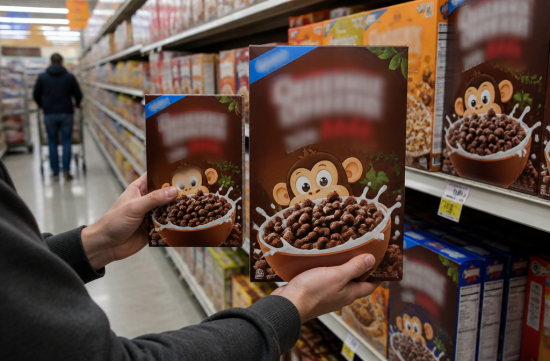
Last week, I had a rather surprising experience while buying cereal at the grocery store.
I picked up a large box thinking it would be much cheaper than the smaller size, but when I checked the receipt, I realized I had actually lost money.
When I got home and looked at the shelf photo again, I found the issue was with the small number next to the price tag.
If you look closely at grocery price tags, there's usually a smaller number below the big price that says something like "price per ounce."
This is the unit price, meaning the price per unit.
While the total price may make the larger container seem like a better deal, what you really need to compare is that small number.
For instance, comparing one cereal brand shows a pretty clear difference.
The 40.7-ounce Cheerios sold at Costco is about $0.17 per ounce, while the same brand's 18-ounce box at Walmart is around $0.25 per ounce.
At this point, the larger size definitely seems to be the better deal, but the problem is that not all products follow this pattern.
Sometimes, brands package larger sizes as a premium, resulting in a higher price per ounce.
The same goes for when sales or coupons are only available for the smaller sizes.
So, if you just assume "bigger is better" based on visual estimation, you might end up disappointed.
Interestingly, this unit price labeling is not mandatory across the entire U.S.
Ten states, including Connecticut, Massachusetts, New York, New Jersey, and Oregon, along with Washington D.C., have laws requiring unit price labeling in grocery stores.
Texas is not on that list.
This means that here, it's not illegal to not have the label, and if it is present, it's more of a voluntary service from the store.
Fortunately, most large chains do voluntarily include it, but the text is often so small that it can be hard to see without glasses.
A survey conducted by Purdue University in 2024 found that 82 percent of consumers check prices carefully before shopping.
However, only about half of those respondents said they habitually check the unit price.
This means that while they look at the price, they are only considering half of the actual comparison criteria, which made me a bit uneasy after seeing this statistic.
I'm not saying that buying in bulk is always a loss.
According to a LendingTree study, buying in bulk can save an average of about 27 percent.
However, the same study found that 38 percent of respondents had occasionally or frequently thrown away bulk items, while only 24 percent said they had never thrown anything away.
This means that just because something is cheaper doesn't mean it's a good deal if you can't use it all before it expires.
Items like detergents or toilet paper, which essentially have no expiration date, are almost always a better deal in bulk.
On the other hand, items like sauces, nuts, or dairy products that spoil quickly after opening are a different story.
If you live alone or have a small family, you might often find that you end up throwing away large containers before using them all due to mold or changes in taste.
It's also important to double-check unit prices when there are sales or coupons.
When a store prominently displays a few dollars off the total price, it can be easy to get confused about whether it's really a good deal, but dividing the discounted price by the volume can sometimes reveal that the price per ounce is actually higher than the original smaller size.
Store brands, or private label products, should also be included in your comparisons.
It's often the case that a mid-size private label product has a lower unit price than a large name-brand product, so if you only look at the brand name, you might miss out on savings.
If I were to summarize this, I would say that the first step is to get into the habit of using a smartphone calculator to divide the price by the volume for direct comparisons.
There are often stores in Texas that don't have unit prices displayed, so in those cases, you'll have to take the time to do the math yourself.
Also, by honestly assessing your consumption rate, it's often more economical to choose smaller sizes for items you're not sure you can finish.
I really felt this time that just checking that small number can significantly change the total amount in your shopping cart for the month.
 FungusLegend







 Idaho's Sumi's House |
 holy cheese |
 Michigan Enthusiast |
 Anna Life |
 JESIKYEOALBA BLOG |
 jaxter |
 sunny flower |
 chilli chilli |
 HVAC will prosper |
 Rocky Mountains |
  Whoever It Is, I Don't Know |
  Why Not Me |
  Plastic Rose |
  Rice Shop Uncle BLOG |
  Victory 1988 |
  Gook Rule |
  Rowland Mama |
  Coco and Lulu |
  Baguette Blog |
  washington mom |
  yorvik12 |
  mortrix |
  Panorama Kstar |
  MAX009 BLOG |
  K-POP TV News |
  My Beloved Hometown Hwagae Market |
  Tart Tart |
  Min's blog |