

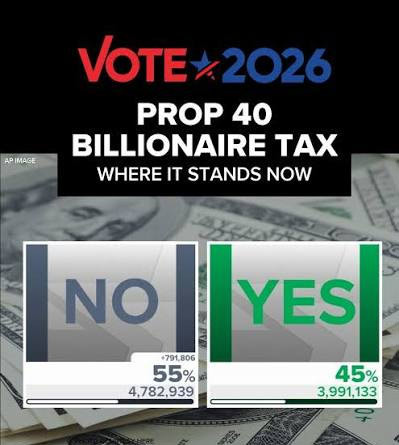
Living in LA, where the Democratic Party is dominant, discussions about raising taxes on high earners are common, but the voting results often tell a different story.
This time, California's Proposition 40, which aimed to tax billionaires 5% of their wealth, was ultimately defeated.
Personally, seeing this outcome made me realize that California residents are now wary whenever the topic of taxes comes up.
In simple terms, the proposal was straightforward: it aimed to tax individuals with over $1 billion in assets—equivalent to over 1 trillion won—5% of their net worth.
A person with $1 billion would owe $50 million.
A person with $10 billion would owe $500 million.
Of course, most of these wealthy individuals' assets are not cash but stocks or business equity, so the actual process of paying taxes is not that simple.
Still, from the perspective of ordinary citizens, it's hard not to think this way.
Is it really so unfair for people with trillions in assets to pay just 5%?
However, looking at the money poured into the opposing campaign during this election is jaw-dropping.
Sergey Brin, co-founder of Google, reportedly contributed over $100 million to the anti-campaign.
The opposing political action committee raised an astounding $330 million.
They spent money that most of us will never see in our lifetimes to prevent a tax increase.
Of course, the wealthy have their arguments as well.
They might say that they are already paying a lot of taxes while creating jobs through their businesses, and that it is unjust to impose additional taxes simply because the value of their stocks has increased.
Moreover, California is already a high-tax state.
It's tough to even buy a house in LA, and with gas prices, insurance, and living costs being significant, it's no surprise that people are not thrilled about the prospect of new taxes.
Interestingly, Governor Gavin Newsom, a Democrat, also opposed this bill.
While the Democratic Party usually advocates for taxing the wealthy, it seems that the prospect of Silicon Valley billionaires leaving for other states complicated matters.
In fact, there have been indications that even Google founders are considering distancing themselves from California.
If these individuals move their addresses to Texas or Florida, California risks losing existing tax revenue while trying to impose new taxes.
That said, the intent behind this wealth tax was not bad.
The plan was to use most of the collected taxes for healthcare support, with some allocated for education and food assistance for low-income individuals.
Proponents argued that California could face a budget shortfall of about $100 billion over the next five years as federal healthcare support budgets decrease.
Living in LA, I see how many people rely on Medi-Cal and various public healthcare supports.
Especially among elderly Korean residents, many find it burdensome to visit hospitals without these benefits.
Thus, the argument for collecting a bit more from the wealthy to maintain healthcare support is quite understandable.
In this vote, younger voters under 30 were largely in favor, while about 70% of voters over 65 opposed it.
I find it hard to say that either side was completely right in this election.
However, one thing is clear.
California needs to explain not only why it wants to collect more taxes from the wealthy but also why, despite spending so much money, the lives of ordinary residents are not improving.
Ultimately, what matters is not just how much tax is collected from whom, but how that money is spent.
Proponents say they may push for another vote in 2028.
This time, billionaires won, but the debate is far from over.
Yet, if in the next election the wealthy pour millions of dollars into campaigns, politicians pass the buck, and our lives remain unchanged, it will be quite disheartening.
 PuddingBud




 Texas Migration Story |

 cyvera80 |
 Que Buena |

 California Information News |

 Noodle Noodle |

 Anjollinya Blog |

 Valley Hong |

 Weekend Movie Blog |

 Hakuna Matata |
 pixel77 |
 uplifted |
 moo moo |
 winter |
 windstone |
 My winter |
 Gomo Nim |
 oneonly |
 blixon24 |
 canyon |
 juniper |
 novaline |
 sunny side |
 kimchi warrior |
 nero kim |
 refresh |
 rainyday |
 springw |