
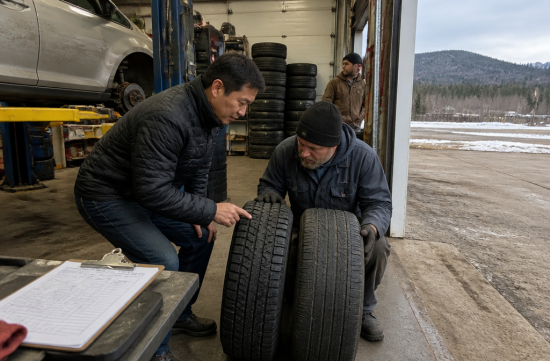
To get straight to the point: If you can't avoid early morning commutes or hilly roads in winter, winter tires are more efficient. However, if you can simply avoid going out on snowy days, you may not need to buy them.
Upon examining this issue closely, I realized the question was slightly off. The real question isn't which is cheaper between winter and all-season tires, but whether it's worth adding a set of winter tires on top of your all-season ones.
First, I looked at the prices. As of early November, I checked the SimpleTire list prices and standardized on the size 225/55R17 to minimize variables.
The all-season General Altimax RT45 costs $160.99 each, totaling $643.96 for four.
The winter General Altimax Arctic 12 costs $172.96 each, totaling $691.84 for four.
The Bridgestone Blizzak WS90 costs $221.96 each, totaling $887.84 for four.
I was a bit surprised here. The Arctic 12 is only $47.88 more expensive than the RT45 per set, and the WS90 is $243.88 more.
Of course, there's a catch. These prices do not include installation fees and can vary by retailer. Additionally, if you already have all-season tires, the actual expenditure is the total cost of the new set, not just the price difference.
So how much will you get back from that money? When using winter tires, your all-season tires won't wear out.
The RT45 has a T and H rating warranty for 75,000 miles. Dividing the set price by the mileage gives a cost of about 0.86 cents per mile.
If we assume you drive 4,000 miles in winter, you save about $34.34 on all-season tire wear. Keep in mind that the warranty mileage is not the actual lifespan, so this is just a reference calculation.
If you use the Arctic 12 for five seasons, that averages out to $138.37 per year. Subtracting the $34.34 gives you $104.03 remaining.
The WS90 would similarly average $143.23 per year. The five-season estimate is my assumption. Since the WS90 has no mileage warranty, you need to adjust this value based on your actual driving distance.
Based on these assumptions, the actual cost of this decision falls between $104 and $143 per year.
We should also consider what you can buy with that money. According to the average values from Rapid City Regional Airport from 1991 to 2020, the average high in January is 36.0°F, and the average low is 12.7°F.
Days when the high stays below 32°F average 43 days, and nights when temperatures drop to 0°F occur about 18 days. The average seasonal snowfall is 48.5 inches.
Winter tires are generally designed for temperatures below 45°F. The WS90 also advises against use in weather above 45°F, so you need to factor in when to take them off in spring.
The specifications vary based on the snowflake and mountain symbol, 3PMSF. In traction tests on packed snow, the reference tire is set at 100, and a score above 110 is required to qualify.
Both the WS90 and Arctic 12 have this mark, while the RT45 does not. This doesn't mean you can't drive on snow with all-season tires; it simply means they are not certified for severe snow conditions.
Ice performance is another standard. To receive the Ice Grip mark, a tire must demonstrate at least 18% better straight-line braking than the reference tire. This is not a direct comparison with all-season tires, so be cautious when interpreting these results.
I wanted to specify how many feet the braking distance differs, but I couldn't secure reliable test data this time, so I left out the numbers. Including unverified values is like deploying without testing.
So, if it were up to me, I would decide this way: If I need to go out before sunrise and have to navigate hills or shaded roads, I would go with winter tires.
If I can delay my trip on snowy days and stick to cleared city roads, I would try to manage with all-season tires.
There's also a middle option. All-weather tires with the 3PMSF mark can be used year-round, eliminating storage concerns. However, I couldn't check the prices this time, so I recommend looking up the cost for your specific size.
There are conditions to filter out before buying. The WS90 is designed for coupes, sedans, and minivans, so if you have an SUV, you should look at a separate line like the Blizzak DM-V2.
The WS90 has a directional pattern, so rotation can only be done front to back. Studs are not allowed on the WS90, but they are permitted on the Arctic 12.
If you're considering studs, check South Dakota law SDCL 32-19 and consult with your tire shop before installation. Many areas have restrictions on when they can be used.
Wheels are also a variable. If you change tires on the same wheels every year, mounting costs will keep adding up, so it's better to ask for a quote that includes separate wheels and seasonal storage.
Let's also add a note about insurance. If your deductible is $500, a single bumper repair from slipping could exceed the cost of the Arctic 12 over four years. Of course, this doesn't mean that using winter tires guarantees you won't have an accident.
My choice is winter tires. If I can reduce the stress of driving in snowy mornings for $104 a year, I consider that a pretty good trade-off.
Finally, don't just copy these numbers directly. They are based on the 225/55R17 size, so adjust the variables according to your car size and mileage to find your answer quickly.
 LuckyLife
 blueforest1974


 content |

 Carolina border |

 Que Buena |

 juicylol |

 Mr Song Song |

 silverpath |


 Dakota Man Blog Thanks |



 U.S. Weather Bureau News |
 Noodle Noodle |
 Hakuna Matata |
 pixel77 |
 uplifted |
 moo moo |
 winter |
 windstone |
 My winter |
 Gomo Nim |
 oneonly |
 blixon24 |
 canyon |
 juniper |
 novaline |
 sunny side |
 kimchi warrior |
 nero kim |
 refresh |
 rainyday |
 springw |