
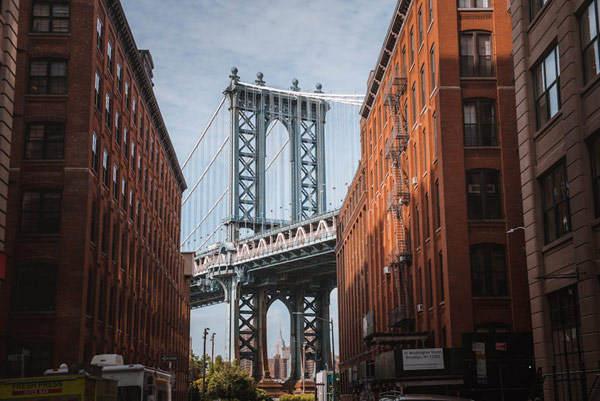
Brooklyn is one of the five boroughs that make up New York City, located just east of Manhattan and bordered by the Hudson River. Brooklyn is one of the most important cities in the United States, boasting a rich history, culture, and economic development. The history of Brooklyn dates back to the Native American era, through the Industrial Revolution, urbanization, and into today's diverse culture.
1. The Native Americans and Colonial Era of Brooklyn
The Brooklyn area was originally inhabited by the Lenape Native Americans. They were indigenous people who spoke an Algonquin language, and Brooklyn was referred to as "Beyouerk" by them. In 1609, Henry Hudson explored the Hudson River, marking the first arrival of Europeans in the Brooklyn area. Subsequently, the Dutch colonial government colonized the area, ruling over a vast region that included New Amsterdam (now New York City).
2. The Development and Independence of Brooklyn
In 1664, when the British seized the Dutch colony, Brooklyn came under British rule. Thereafter, Brooklyn was incorporated as part of the British colony of New York. In 1834, Brooklyn established a self-governing body, gaining the status of an independent city. At that time, Brooklyn began to rapidly develop as a major commercial center and port city. The Brooklyn port became a crucial hub for trade, and many industries settled in Brooklyn.
3. The Construction of the Brooklyn Bridge and Urban Development
One of the significant events in Brooklyn's history is the construction of the Brooklyn Bridge. Construction began in 1869 and was completed in 1883. This bridge was the first to connect Manhattan and Brooklyn, and it was an architecturally innovative suspension bridge of its time. The Brooklyn Bridge made a significant contribution to the commercial and social development of New York City. Thanks to this bridge, Brooklyn became more closely connected to Manhattan, leading to rapid urbanization and industrialization.
4. Industrialization and the Influx of Immigrants
In the late 19th century, Brooklyn underwent rapid industrialization. Many factories and manufacturing industries were established in Brooklyn, leading to a large influx of immigrants. Immigrants primarily from Europe settled in Brooklyn, forming a diverse community that included Italians, Irish, and Germans. They invigorated Brooklyn's economy and had a significant impact on the local culture.
Brooklyn was also an important area for the formation of the Black community. With the spread of the Harlem Renaissance, Brooklyn became a vibrant center for African American music and culture, including jazz, blues, and soul music.
5. The Early 20th Century and the Impact of the Great Depression
In the early 20th century, Brooklyn continued to experience urbanization and industrialization, but during the Great Depression, it faced severe economic hardships. Many factories closed, unemployment surged, and poverty increased. However, after the Great Depression, Brooklyn gradually recovered through New Deal policies and federal government support.
6. The Cultural and Artistic Development of Brooklyn
In the late 20th century, Brooklyn began to emerge once again as an important cultural center. Artists and cultural figures flocked to the area, establishing Brooklyn as a hub of art. Cultural facilities such as the Brooklyn Museum, Brooklyn Academy of Music (BAM), and Brooklyn Bridge Park led the development of the area, and Brooklyn gained global recognition in various artistic fields, including hip-hop culture, visual arts, literature, and music.
7. Recent Redevelopment and Transformation
In recent years, Brooklyn has seen active redevelopment and urban innovation. Areas such as Downtown Brooklyn, Williamsburg, and Bedford-Stuyvesant have rapidly transformed into residential and commercial districts. With the increase of upscale apartments, restaurants, and shopping malls, Brooklyn has a complex structure that includes both affluent neighborhoods and low-income areas. This has led to the emergence of gentrification in some areas, resulting in social issues such as income inequality and rising housing costs.
Brooklyn is a historical and cultural center of New York City, having experienced diverse cultural and historical developments. Elements such as industrialization, the influx of immigrants, the Brooklyn Bridge, and its status as a cultural and artistic hub make this area unique, and it continues to evolve with various cultural backgrounds and economic changes. The development of Brooklyn holds significant meaning as a cultural icon of New York City itself, radiating lasting appeal to many people.








 Starbucks Reserve Roastery Closure |
 Encyclopedia of New York and Surrounding Areas |
 Softember |

 Franco Family |
  US Embassy |
  Korean Mom |
  My NYC |
  moo moo |
  Mr Oh |
  forevergee |
  festival |
  manchester |
  constant |
  Leapfrog Move |
  vibranto |
  Tora Tora |
  yellowbutter |
  Dolly |
  NYC saladbar |
  Finding Superfoods |
  lightyear |
  song bang |
  vexomo |
  Indiana Jones |