

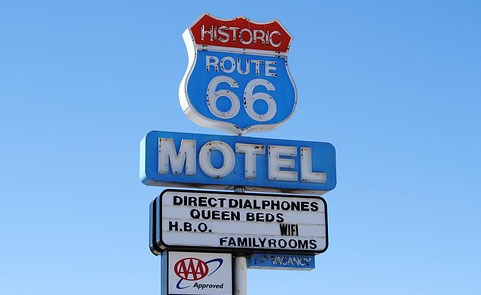
Living in Oklahoma means having the advantage of seeing a legendary road, Route 66, that runs through the vast plains in the heart of America. This Route 66, which passes through Oklahoma, stretches from Oklahoma City to Tulsa, Elk City, Clinton, and all the way to the Texas border.
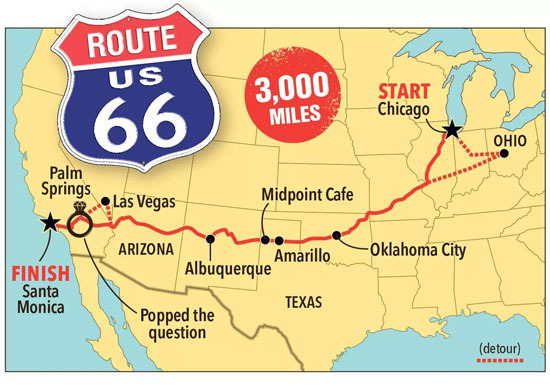
Route 66 was opened in 1926. Starting from Chicago and ending in Santa Monica, LA, it spans a total length of 2,448 miles, with about 400 miles of it passing through Oklahoma. It is one of the longest segments of the entire route, and it is not an exaggeration to call Oklahoma the 'heart of Route 66.' Once, it served as a major artery connecting the Midwest and the West, with countless immigrants, merchants, and travelers seeking hope along this road.
Route 66 was not just a means of transportation. During the Great Depression and the Dust Bowl era, it was an escape route for Midwestern farmers fleeing drought and poverty, and during World War II, it was a strategic route for transporting military supplies and troops. Particularly, Oklahoma was one of the regions heavily affected by the Dust Bowl, so Route 66 holds a complex meaning of 'survival' and 'new beginnings' for the people of this land.
Thus, this road is also called the 'Mother Road.' It has become a cultural symbol, not just a geographical name.
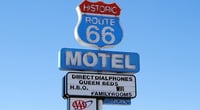
The song '(Get Your Kicks on) Route 66' by Nat King Cole, set against the backdrop of Route 66, can still be heard in jazz bars and classic car cafes. This song has remained a classic of rhythm and blues, covered by notable artists like Elvis Presley, The Rolling Stones, and Natalie Cole. Interestingly, while Koreans may not know this song, they have likely seen the sign 'Route 66' many times. In craft beer pubs in Seoul, jazz bars in Hongdae, or camping-themed shops, vintage signs of this road are consumed as a kind of 'American sentiment' item. Even though it is a road that many do not know well, its image evokes romance and freedom. That is the power of Route 66.
However, this road, which seemed eternal, had to bow to the flow of time. In 1956, with the introduction of the Interstate Highway System led by President Eisenhower, Route 66 began its decline. Major segments passing through central Oklahoma gradually gave way to faster and wider highways like I-44 and I-40. In particular, I-40 almost completely replaced Route 66 in western Oklahoma. The road was cut into segments, and as people moved to faster routes, the traffic on Route 66 naturally decreased. Ultimately, on June 26, 1985, Route 66 was officially decommissioned from the U.S. federal highway system.
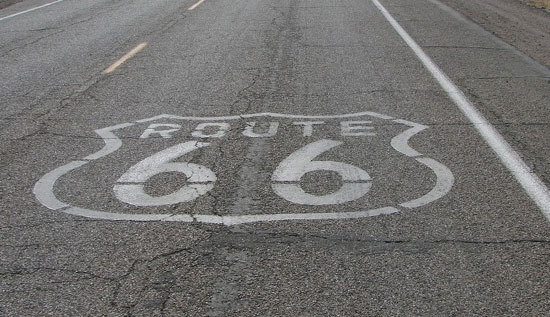
However, the sentiment towards this road did not disappear. Rather, it became more desperate because it was lost. In 2003, the entire route was restored as 'Historic Route 66,' coming back to life as a tourist destination and cultural heritage.
In particular, in Oklahoma, places related to Route 66, such as the Route 66 Museum in Clinton, the Route 66 Village in Tulsa, and the Afton Park in Oklahoma City, have become popular tourist attractions. Americans enjoy traveling along Route 66 in RVs, stopping at pancake diners, and staying in classic-style motels. And at the center of it all is our Oklahoma.
Sometimes, on my way home from work in Oklahoma City, I deliberately drive slowly along the roads that still bear traces of Route 66.
It may not be as fast as the highway, but there is a certain leisure in that slowness. Passing by old gas stations, diners with vintage signs, and charming service stations, I feel that this road is not just an asphalt path. It holds the lives of people, music, and dreams.
Route 66 is America's past, present, and a future that will someday come back to life.
Living in Oklahoma and having this legendary road close by is quite a romantic thing.
And if I ever get the chance, I would love to travel the entire length of Route 66 from Chicago to LA.

 daisypat |
 Chimhanbang Korea ACU |
 Trustworthy Faces |
 US Regional Information Blog |
  Atlanta Mama |
  Baguette Blog |
  US Embassy |
  Korean Mom |
  My NYC |
  moo moo |
  Mr Oh |
  forevergee |
  festival |
  manchester |
  constant |
  Leapfrog Move |
  vibranto |
  Tora Tora |
  yellowbutter |
  Dolly |
  NYC saladbar |
  Finding Superfoods |
  lightyear |
  song bang |