
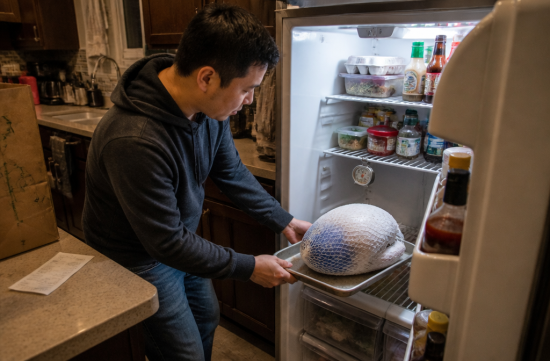
Today, after closing the store, I went grocery shopping and stood in front of the frozen section for a long time. It wasn't until I picked up a turkey that I thought, when should I move this to the refrigerator?
This year's Thanksgiving is on Thursday, November 26. Since today is Saturday the 21st, that means there are exactly 5 days left. That's less time than I expected.
So, I looked up the USDA guidelines and Butterball instructions. To cut to the chase, it's time to move a large turkey to the refrigerator right now.
The USDA recommends thawing in the refrigerator at a rate of 24 hours for every 4 to 5 pounds. The refrigerator temperature should be maintained at 40 degrees Fahrenheit or lower.
Butterball suggests a more conservative estimate of one day for every 4 pounds. I find it easier to calculate using this guideline.
Based on this, a 12-pound turkey will take 3 days, a 16-pound turkey will take 4 days, and a 20-pound turkey will take 5 days. If you bought a large one over 20 pounds, moving it today is cutting it close.
Honestly, I was a bit shocked when I first saw the numbers. Five days to thaw a chunk of meat? Even a turkey that's a reasonable size for family meals quickly exceeds 12 pounds, so you should plan for at least three days.
Then there's the worry about taking it out too early. The USDA advises that a turkey thawed in the refrigerator can be stored for an additional day or two.
Butterball states that a thawed turkey can be kept in the refrigerator at 40 degrees Fahrenheit or lower for up to 4 days. Since the guidelines differ slightly, I would lean towards the shorter time frame.
Also, meat thawed in the refrigerator can be cooked without refreezing. However, the taste and texture may suffer a bit.
There are tips for placing it in the refrigerator too. Keep it on a tray or in a large pan, and place it on the bottom shelf.
As it thaws, it releases more blood than you might expect. If this drips onto vegetables or side dishes on the lower shelf, it can be quite problematic. It's best to discard any vegetables that have been contaminated with raw meat juices.
Make sure to check the refrigerator temperature as well. In homes where the door is frequently opened and closed, the temperature can rise higher than expected. Just having a cheap refrigerator thermometer can provide peace of mind.
The issue is finding space in the refrigerator. In a commercial kitchen, the refrigerator is always packed, and a turkey takes up an entire shelf. If you don't organize ahead of time, it can be chaotic the night before.
So, I clear out the refrigerator the day before buying the turkey. By organizing expired sauce bottles and side dishes whose origins I can't remember, I surprisingly create quite a bit of space.
If you think it's too late, there's also the option of thawing in cold water. The guideline is 30 minutes per pound, so for a 16-pound turkey, it would take about 8 hours.
The method is to fill the sink or a large container with cold water and submerge the turkey without unwrapping it. The water needs to be changed every 30 minutes.
Butterball recommends submerging it breast-side down. If the packaging has holes, it's a good idea to wrap it in a plastic bag for extra protection.
The important thing is that if you thaw it in cold water, you must cook it immediately. You can't leave it out for days like with refrigerator thawing.
Microwave thawing is also possible. However, it's questionable whether you even have a microwave large enough for a big turkey, and you must cook it right after thawing. This is because some parts may start to cook slightly.
What you should absolutely avoid is leaving it out on the countertop. The outside may thaw and enter the 40 to 140 degrees Fahrenheit range, while the inside remains frozen.
This temperature range is known as the danger zone where bacteria can multiply rapidly. Leaving frozen meat at room temperature for more than 2 hours is considered unsafe.
Soaking it in hot water is also not allowed for the same reason. I completely understand the desire to thaw it quickly.
If it's still frozen on the morning of the day, surprisingly, the USDA says it's safe to cook it while still frozen.
However, they say it will take at least 50% longer than cooking a fully thawed turkey. If you have a set time for guests to arrive, that can be quite a burden.
Also, when it's frozen, you can't remove the bag of giblets from inside. You need to wait until it has thawed enough to be soft before carefully pulling it out with tongs.
Whatever method you choose, the final check is with a thermometer. You need to ensure that the thickest parts of the inner thigh, wing, and breast reach 165 degrees Fahrenheit.
If you're still confused, Butterball has a consultation hotline. You can call 1-800-BUTTERBALL during the season with questions about thawing or cooking times. If you're worried about speaking English, I recommend writing down the weight and your questions beforehand.
To summarize, if it's over 20 pounds, move it today; if it's around 16 pounds, do it by Sunday at the latest; and if it's about 12 pounds, put it in the refrigerator by Monday.
I've decided to move it tonight. It's fine to thaw a day early, but the thought of holding a rock-solid turkey on Thursday morning is just too daunting.
In both business and holiday preparations, it seems that those who act a day earlier have the advantage. Everyone, make sure to clear out the bottom shelf of your refrigerator!
 PastaPilot
 FlandersDog



 donggul donggul |

 Mr. Largo |

 Silent Sea |

 Noodle Noodle |

 figtop |
 midnight blue |

 cherry cherry |

 gentle |


 blossom7 |

 Shining Our Own World |
 Raymond K. |
 gravity |
 714 Success Era Real Estate |
 Investment Beginner Company Information Encyclopedia |
 musicque |
 The Gelaton |
 ovelion |
 Chicagonian |
 Freedom Yea |
 AZ Road Master |
 glenix39 |
 Something is popping in the situation |
 orvella |
 vella |
 comets |
 Banana |
 Yes Dorian |
 Minnesota Sonata N |
 zentar |