
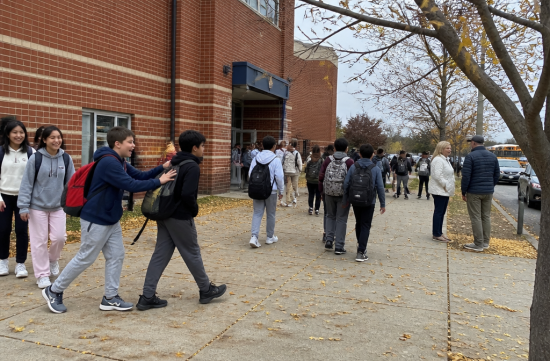
As I passed by a local school around three in the afternoon, I noticed that very few students were holding cell phones. Instead, I heard the sounds of friends playfully tapping each other's bags and someone humming a tune. It was such a stark contrast to the scenes from a few years ago that I stopped in my tracks.
The reason is well-known: this year, a so-called bell-to-bell cell phone ban has been implemented across all public schools in New Jersey. This regulation prohibits students from using personal cell phones from the first bell to the last.
The bill was signed on January 8, 2026, by former Governor Murphy just before the end of his term at Ramsey High School. Starting from the 2026-27 school year, each school district is required to adopt policies that comply with this standard.
There was almost no opposition in the legislature. With only three votes against it out of 120 state legislators, it seems that everyone was grappling with similar concerns, regardless of political affiliation.
So, exactly what is prohibited? Initially, I thought it only applied during class time, but that's not the case.
According to an FAQ released by the state Department of Education in July, personal devices must be turned off and stored while on school grounds. This includes lunch periods, study hall, and breaks between classes.
Even extracurricular activities held during school hours are not exempt from this rule. It's more comprehensive than I expected.
The method of storage varies by school district. Some use locking pouches, while others utilize lockers or storage bins.
If the device is turned off and kept out of sight, students are allowed to have it on them. Therefore, the best way to know how our local school handles this is to check the policy posted on the district's website.
Another point to check is regarding smartwatches. While the state guidelines focus on cell phones, some districts include smartwatches or tablets under the same regulations. If your child receives messages on their watch, be sure to verify our district's policy wording.
One of the most common questions from parents is about exceptions. What happens if a child is sick or needs special support?
If device use is included in an IEP or 504 plan, that is permitted. Health-related reasons supported by written documentation, such as a doctor's note, are also recognized as exceptions.
For example, if a child needs to check their blood sugar using a phone app, it's advisable to discuss this with the school nurse in advance. The state Department of Education guidelines also suggest that the nurse and IEP coordinator work together to create a plan, ensuring that the process remains confidential.
Additionally, students can use their devices when instructed by teachers for educational purposes. It's not an absolute prohibition.
In fact, the biggest concern is emergency situations. Parents have expressed anxiety about not being able to contact their children if something happens, and this has been reported in the news.
Those in favor believe that the school's landline and existing emergency response procedures are sufficient. Honestly, I can see both sides.
So, if it were me, I would save the main office number in my phone at the beginning of the semester and double-check that my number on the emergency contact list is correct. It's a small thing, but it can provide a lot of peace of mind.
It's also a good idea to set up a plan with your child in advance. For instance, agree that if something urgent arises while they are at school, they will contact you through the office, and that they will send a text by a certain time after school. Having these rules in place can significantly reduce anxiety for both the child and the parents.
What about the effects? Ramsey, in the same Bergen County, has been using pouches even before the law was enacted.
After four months of implementing the ban, nearly 80% of teachers at Ramsey High School reported increased participation in classes. I was a bit surprised by that number.
Of course, student reactions vary. Some dislike losing contact with their parents or feel that their autonomy has been taken away.
By middle school, I can understand that sentiment well. Back in my school days, losing an MP3 player felt like the end of the world.
The state government has allocated $3 million in this year's budget for school district support. This is intended for expenses related to pouches or storage solutions.
The current governor, Governor Cheryl, mentioned that after meeting with students and parents in the spring and summer, the overall response was positive. However, it's important to note that this is an evaluation from the state government's perspective.
I keep thinking about that humming I heard in front of the school. If students spend their breaks looking at each other instead of screens, maybe they'll end up singing a line or two together.
Just as music needs pauses to bring the next measure to life, a few hours of phone-free time each day could serve as a similar pause for the kids.
Still, since this is the first year, there will likely be some bumps along the way. If you have questions, the best way to get answers is to ask directly at school announcements or school board meetings.
Personally, I support this change. I'm a bit curious to see how the scene in front of the school will change by the time cherry blossoms bloom next spring.
 NoManners212
 skyvalleydreamer1990


 rissa |

 Gomo Nim |

 lattepop |

 Well Done Sir |

 butter 90 |

 gentle |

 midnight blue |

 autumn |

 blossom7 |

 springwaltz |
 strawberry |
 US Regional Information Local News |
 USA Business News |
 Blondee |
 E whisper |
 Potato House |
 freshmint |
 Ansaso |
 Golado |
 babybay |
 honeycom |
 French Macarons |
 Exploring American Life Information |
 Sunshine Blog |
 Community Cross |
 Sayonara H |
 What can make money? |
 Information Search LifeMAN |
 morvex37 |
 neontrail |