
Last week, a couple I know went for a home inspection. It was a cold day with a sea breeze at 8 AM, and when they received the report, it noted "not tested" for the air conditioning.
The couple felt disappointed, thinking the inspector had overlooked it. However, this is quite common during winter inspections.
Many inspectors do not run the air conditioning if the outside temperature is below 60 degrees Fahrenheit. Some use 65 degrees as a guideline.
The reason is that if liquid refrigerant is trapped inside the compressor in cold weather, it can damage the components when it starts up. However, there is no standardized official guideline in the industry, and judgments vary by inspector.
So, if you see such a note in the report, don't just brush it off. It's advisable to request an HVAC company to come and conduct a separate inspection during a warmer time before closing.
In Southern California, there are many days when the temperature rises close to 70 degrees in the afternoon. Just scheduling the inspection for the afternoon instead of early morning can often resolve this issue.
On the other hand, there are things that are more visible in winter. The heater is the first one.
The couple's home had an old wall-mounted gas heater in the living room. The inspector checked the flame color, vent connection, and surrounding soot one by one.
If it were summer, no one would have turned it on. But since it was a cold day, they could actually run it for a few minutes and check for smells or noises.
When checking the heater, you should also look at the carbon monoxide detector. In California, it is required to have a carbon monoxide detector if there are gas appliances, fireplaces, or if the garage is attached to the house.
This requirement has been in effect for single-family homes since July 1, 2011, and for other residential buildings like apartments since January 1, 2013. However, when you actually visit, there are still homes that only have smoke detectors and lack carbon monoxide detectors.
The same goes for smoke detectors. When selling a single-family home, sellers are usually required to provide a written confirmation that they have complied with smoke detector standards, but even if it's checked off on the paperwork, it's best to actually press the button to see if it sounds.
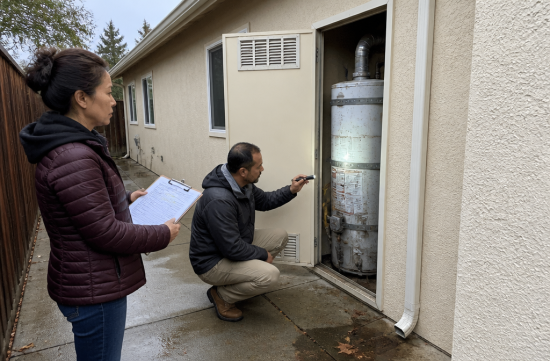
You can't forget about the water heater. In California, water heaters must be secured for earthquake safety, and sellers must confirm this in writing when selling the home.
If there's a gas smell around the water heater or if the vent connection is rusted, make sure to ask for that to be noted in the report. In winter, the usage of hot water increases, so small issues can escalate quickly.
Sometimes city ordinances are stricter than state laws. If there's only one strap wrapped around, it's safe to check the city building standards.
It's much more accurate to check the roof after the first rain. There can be water stains on the ceiling that looked fine during the dry season.
The couple's home also had a round stain on one side of the garage ceiling. The inspector used a moisture meter to check and confirm if it was a recent wet spot.
You should also check where the rainwater drains. If the gutters are clogged with leaves or if the end of the drainage pipe is right next to the house foundation, water can pool against the walls.
If it's an old house with raised floors, you should check the space under the floor as well. If you go in the day after it rains, you might find standing water or a moldy smell.
For older homes, considering a sewer camera inspection is worthwhile. Sewer lines can easily back up during heavy rains if tree roots have invaded them, and this inspection is usually not included in a standard inspection, so you need to request it separately.
Windows also show issues more clearly in winter. If there's fog between the double-pane glass, it's a sign that the seal has broken.
If the house has a fireplace, a standard inspection may not be sufficient. Since they don't usually check inside the chimney, it's better to get a professional chimney inspection separately.
So, when should these issues be resolved? The California Association of Realtors standard purchase agreement sets the investigation period at a default of 17 days.
This number can be changed at the time of the contract, and if the paperwork is delayed, the deadline can be pushed back. Make sure to check how many days are actually written in your contract.
During that period, you need to complete additional inspections and make repair requests or negotiate credits. At the end of the year, scheduling can get busy, so it's best to book appointments right on the day of the inspection.
The couple ultimately requested a re-inspection of the air conditioning and a chimney inspection. They decided to receive a credit for the heater vent repair costs.
People often say that buying a house in winter is disadvantageous, but I don't see it that way. It's actually a season where sellers find it harder to hide issues related to rainwater and heating.
If it were me, I would schedule the inspection for the afternoon after it rains. You can run the air conditioning, and it's the best time to see the roof and drainage conditions most honestly.
Contract terms and local regulations can vary from house to house. Before making important decisions, double-check with your agent or inspector.
 Squid Q
 vibefreedommaker1962








 Something is popping in the situation |

 lumix88 |

 quiet river |

 Doori Ark |

 My Town My Way Blog |

 Korean Blog |

 Fong Mr |

 Information on All Regions of the United States |

 Coastal city |
 Shining Our Own World |
 Raymond K. |
 gravity |
 714 Success Era Real Estate |
 Investment Beginner Company Information Encyclopedia |
 musicque |
 The Gelaton |
 ovelion |
 Chicagonian |
 Freedom Yea |
 AZ Road Master |
 glenix39 |
 orvella |
 vella |
 comets |
 Banana |
 Yes Dorian |
 Minnesota Sonata N |
 zentar |