

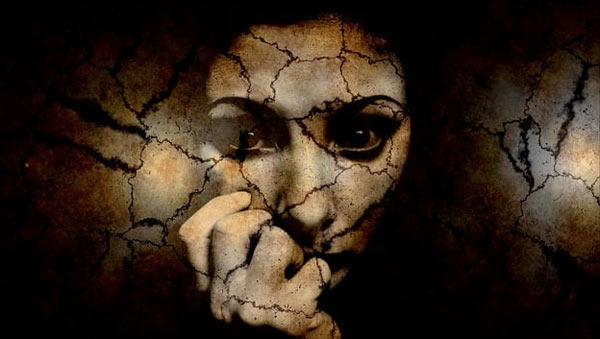
Everyone experiences "sleep paralysis" at least once in their life.
When I feel it while sleeping, it can be frightening, but upon waking and reflecting... it is strangely mysterious.
My body is asleep, yet my consciousness is awake, and even though I try to move, I cannot... it feels as if my body and mind are playing separately.
Interestingly, the term 'sleep paralysis' in Korean has the word 'scissors' in it. In fact, it has nothing to do with scissors, yet it is attached.
This is because it was believed that a ghost would press down on you with a sharp object like scissors, preventing movement.
So even today, people jokingly say that if they experience sleep paralysis, a ghost has climbed on them.
In Eastern culture, sleep paralysis has long been regarded as a supernatural phenomenon.
It is said that a ghost pressed down on you or that bad energy has covered you. In Buddhism, it is interpreted as karma manifesting in an unconscious state of sleep.
In my case, when I was young, I really thought a ghost was sitting on me. So, in fear, I would struggle but instinctively pray to Jesus.
Strangely, when I prayed, I would wake up as if it was released, or my body would start to move normally in a half-asleep state.
Now, even though I know it can be explained scientifically, I still instinctively pray when I experience sleep paralysis.
In the West, sleep paralysis is referred to as Sleep Paralysis.
Medically, it is when the body intentionally becomes paralyzed during the REM stage of dreaming.
However, if the consciousness wakes up first, the body remains bound.
During this process, hallucinations often occur. Many people report seeing 'black shadows' or 'strange beings.'
Scientifically, it is explained as a visual illusion caused by mixed signals in the brain as it awakens.
I think of it in two ways: one is a scientific explanation, and the other is a philosophical meaning.
Zhuangzi said that human life is free when it breaks away from the rules it has forced upon itself.
Sleep paralysis feels like an experience where the 'natural flow' is momentarily blocked as the body and mind are misaligned.
On the other hand, Descartes explained humans as divided into mind and body, and sleep paralysis seems to be an experience that stands in that gap.
The mind is awake, but the body is still asleep.
From Nietzsche's perspective, it is different. He said that humans lose power when trapped by social norms and morals.
Sleep paralysis may be the opposite situation, where instincts and the body are momentarily sealed, and only consciousness remains alive.
It is an experience that confronts the power of the unconscious.
I still occasionally experience sleep paralysis. It usually comes when I am very tired or stressed.
In that moment, it is a space of imagination I have created, so it is still scary, but at the same time, it strangely evokes a sense of awe.
Every time I wake up while praying, I feel a sense of relief that "I am alive right now."
At the same time, I also realize that "what I call reality is ultimately just electrical signals in the brain."
Of course, no matter how mysterious it is, experiencing it often can be exhausting.
So it is important to prevent it through lifestyle habits.
Sleep time and posture management: Research shows that sleeping on your side can reduce sleep paralysis. The more irregular your sleep time, the higher the likelihood of sleep paralysis.
Stress management: Sleep paralysis occurs more frequently when psychological tension is high. Meditation or light exercise can help.
Reducing caffeine and alcohol: Especially late at night, caffeine or alcohol can disrupt sleep cycles and trigger sleep paralysis.
Creating a good sleep environment: Darkening the room and reducing the use of electronic devices can also be effective.
Sleep paralysis is certainly a brain error scientifically. But at the moment of experiencing it, it is hard to dismiss it simply as a 'nervous system error.'
In the East, it is seen as a ghost's prank, in the West as a product of brain science, and philosophers view it as a phenomenon occurring at the boundary between body and mind.
Interestingly, I found that even congenitally blind people experience sleep paralysis in dreams as a feeling of 'hearing and sensing.'
In the case of the blind, despite the absence of visual information, they feel overwhelming tactile and auditory threats during sleep paralysis.
I still pray when I experience sleep paralysis. That moment is scary, but at the same time, it feels like a window into the mystery of life.
Perhaps sleep paralysis is a small experience that conveys the message, "What you think of as reality is not everything."






 Shining Our Own World |
 California Kangaroo |
 Living Economy Information Blog |
 US Embassy |
  Korean Mom |
  My NYC |
  moo moo |
  Mr Oh |
  forevergee |
  festival |
  manchester |
  constant |
  Leapfrog Move |
  vibranto |
  Tora Tora |
  yellowbutter |
  Dolly |
  NYC saladbar |
  Finding Superfoods |
  lightyear |
  song bang |
  vexomo |
  Indiana Jones |