

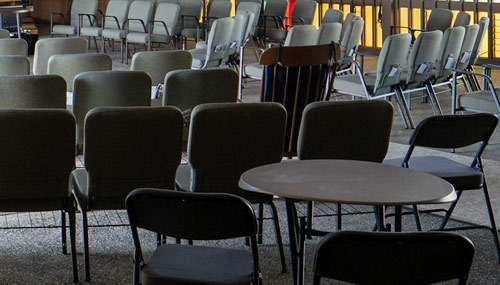
In the past, when immigrants first arrived in Seattle, the first place they sought out was the church.
They would get information about housing, find job opportunities, share kimchi, and make friends in Sunday school while studying the Bible.
Typically, Korean churches were not just places for worship but served as the center of the Korean community.
However, these days, it's common to hear, "I heard that church closed," or "Two churches merged," more frequently than before. Why is this happening?
The biggest reason is that the number of Korean immigrants is not increasing as it once did.
In the 1980s and 1990s, Korean immigration to the U.S. was active, and churches naturally grew. However, recently, the number of new immigrants and international students has significantly decreased, leading to fewer new members joining the churches consistently.
Surveys related to Korean churches in the U.S. show that congregants cite the decline in immigrants and international students as the primary reason.
The second reason is the aging of church members. The initial immigrant generation is now reaching retirement age, and many face health issues that make attending church difficult.
Meanwhile, the younger generation is not filling the gap. With a decrease in donations and a lack of volunteers, smaller churches are finding it increasingly difficult to operate.
Another factor is the change among the second generation. While parents attend services in Korean, their children often choose English-speaking churches or do not attend church at all. Many also move to different areas for college or jobs.
Ultimately, the inability to naturally transition between generations has become a significant concern for Korean churches.
The changes following the pandemic cannot be ignored. With online worship becoming commonplace, it is now possible to attend services without going to the church building.
While this offers convenience, some congregants have not returned to in-person services. Smaller churches have been particularly affected by the decrease in attendance.
The polarization among churches has also intensified. There is a continuing trend of congregants moving to larger churches with diverse programs and well-established educational systems. Conversely, smaller churches are experiencing a vicious cycle of declining new member influx, making operations even more challenging.
Additionally, the high real estate prices and cost of living in Seattle also play a role. As operating costs such as building maintenance, insurance, and utilities continue to rise while the number of congregants decreases, the financial burden inevitably increases. As a result, some churches choose to merge or change their ministry direction.
However, not all Korean churches are struggling. Some are strengthening English-language services, expanding multicultural ministries, or actively participating in community service to embrace a new generation.
In fact, Korean churches in the U.S. are being recognized for attempting new changes through bilingual ministry and community-centered service.
Ultimately, the changes experienced by Korean churches in Seattle are not just issues for specific churches. They reflect a trend created by changes in the immigrant population, generational transitions, and shifts in social culture.
In the future, churches that go beyond simply providing Korean-language services to create communities where first and second generations can practice their faith together and connect with the local community are likely to survive better.
 DawnTalk
 CarrotOK







 Twist Kim |
 U.S. Weather Bureau News |
 Community Cross |
 Conflite Teacher |
 SEVEN SEVEN |
 PETRO Vatican Shrine |
 Bald Eagle Brothers |
 Real Estate Agent USA |
 General Knowledge Blog |
 Bacon King Blog |
  Soft Feeling That Feeling |
  assa man |
  Yugo Girl I'm So Hot |
  nexaro |
  Experiences Living in America |
  arsnack |
  Nebraska Center Director TOP |
  Florida Gario |
  menmo |
  Arizona AZ Cowboy |
  springw |
  Woooooah |
  frostpup |
  chocopup |
  Angeles Choi |
  My Heart Popper |
  comova |
  vintago |
  Sky Way |
  Top Beaches |