
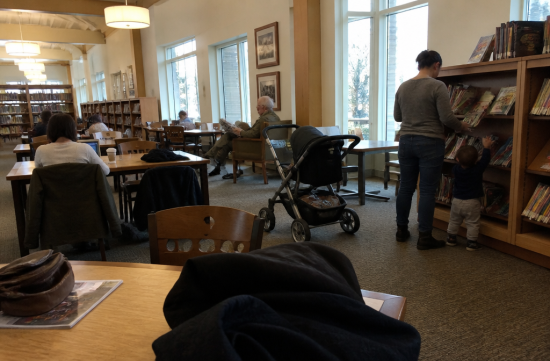
Recently, I stopped by the local library on a weekday afternoon and had to circle around for a while because there were no parking spots available. I wondered why there were so many people there, especially since school wasn't out yet.
Once I went inside, the reason became clear. There were people working on laptops, parents holding their children's hands while picking out picture books, and seniors reading newspapers, all gathered in one space.
Thinking about it, there are now very few places left where people of different ages and purposes naturally mix like this. Local bookstores, arcades, and small shops have all been closing down one by one for a long time.
Sociologist Ray Oldenburg referred to spaces where people gather for no particular reason, neither home nor work, as the "third place." Cafés, barbershops, and local pubs fall into this category, and his argument is that as these spaces decrease, so does the trust and sense of community among people.
However, public libraries seem to be an exception to this trend. Looking back at the history of American libraries, the first library funded by Andrew Carnegie in the U.S. was established in 1889 in Braddock, Pennsylvania, and his foundation funded the establishment of 1,681 libraries across the country.
Carnegie's condition was that everyone should have free access to knowledge, and that principle has continued for over a century. Today, if you go to a library and get a membership card, you can use books, the internet, and meeting rooms without spending a dime, which is a continuation of that legacy.
Statistics also show that libraries are not dying spaces. According to a survey by the federal agency IMLS, in 2023, the number of visits to public libraries in the U.S. exceeded 800 million, averaging about 2.2 million visits per day.
The number of registered users has surpassed 155 million, meaning that nearly half of the people living in areas with libraries have a membership card. Since this is a rebound after the pandemic, it's not a bad recovery considering the concerns that were raised for a while.
These days, libraries are not just places to borrow books. Many offer programs on how to write resumes, English conversation classes, and citizenship test preparation courses, making them a public institution that immigrant families often visit next to schools.
Looking at the library bulletin board gives you a good sense of what's happening in the neighborhood. From resume workshops to community garden meetings and computer classes for retirees, there are all kinds of announcements posted, and finding an offline place to check this information is becoming rare.
Research shows that the reliance on libraries is higher in lower-income neighborhoods. For those who cannot afford internet fees or meeting space rental costs, libraries are essentially the only alternative.
Some people even seek out libraries as a place to escape the heat in summer or the cold in winter. In an era where churches, community centers, and small club meetings no longer attract as many people, libraries remain one of the few places where anyone can enter without barriers.
Of course, libraries are not completely free from controversy. There are often differing opinions in communities about which books should be on the shelves, and the very fact that these debates occur shows that libraries are still central stages in local communities.
To be fair, libraries are vulnerable institutions that can see reduced operating hours and fewer librarians if budgets are cut. Still, the fact that there is still a space that welcomes such a diverse range of people for free and without discrimination is something I personally find quite fortunate.
Next time I have some time, I should stop by the library to check on my membership status. Spaces like this need to be used to continue existing.
 NewMexicoPal





 Victory 1988 |
 Panorama Kstar |
 Giant Squid and Sweet Potato Soup |
 Lol Life |
 lavender |
 golfmaster |
 Trot King News |


 Why Not Me |
  Plastic Rose |
  Rice Shop Uncle BLOG |
  Gook Rule |
  Rowland Mama |
  Coco and Lulu |
  Baguette Blog |
  washington mom |
  yorvik12 |
  HVAC will prosper |
  mortrix |
  MAX009 BLOG |
  K-POP TV News |
  My Beloved Hometown Hwagae Market |
  Tart Tart |
  Min's blog |
  Tora Tora |
  pixel77 |