

Artificial voice technology is now very familiar to us through navigation systems, various apps, and Alexa.
However, this technology dates back to the 1930s, before World War II.
The robot voices we commonly think of are actually products of speech synthesis technology that was researched as early as the 1930s.
When you realize this, you can't help but be surprised, thinking, "Has artificial voice technology been around for so long?"
A prime example is the vocoder. Originally developed for military encrypted communication, the vocoder worked by separating human voices into frequency bands and overlaying them onto other signals.
During the war, it was used to communicate while maintaining confidentiality, but in the 1960s and 70s, it began to be used as a device to create unique sounds in music and film. When voices are modulated mechanically, a metallic resonance is produced, which is the typical feel of the robot voices we think of.
For instance, the voice of Darth Vader in Star Wars or HAL 9000 in 2001: A Space Odyssey are representative examples processed based on this principle. The reason audiences were amazed by the "human yet mechanical" voices at that time is right here.
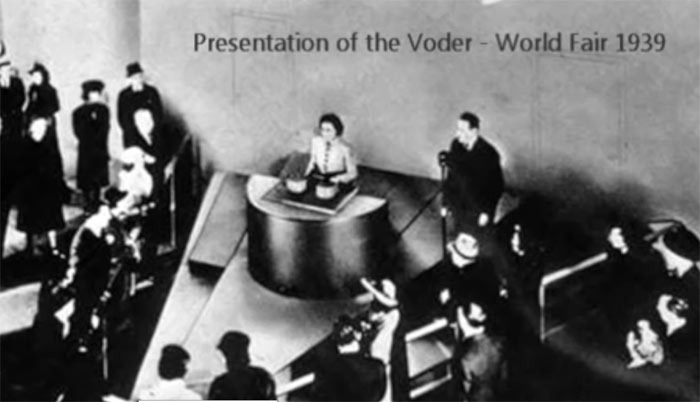
Another important device is the early electronic speech synthesizer, or speech simulator. The VODER, showcased by Bell Labs at the 1939 World Fair, is considered the first electronic artificial voice device. What's noteworthy is that this was not just a simple playback device; a person operated a keyboard and pedals to synthesize vowels, consonants, and intonations.
At that time, the very idea of electronically synthesizing speech was revolutionary, revealing that the foundations of artificial voice had already been laid before the war.
Development continued after that. An experiment conducted by IBM in 1961 is still legendary; the IBM 704 computer successfully sang the song "Daisy Bell." The fact that a machine could sing shocked not only the scientific community but also the public.
In the 1980s, digital synthesizers like DECtalk emerged, serving as assistive devices for the visually impaired or those with communication difficulties, bringing artificial voice into real life beyond just movie robot voices.
At the center of all these advancements was Homer Dudley, a researcher at Bell Labs. The vocoder and VODER he developed in the late 1930s held significance beyond just being voice modulation devices.
They marked the starting point of modern artificial voice technology. Thanks to this, people who were amazed by robot voices in 1970s films were indirectly experiencing the results of research that had been established since before the war.
In summary, artificial voice is not merely a special effects technology of the 70s, but the fruit of ongoing research in electronics and acoustics since before World War II. Without the vocoder and VODER, today's natural TTS technology or AI-based voice synthesis would have been difficult to achieve.
Ultimately, the artificial voice guidance we now hear in smartphones and navigation systems is the result of a long journey that began with scientists' experiments to mimic human voices with machines over 80 years ago.
From this perspective, the history of artificial voice can be seen as a challenge to the long-standing question of "how can humans and machines communicate?"
Today's natural AI voices are not just a convenience feature; they carry greater significance as the latest results built upon that long history.






 Living Economy Information Blog |
 Churros Train Conductor |
 Shining Our Own World |

 Rushing Youngest Rabbit Toto |
  silverpath |
  Komet Park |
  reliable |
  vexo90 |
  As Always Today |
  veltar87 |
  United States National Administrative Organization Stories |
  springwaltz |
  dense |
  Tiger Milk Foam Research Institute |
  Oreore Mushroom |
  optimistic |
  Good Good |
  berion88 |
  bravo777 |
  skyblue |
  Project Tomorrow |
  apricotla |
  Soy Angelino |
  nati8 |