
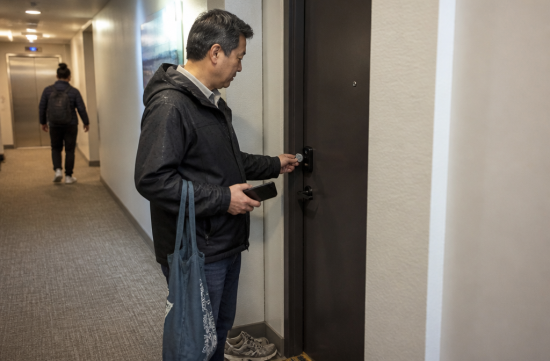
Your phone battery has died. But what if the only way to unlock your door is through an app on that phone?
This is a situation that can easily happen if you live in an apartment with a keyless smart door lock. Convenience and anxiety are essentially stuck together in one door.
Washington State has provided an answer to this issue. The bill number is ESSB 5937, Chapter 55 of the 2026 laws.
The governor's signature date is March 16, 2026, and the effective date is January 1, 2027. So, it's not a right you can use today; it starts from the first day of the new year.
I was a bit surprised by the voting numbers. The Senate voted 49 to 0, and the House voted 93 to 1.
Even as someone who is skeptical about landlord regulations, I had to take a closer look at this. So, I read the original session law myself.
The key point is one line. If a tenant requests it, the landlord must provide an alternative key that does not use biometric data or a phone app.
Examples listed in the law include key fobs, key cards, traditional keys, keypads that require manual entry, and other physical means of access.
There is a common misunderstanding here. You do not have the right to demand a metal key.
If the landlord provides a fob or card, it qualifies as an alternative key according to the law. If the building already uses fobs for access, not much may change.
Another point is that there is a condition of "upon request." It's not a law that guarantees a key will be delivered automatically on January 1.
This law does not prohibit smart systems. Those who prefer using an app can continue to do so.
I like this design. It doesn't block technology but leaves the choice open.
There were no opposing testimonies during the House committee hearing. The Washington Multi-Family Housing Association, which is part of the rental industry, positively evaluated the delay in implementation and the amendment that allows for policy guidance through links.
So, what types of buildings will this apply to? A smart access system is one that uses digital technology like phone apps, RFID cards, or biometric data to gather information to unlock doors.
This does not only apply to front doors. It includes building entrances, elevators, and common areas.
On the other hand, a keypad that only requires manual entry is excluded from this definition. Even if it looks outdated, it is treated separately under the law.
The second focus is data. In fact, I believe this aspect is more important than the key itself.
The records from the House hearing show cases where landlords installed smart locks and denied tenants alternative keys. The privacy policy of that system stated it could collect access logs as well as browsing history.
Why would internet records be necessary just to open a door? Whether conservative or progressive, this crosses a line.
The new law allows only the minimum necessary authentication information to be collected for access. It also specifies eight items that can be collected.
These include name, unit number and access area, preferred contact method, biometric data (if used by the system), device identification numbers like cards, passwords and account information, lease information including move-in date, and access times and methods.
Access times can only be used for security and operational purposes. Browser history is not included in the list.
However, video footage from surveillance cameras that only monitor the entrance without opening the door is excluded from the authentication information defined by this law. This means it does not regulate CCTV, so it's good to manage your expectations.
A written policy must also be provided. This should be done at the time of the initial lease signing or within five days after the system installation.
This policy must clearly outline the items collected, including guest information, protective measures, retention periods, responses and notifications in case of a breach, and destruction criteria. If the landlord does not store or sell the information, they can instead provide a developer policy that contains all necessary information or a link to it.
It's fair to mention the limitations as well. The new provisions do not specify who pays for the alternative key, how many days it should take to provide it, or what the penalties are.
However, the basics have been in place. The state law RCW 59.18.060 has long required landlords to provide appropriate locks and keys.
Just because a landlord can remotely unlock the door does not mean they can enter at will. Except in emergencies, a written notice at least two days in advance is the principle, and visits to show the house require at least one day's notice.
If I were in your shoes, I would write down RCW 59.18.750 in an email and request an alternative key in January, then save the response.
During lease renewal or tours, I would ask three questions: How do I get in if my phone is dead? How long do you keep access logs? Where can I view the privacy policy?
If you are denied or the conditions are vague, check tenant resources like Washington Law Help and seek legal advice. I believe that how I open my own front door is a choice I should make, and that's common sense.
 KpopTV







 US Snowboard Information Exchange |

 Bacon King Blog |

 Praise Loudly Blog |

 USA Business News |











 Mr. Midwest America |
 orvella |

 donggul donggul |

 Mr. Largo |

 Silent Sea |
 Entering Art Directly |
 Mini Mee |
 Exciting chichichi |
 My Circle |
 Fun Flex Life |
 dermoon |
 Starbucks Reserve Roastery Closure |
 Noodle Noodle |
 Round and Round Children's Song Kingdom |
 Exciting FM Radio |
 vexon87 |
 Helpful Life Stories |
 leaves |
 glenview 89 |
 Wang Ga Nae |
 Life in the US |
 Alright Twain |
 cloud0 |
 Allaston New Yorker Notebook |
 MBTI Detective Agency |